

molecules having the possibility of forming IHBs, because it proved to yield better
results (results closer to experimental values, when available, or closer to MP2
results) for IHB parameters and for the effects of IHB removal, for some classes of
molecules, including the large class of acylphloroglucinols [5–10]. It also provides
HOMO-LUMO energy differences closer to experimental values. Furthermore, HF
constitutes the first (unperturbed) step for MP2 calculations.
DFT calculations are popular because of their ability to take into account part of
the correlation effects at a not-too-high cost, and B3LYP [11–13] is the most
commonly used functional. The presence of diffuse functions in the basis set for
DFT/B3LYP calculations proved important for better-quality results with molecules
containing IHBs [5].
MP2 calculations are important for their ability to take into account both correlation and dispersion effects. They were performed as SP calculations because
full-optimization MP2 calculations would be unaffordable for a molecule of this
size. On the other hand, SP calculations provide valuable information on features
like conformers’ energetics.
Calculations in solution utilized the Polarisable Continuum Model (PCM
[14, 15]), which considers the solute molecule as embedded in a cavity in the
continuum solvent, which is characterised by its dielectric constant. The default
settings of Gaussian03 [16] were utilised, i.e., Integral Equation Formalism model,
IEF [17–20], Gepol model for building the cavity around the solute molecule
6
5
4
3
2
1
O
10
9
8
14
13
12
11
15
32
31
30
29
34
33
O
O
O
O
CH 3
H 3 C
O
H
O
H 3 C
H
O
H
O
H
O
CH 3
O
H 3 C
36
35
40
39
38
37
41
42
43
44
45
46
7
16
17
18
19
20
21
22
23
24
25
26
27
28
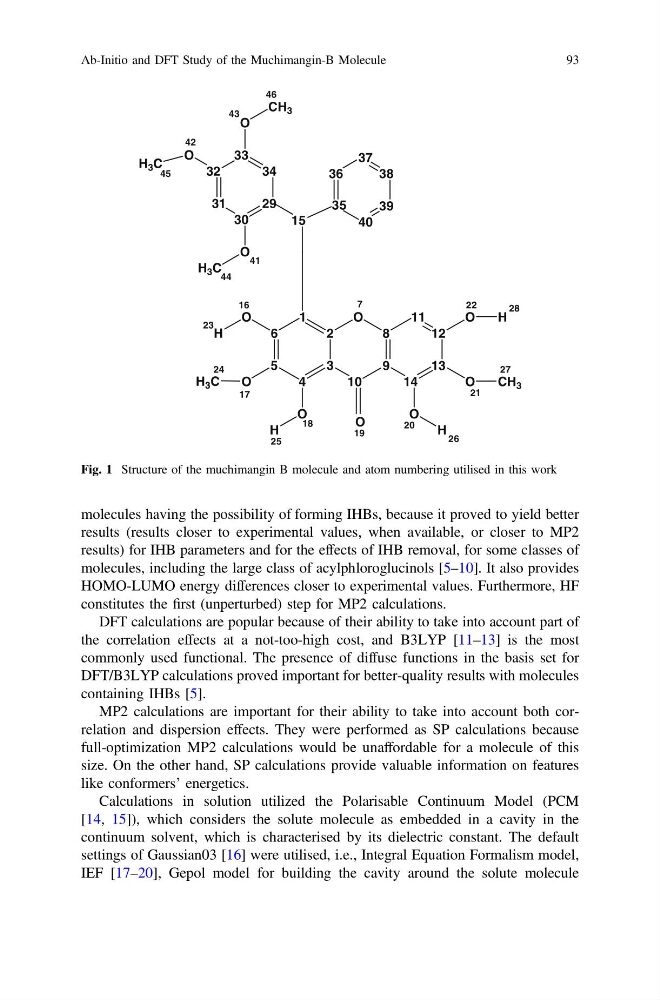
Fig. 1 Structure of the muchimangin B molecule and atom numbering utilised in this work
Ab-Initio and DFT Study of the Muchimangin-B Molecule
93
results (results closer to experimental values, when available, or closer to MP2
results) for IHB parameters and for the effects of IHB removal, for some classes of
molecules, including the large class of acylphloroglucinols [5–10]. It also provides
HOMO-LUMO energy differences closer to experimental values. Furthermore, HF
constitutes the first (unperturbed) step for MP2 calculations.
DFT calculations are popular because of their ability to take into account part of
the correlation effects at a not-too-high cost, and B3LYP [11–13] is the most
commonly used functional. The presence of diffuse functions in the basis set for
DFT/B3LYP calculations proved important for better-quality results with molecules
containing IHBs [5].
MP2 calculations are important for their ability to take into account both correlation and dispersion effects. They were performed as SP calculations because
full-optimization MP2 calculations would be unaffordable for a molecule of this
size. On the other hand, SP calculations provide valuable information on features
like conformers’ energetics.
Calculations in solution utilized the Polarisable Continuum Model (PCM
[14, 15]), which considers the solute molecule as embedded in a cavity in the
continuum solvent, which is characterised by its dielectric constant. The default
settings of Gaussian03 [16] were utilised, i.e., Integral Equation Formalism model,
IEF [17–20], Gepol model for building the cavity around the solute molecule
6
5
4
3
2
1
O
10
9
8
14
13
12
11
15
32
31
30
29
34
33
O
O
O
O
CH 3
H 3 C
O
H
O
H 3 C
H
O
H
O
H
O
CH 3
O
H 3 C
36
35
40
39
38
37
41
42
43
44
45
46
7
16
17
18
19
20
21
22
23
24
25
26
27
28
Fig. 1 Structure of the muchimangin B molecule and atom numbering utilised in this work
Ab-Initio and DFT Study of the Muchimangin-B Molecule
93