

3.2 A Counter Intuitive Trend Arose from Quantum Nature
To assess the fidelity of the quantum behavior of proton with conventional chemical
wisdom; we solve both one- (z-coordinate) and two-dimensional (z and R-coordinate)
vibrational Schrödinger equation using the method of finite difference discussed in
previous section.
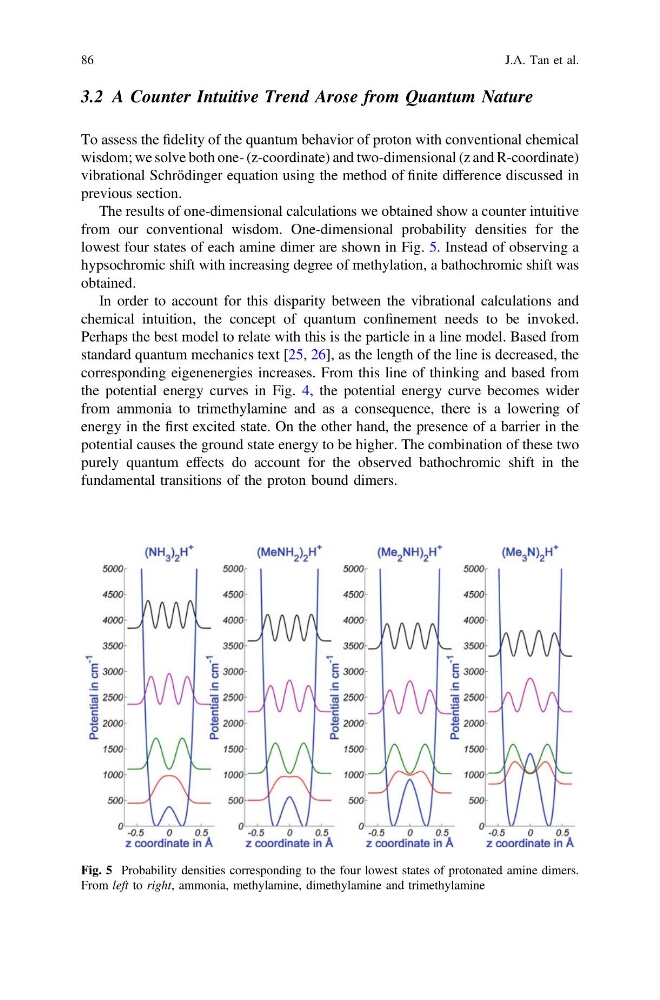
The results of one-dimensional calculations we obtained show a counter intuitive
from our conventional wisdom. One-dimensional probability densities for the
lowest four states of each amine dimer are shown in Fig. 5. Instead of observing a
hypsochromic shift with increasing degree of methylation, a bathochromic shift was
obtained.
In order to account for this disparity between the vibrational calculations and
chemical intuition, the concept of quantum confinement needs to be invoked.
Perhaps the best model to relate with this is the particle in a line model. Based from
standard quantum mechanics text [25, 26], as the length of the line is decreased, the
corresponding eigenenergies increases. From this line of thinking and based from
the potential energy curves in Fig. 4, the potential energy curve becomes wider
from ammonia to trimethylamine and as a consequence, there is a lowering of
energy in the first excited state. On the other hand, the presence of a barrier in the
potential causes the ground state energy to be higher. The combination of these two
purely quantum effects do account for the observed bathochromic shift in the
fundamental transitions of the proton bound dimers.
Fig. 5 Probability densities corresponding to the four lowest states of protonated amine dimers.
From left to right, ammonia, methylamine, dimethylamine and trimethylamine
86
J.A. Tan et al.
To assess the fidelity of the quantum behavior of proton with conventional chemical
wisdom; we solve both one- (z-coordinate) and two-dimensional (z and R-coordinate)
vibrational Schrödinger equation using the method of finite difference discussed in
previous section.
The results of one-dimensional calculations we obtained show a counter intuitive
from our conventional wisdom. One-dimensional probability densities for the
lowest four states of each amine dimer are shown in Fig. 5. Instead of observing a
hypsochromic shift with increasing degree of methylation, a bathochromic shift was
obtained.
In order to account for this disparity between the vibrational calculations and
chemical intuition, the concept of quantum confinement needs to be invoked.
Perhaps the best model to relate with this is the particle in a line model. Based from
standard quantum mechanics text [25, 26], as the length of the line is decreased, the
corresponding eigenenergies increases. From this line of thinking and based from
the potential energy curves in Fig. 4, the potential energy curve becomes wider
from ammonia to trimethylamine and as a consequence, there is a lowering of
energy in the first excited state. On the other hand, the presence of a barrier in the
potential causes the ground state energy to be higher. The combination of these two
purely quantum effects do account for the observed bathochromic shift in the
fundamental transitions of the proton bound dimers.
Fig. 5 Probability densities corresponding to the four lowest states of protonated amine dimers.
From left to right, ammonia, methylamine, dimethylamine and trimethylamine
86
J.A. Tan et al.