

due to the fact that the basicity of the amine is enhanced upon increasing
methylation.
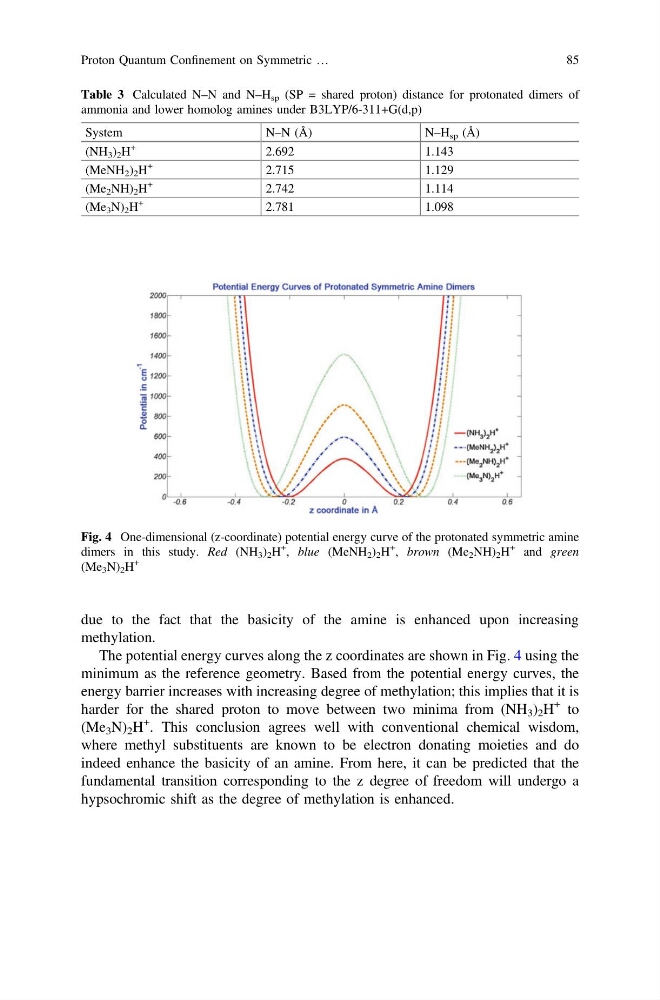
The potential energy curves along the z coordinates are shown in Fig. 4 using the
minimum as the reference geometry. Based from the potential energy curves, the
energy barrier increases with increasing degree of methylation; this implies that it is
harder for the shared proton to move between two minima from (NH 3 ) 2 H
+ to
(Me 3 N) 2 H
+
. This conclusion agrees well with conventional chemical wisdom,
where methyl substituents are known to be electron donating moieties and do
indeed enhance the basicity of an amine. From here, it can be predicted that the
fundamental transition corresponding to the z degree of freedom will undergo a
hypsochromic shift as the degree of methylation is enhanced.
Fig. 4 One-dimensional (z-coordinate) potential energy curve of the protonated symmetric amine
dimers in this study. Red (NH 3 ) 2 H
+ , blue (MeNH 2 ) 2 H
+ , brown (Me 2 NH) 2 H
+ and green
(Me 3 N) 2 H
+
Table 3 Calculated N–N and N–H sp (SP = shared proton) distance for protonated dimers of
ammonia and lower homolog amines under B3LYP/6-311+G(d,p)
System
N–N (Å)
N –H sp (Å)
(NH 3 ) 2 H
+
2.692
1.143
(MeNH 2 ) 2 H
+
2.715
1.129
(Me 2 NH) 2 H
+
2.742
1.114
(Me 3 N) 2 H
+
2.781
1.098
Proton Quantum Confinement on Symmetric …
85
methylation.
The potential energy curves along the z coordinates are shown in Fig. 4 using the
minimum as the reference geometry. Based from the potential energy curves, the
energy barrier increases with increasing degree of methylation; this implies that it is
harder for the shared proton to move between two minima from (NH 3 ) 2 H
+ to
(Me 3 N) 2 H
+
. This conclusion agrees well with conventional chemical wisdom,
where methyl substituents are known to be electron donating moieties and do
indeed enhance the basicity of an amine. From here, it can be predicted that the
fundamental transition corresponding to the z degree of freedom will undergo a
hypsochromic shift as the degree of methylation is enhanced.
Fig. 4 One-dimensional (z-coordinate) potential energy curve of the protonated symmetric amine
dimers in this study. Red (NH 3 ) 2 H
+ , blue (MeNH 2 ) 2 H
+ , brown (Me 2 NH) 2 H
+ and green
(Me 3 N) 2 H
+
Table 3 Calculated N–N and N–H sp (SP = shared proton) distance for protonated dimers of
ammonia and lower homolog amines under B3LYP/6-311+G(d,p)
System
N–N (Å)
N –H sp (Å)
(NH 3 ) 2 H
+
2.692
1.143
(MeNH 2 ) 2 H
+
2.715
1.129
(Me 2 NH) 2 H
+
2.742
1.114
(Me 3 N) 2 H
+
2.781
1.098
Proton Quantum Confinement on Symmetric …
85