

Receives input
(EMMI)
Output
EMMI
(from
object 2)
Losses EMMI while transforming input
EMMI into output EMMI
Physical boundary (after
mechanism enabled)
Control
Object 1
mechanism
Control
Object 2
mechanism
Physical boundary
(after mechanism
enabled due to object 2)
Performance at
physical boundary
(output EMMI due
to object 1 and object 2)
Functional boundary (after
mechanisms enabled)
Behavioral
boundary (after
mechanisms
Performance
measured at
functional boundary
(output EMMI due to
object 1 and object 2)
Performance
measured at
behavioral boundary
(output EMMI due to
object 1 and object 2)
Losses EMMI while transforming input
enabled)
EMMI into output EMMI
36
Engineering Systems Integration
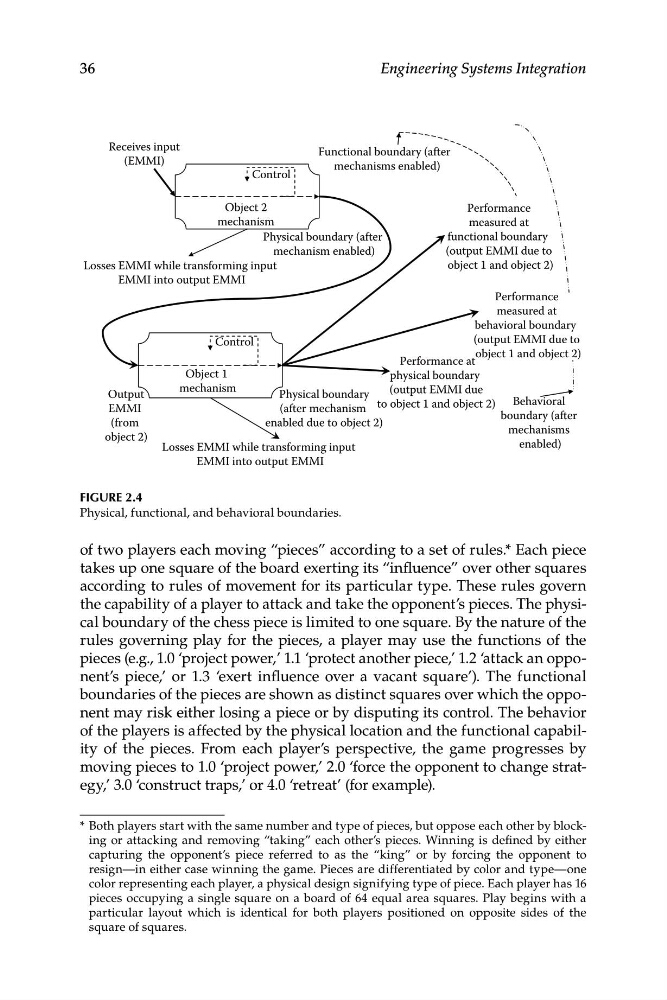
FIgure 2.4
Physical, functional, and behavioral boundaries.
of two players each moving “pieces” according to a set of rules.* Each piece
takes up one square of the board exerting its “influence” over other squares
according to rules of movement for its particular type. These rules govern
the capability of a player to attack and take the opponent’s pieces. The physical boundary of the chess piece is limited to one square. By the nature of the
rules governing play for the pieces, a player may use the functions of the
pieces (e.g., 1.0 ‘project power,’ 1.1 ‘protect another piece,’ 1.2 ‘attack an opponent’s piece,’ or 1.3 ‘exert influence over a vacant square’). The functional
boundaries of the pieces are shown as distinct squares over which the opponent may risk either losing a piece or by disputing its control. The behavior
of the players is affected by the physical location and the functional capability of the pieces. From each player’s perspective, the game progresses by
moving pieces to 1.0 ‘project power,’ 2.0 ‘force the opponent to change strategy,’ 3.0 ‘construct traps,’ or 4.0 ‘retreat’ (for example).
* Both players start with the same number and type of pieces, but oppose each other by blocking or attacking and removing “taking” each other’s pieces. Winning is defined by either
capturing the opponent’s piece referred to as the “king” or by forcing the opponent to
resign—in either case winning the game. Pieces are differentiated by color and type—one
color representing each player, a physical design signifying type of piece. Each player has 16
pieces occupying a single square on a board of 64 equal area squares. Play begins with a
particular layout which is identical for both players positioned on opposite sides of the
square of squares.
(EMMI)
Output
EMMI
(from
object 2)
Losses EMMI while transforming input
EMMI into output EMMI
Physical boundary (after
mechanism enabled)
Control
Object 1
mechanism
Control
Object 2
mechanism
Physical boundary
(after mechanism
enabled due to object 2)
Performance at
physical boundary
(output EMMI due
to object 1 and object 2)
Functional boundary (after
mechanisms enabled)
Behavioral
boundary (after
mechanisms
Performance
measured at
functional boundary
(output EMMI due to
object 1 and object 2)
Performance
measured at
behavioral boundary
(output EMMI due to
object 1 and object 2)
Losses EMMI while transforming input
enabled)
EMMI into output EMMI
36
Engineering Systems Integration
FIgure 2.4
Physical, functional, and behavioral boundaries.
of two players each moving “pieces” according to a set of rules.* Each piece
takes up one square of the board exerting its “influence” over other squares
according to rules of movement for its particular type. These rules govern
the capability of a player to attack and take the opponent’s pieces. The physical boundary of the chess piece is limited to one square. By the nature of the
rules governing play for the pieces, a player may use the functions of the
pieces (e.g., 1.0 ‘project power,’ 1.1 ‘protect another piece,’ 1.2 ‘attack an opponent’s piece,’ or 1.3 ‘exert influence over a vacant square’). The functional
boundaries of the pieces are shown as distinct squares over which the opponent may risk either losing a piece or by disputing its control. The behavior
of the players is affected by the physical location and the functional capability of the pieces. From each player’s perspective, the game progresses by
moving pieces to 1.0 ‘project power,’ 2.0 ‘force the opponent to change strategy,’ 3.0 ‘construct traps,’ or 4.0 ‘retreat’ (for example).
* Both players start with the same number and type of pieces, but oppose each other by blocking or attacking and removing “taking” each other’s pieces. Winning is defined by either
capturing the opponent’s piece referred to as the “king” or by forcing the opponent to
resign—in either case winning the game. Pieces are differentiated by color and type—one
color representing each player, a physical design signifying type of piece. Each player has 16
pieces occupying a single square on a board of 64 equal area squares. Play begins with a
particular layout which is identical for both players positioned on opposite sides of the
square of squares.