

Performance
measured at
functional boundary
(output EMMI due to
object 1 and object 2)
Receives input
(EMMI)
Output
EMMI
(from
Losses EMMI while transforming input
EMMI into output EMMI
Physical boundary (after
mechanism enabled)
Control
Control
Object 2 mechanism
Object 1 mechanism
Physical boundary
(after mechanism
enabled due to object 2)
Performance at
physical boundary
(output EMMI due
to object 1 and
object 2)
Functional boundary (after
mechanisms enabled)
object 2) Losses EMMI while transforming input
EMMI into output EMMI
35
Essences of Interaction
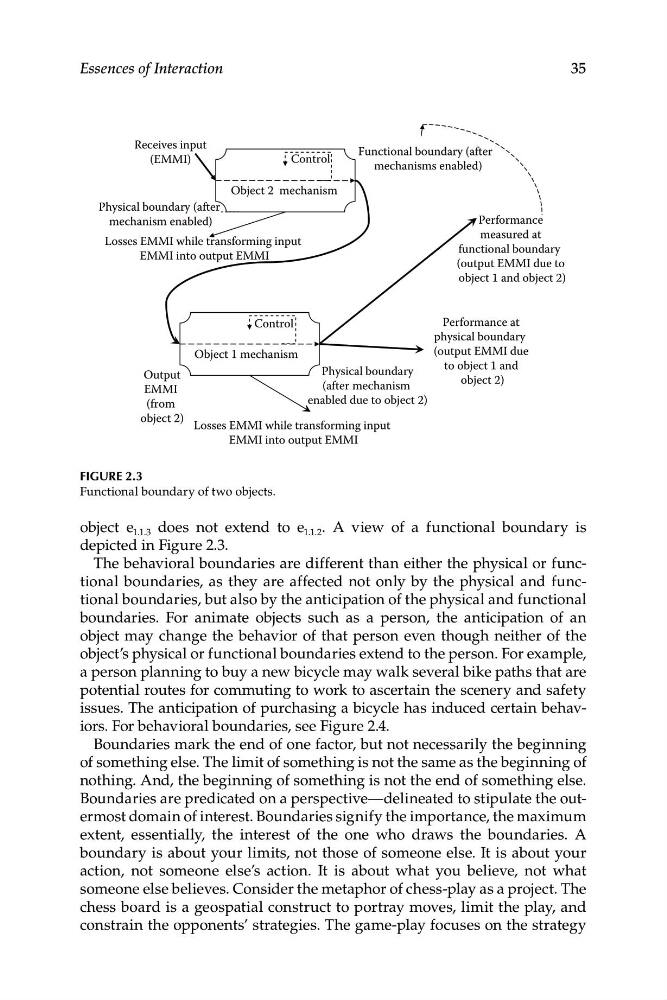
FIgure 2.3
Functional boundary of two objects.
object e 1.1.3 does not extend to e 1.1.2 . A view of a functional boundary is
depicted in Figure 2.3.
The behavioral boundaries are different than either the physical or functional boundaries, as they are affected not only by the physical and functional boundaries, but also by the anticipation of the physical and functional
boundaries. For animate objects such as a person, the anticipation of an
object may change the behavior of that person even though neither of the
object’s physical or functional boundaries extend to the person. For example,
a person planning to buy a new bicycle may walk several bike paths that are
potential routes for commuting to work to ascertain the scenery and safety
issues. The anticipation of purchasing a bicycle has induced certain behaviors. For behavioral boundaries, see Figure 2.4.
Boundaries mark the end of one factor, but not necessarily the beginning
of something else. The limit of something is not the same as the beginning of
nothing. And, the beginning of something is not the end of something else.
Boundaries are predicated on a perspective—delineated to stipulate the outermost domain of interest. Boundaries signify the importance, the maximum
extent, essentially, the interest of the one who draws the boundaries. A
boundary is about your limits, not those of someone else. It is about your
action, not someone else’s action. It is about what you believe, not what
someone else believes. Consider the metaphor of chess-play as a project. The
chess board is a geospatial construct to portray moves, limit the play, and
constrain the opponents’ strategies. The game-play focuses on the strategy
measured at
functional boundary
(output EMMI due to
object 1 and object 2)
Receives input
(EMMI)
Output
EMMI
(from
Losses EMMI while transforming input
EMMI into output EMMI
Physical boundary (after
mechanism enabled)
Control
Control
Object 2 mechanism
Object 1 mechanism
Physical boundary
(after mechanism
enabled due to object 2)
Performance at
physical boundary
(output EMMI due
to object 1 and
object 2)
Functional boundary (after
mechanisms enabled)
object 2) Losses EMMI while transforming input
EMMI into output EMMI
35
Essences of Interaction
FIgure 2.3
Functional boundary of two objects.
object e 1.1.3 does not extend to e 1.1.2 . A view of a functional boundary is
depicted in Figure 2.3.
The behavioral boundaries are different than either the physical or functional boundaries, as they are affected not only by the physical and functional boundaries, but also by the anticipation of the physical and functional
boundaries. For animate objects such as a person, the anticipation of an
object may change the behavior of that person even though neither of the
object’s physical or functional boundaries extend to the person. For example,
a person planning to buy a new bicycle may walk several bike paths that are
potential routes for commuting to work to ascertain the scenery and safety
issues. The anticipation of purchasing a bicycle has induced certain behaviors. For behavioral boundaries, see Figure 2.4.
Boundaries mark the end of one factor, but not necessarily the beginning
of something else. The limit of something is not the same as the beginning of
nothing. And, the beginning of something is not the end of something else.
Boundaries are predicated on a perspective—delineated to stipulate the outermost domain of interest. Boundaries signify the importance, the maximum
extent, essentially, the interest of the one who draws the boundaries. A
boundary is about your limits, not those of someone else. It is about your
action, not someone else’s action. It is about what you believe, not what
someone else believes. Consider the metaphor of chess-play as a project. The
chess board is a geospatial construct to portray moves, limit the play, and
constrain the opponents’ strategies. The game-play focuses on the strategy