

329
Appendix 1: “To Manage” Decomposition
1.2.8.2.2 Specify the problem that needs to have a communication
1.2.8.2.3 Identify the need for the message
1.2.8.2.4 Determine the recipients
1.2.8.2.5 Conceptualize the form of the message content
1.2.8.2.6 Conceptualize the message content
1.2.8.2.7 Draft the message content
1.2.8.2.8 Type of content
1.2.8.2.8.1 Physical
1.2.8.2.9 Trust
1.2.8.2.9.1 Content
1.2.8.2.9.2 Address
1.2.8.2.9.3 Channel
1.2.8.2.9.4 Delivery
1.2.8.2.9.4.1 Act of
1.2.8.2.9.4.1.1 Building, inputting, and outputting message
1.2.8.2.9.4.1.2 Encrypting
1.2.8.2.9.4.1.3 Decrypting
1.2.8.2.10 Finalize the message content
1.2.8.2.10.1 Identify recipient(s)
1.2.8.2.10.2 Specify address of recipient(s)
1.2.8.2.10.3 Confirm address of recipient(s)
1.2.8.2.10.4 Determine the available channels for conveying
message to recipient(s)
1.2.8.2.10.4.1 Media
1.2.8.2.10.4.1.1 TV
1.2.8.2.10.4.1.2 Visual (broadcast/cable)
1.2.8.2.10.4.1.3 Digital storage media
1.2.8.2.10.4.1.4 Radio
1.2.8.2.10.4.1.5 Print advertising
1.2.8.2.10.4.1.6 Word of mouth
1.2.8.2.10.5 Determine the temporal requirements for
delivery
1.2.8.2.10.5.1 Start time
1.2.8.2.10.5.2 End time
1.2.8.2.10.5.3 Elapsed time
1.2.8.2.10.6 Determine the needs of the channel to accommodate the message
1.2.8.2.10.7 Select the channel(s) for the message to recipient(s)
1.2.8.2.10.8 Encrypt
1.2.8.2.10.9 Transmit
1.2.8.2.10.10 Receive
1.2.8.2.10.11 Acknowledge receipt
1.2.8.2.10.12 Decrypt
1.2.8.2.10.13 Acknowledge content
Appendix 1: “To Manage” Decomposition
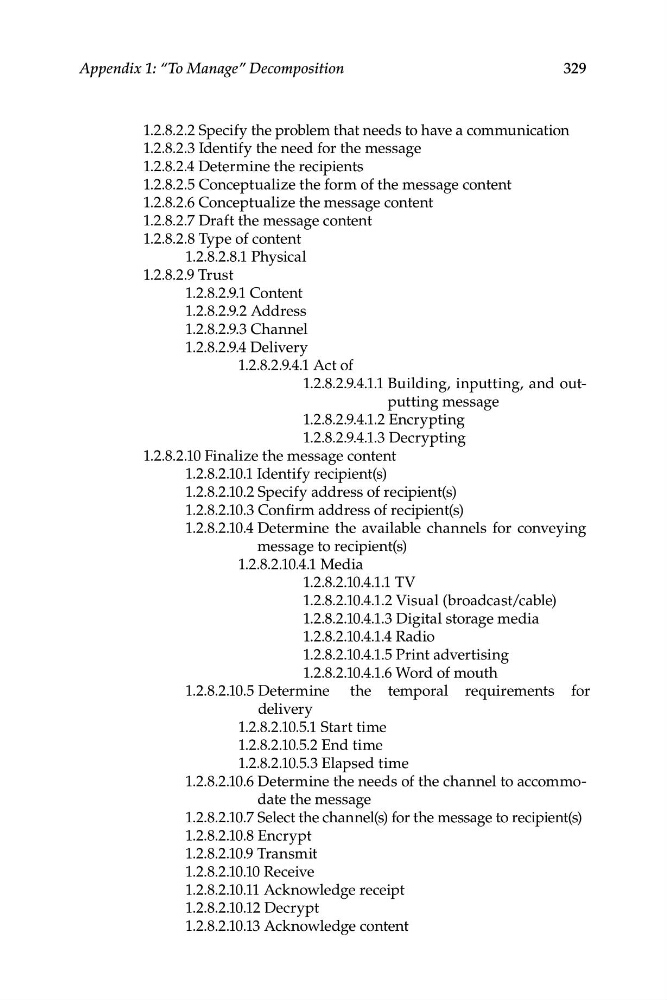
1.2.8.2.2 Specify the problem that needs to have a communication
1.2.8.2.3 Identify the need for the message
1.2.8.2.4 Determine the recipients
1.2.8.2.5 Conceptualize the form of the message content
1.2.8.2.6 Conceptualize the message content
1.2.8.2.7 Draft the message content
1.2.8.2.8 Type of content
1.2.8.2.8.1 Physical
1.2.8.2.9 Trust
1.2.8.2.9.1 Content
1.2.8.2.9.2 Address
1.2.8.2.9.3 Channel
1.2.8.2.9.4 Delivery
1.2.8.2.9.4.1 Act of
1.2.8.2.9.4.1.1 Building, inputting, and outputting message
1.2.8.2.9.4.1.2 Encrypting
1.2.8.2.9.4.1.3 Decrypting
1.2.8.2.10 Finalize the message content
1.2.8.2.10.1 Identify recipient(s)
1.2.8.2.10.2 Specify address of recipient(s)
1.2.8.2.10.3 Confirm address of recipient(s)
1.2.8.2.10.4 Determine the available channels for conveying
message to recipient(s)
1.2.8.2.10.4.1 Media
1.2.8.2.10.4.1.1 TV
1.2.8.2.10.4.1.2 Visual (broadcast/cable)
1.2.8.2.10.4.1.3 Digital storage media
1.2.8.2.10.4.1.4 Radio
1.2.8.2.10.4.1.5 Print advertising
1.2.8.2.10.4.1.6 Word of mouth
1.2.8.2.10.5 Determine the temporal requirements for
delivery
1.2.8.2.10.5.1 Start time
1.2.8.2.10.5.2 End time
1.2.8.2.10.5.3 Elapsed time
1.2.8.2.10.6 Determine the needs of the channel to accommodate the message
1.2.8.2.10.7 Select the channel(s) for the message to recipient(s)
1.2.8.2.10.8 Encrypt
1.2.8.2.10.9 Transmit
1.2.8.2.10.10 Receive
1.2.8.2.10.11 Acknowledge receipt
1.2.8.2.10.12 Decrypt
1.2.8.2.10.13 Acknowledge content