

300
Engineering Systems Integration
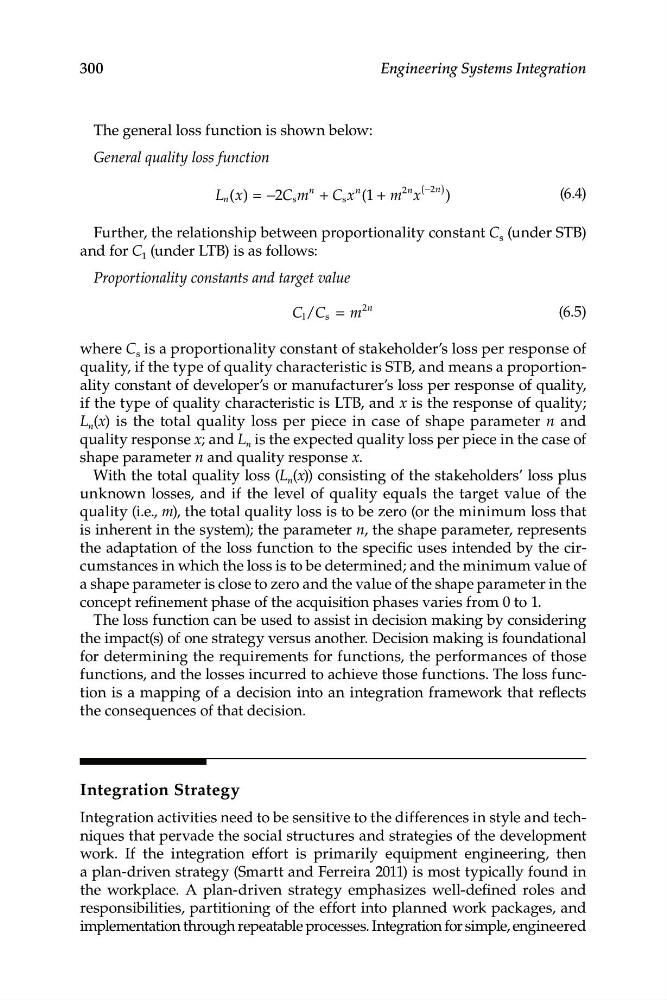
The general loss function is shown below:
General quality loss function
n
n
2n ( )
n
L x = − C m + C x ( + m x
−2
n ( )
2 s
s
1
)
(6.4)
Further, the relationship between proportionality constant C s (under STB)
and for C 1 (under LTB) is as follows:
Proportionality constants and target value
C l /C s = m
2n
(6.5)
where C s is a proportionality constant of stakeholder’s loss per response of
quality, if the type of quality characteristic is STB, and means a proportionality constant of developer’s or manufacturer’s loss per response of quality,
if the type of quality characteristic is LTB, and x is the response of quality;
L n (x) is the total quality loss per piece in case of shape parameter n and
quality response x; and L n is the expected quality loss per piece in the case of
shape parameter n and quality response x.
With the total quality loss (L n (x)) consisting of the stakeholders’ loss plus
unknown losses, and if the level of quality equals the target value of the
quality (i.e., m), the total quality loss is to be zero (or the minimum loss that
is inherent in the system); the parameter n, the shape parameter, represents
the adaptation of the loss function to the specific uses intended by the circumstances in which the loss is to be determined; and the minimum value of
a shape parameter is close to zero and the value of the shape parameter in the
concept refinement phase of the acquisition phases varies from 0 to 1.
The loss function can be used to assist in decision making by considering
the impact(s) of one strategy versus another. Decision making is foundational
for determining the requirements for functions, the performances of those
functions, and the losses incurred to achieve those functions. The loss function is a mapping of a decision into an integration framework that reflects
the consequences of that decision.
Integration Strategy
Integration activities need to be sensitive to the differences in style and techniques that pervade the social structures and strategies of the development
work. If the integration effort is primarily equipment engineering, then
a plan-driven strategy (Smartt and Ferreira 2011) is most typically found in
the workplace. A plan-driven strategy emphasizes well-defined roles and
responsibilities, partitioning of the effort into planned work packages, and
implementation through repeatable processes. Integration for simple, engineered
Engineering Systems Integration
The general loss function is shown below:
General quality loss function
n
n
2n ( )
n
L x = − C m + C x ( + m x
−2
n ( )
2 s
s
1
)
(6.4)
Further, the relationship between proportionality constant C s (under STB)
and for C 1 (under LTB) is as follows:
Proportionality constants and target value
C l /C s = m
2n
(6.5)
where C s is a proportionality constant of stakeholder’s loss per response of
quality, if the type of quality characteristic is STB, and means a proportionality constant of developer’s or manufacturer’s loss per response of quality,
if the type of quality characteristic is LTB, and x is the response of quality;
L n (x) is the total quality loss per piece in case of shape parameter n and
quality response x; and L n is the expected quality loss per piece in the case of
shape parameter n and quality response x.
With the total quality loss (L n (x)) consisting of the stakeholders’ loss plus
unknown losses, and if the level of quality equals the target value of the
quality (i.e., m), the total quality loss is to be zero (or the minimum loss that
is inherent in the system); the parameter n, the shape parameter, represents
the adaptation of the loss function to the specific uses intended by the circumstances in which the loss is to be determined; and the minimum value of
a shape parameter is close to zero and the value of the shape parameter in the
concept refinement phase of the acquisition phases varies from 0 to 1.
The loss function can be used to assist in decision making by considering
the impact(s) of one strategy versus another. Decision making is foundational
for determining the requirements for functions, the performances of those
functions, and the losses incurred to achieve those functions. The loss function is a mapping of a decision into an integration framework that reflects
the consequences of that decision.
Integration Strategy
Integration activities need to be sensitive to the differences in style and techniques that pervade the social structures and strategies of the development
work. If the integration effort is primarily equipment engineering, then
a plan-driven strategy (Smartt and Ferreira 2011) is most typically found in
the workplace. A plan-driven strategy emphasizes well-defined roles and
responsibilities, partitioning of the effort into planned work packages, and
implementation through repeatable processes. Integration for simple, engineered