

299
Systems Integration Management
Nominal-the-best
A 0
L = k y − m k
(6.1)
(
)
2
= Δ 0
2
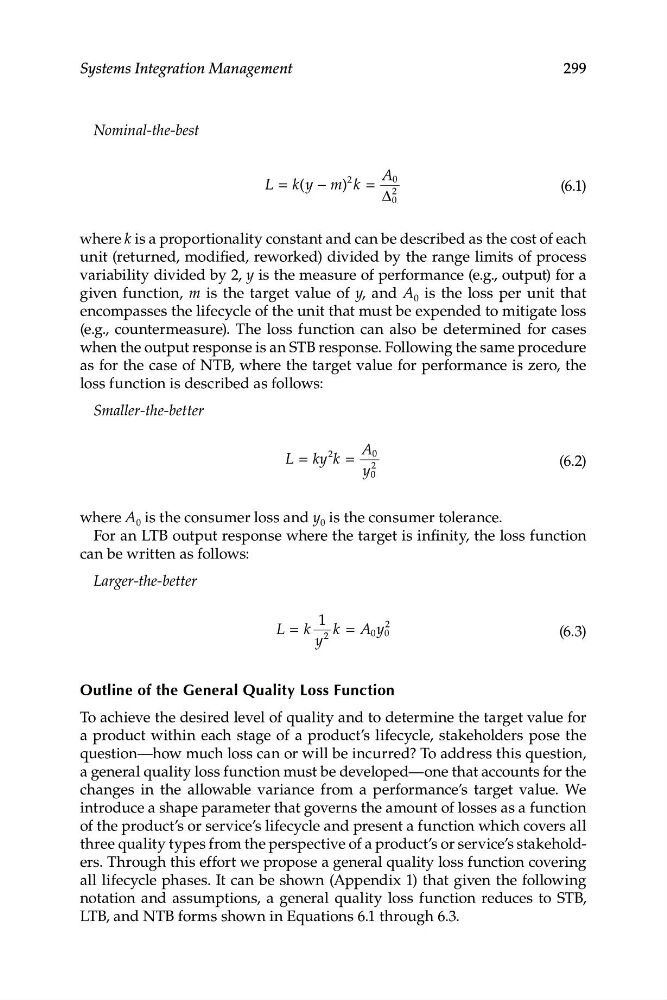
where k is a proportionality constant and can be described as the cost of each
unit (returned, modified, reworked) divided by the range limits of process
variability divided by 2, y is the measure of performance (e.g., output) for a
given function, m is the target value of y, and A 0 is the loss per unit that
encompasses the lifecycle of the unit that must be expended to mitigate loss
(e.g., countermeasure). The loss function can also be determined for cases
when the output response is an STB response. Following the same procedure
as for the case of NTB, where the target value for performance is zero, the
loss function is described as follows:
Smaller-the-better
2
A
L = ky k = 2
0
(6.2)
y 0
where A 0 is the consumer loss and y 0 is the consumer tolerance.
For an LTB output response where the target is infinity, the loss function
can be written as follows:
Larger-the-better
1
2
L = k
k = A y
2
0 0
(6.3)
y
Outline of the general Quality Loss Function
To achieve the desired level of quality and to determine the target value for
a product within each stage of a product’s lifecycle, stakeholders pose the
question—how much loss can or will be incurred? To address this question,
a general quality loss function must be developed—one that accounts for the
changes in the allowable variance from a performance’s target value. We
introduce a shape parameter that governs the amount of losses as a function
of the product’s or service’s lifecycle and present a function which covers all
three quality types from the perspective of a product’s or service’s stakeholders. Through this effort we propose a general quality loss function covering
all lifecycle phases. It can be shown (Appendix 1) that given the following
notation and assumptions, a general quality loss function reduces to STB,
LTB, and NTB forms shown in Equations 6.1 through 6.3.
Systems Integration Management
Nominal-the-best
A 0
L = k y − m k
(6.1)
(
)
2
= Δ 0
2
where k is a proportionality constant and can be described as the cost of each
unit (returned, modified, reworked) divided by the range limits of process
variability divided by 2, y is the measure of performance (e.g., output) for a
given function, m is the target value of y, and A 0 is the loss per unit that
encompasses the lifecycle of the unit that must be expended to mitigate loss
(e.g., countermeasure). The loss function can also be determined for cases
when the output response is an STB response. Following the same procedure
as for the case of NTB, where the target value for performance is zero, the
loss function is described as follows:
Smaller-the-better
2
A
L = ky k = 2
0
(6.2)
y 0
where A 0 is the consumer loss and y 0 is the consumer tolerance.
For an LTB output response where the target is infinity, the loss function
can be written as follows:
Larger-the-better
1
2
L = k
k = A y
2
0 0
(6.3)
y
Outline of the general Quality Loss Function
To achieve the desired level of quality and to determine the target value for
a product within each stage of a product’s lifecycle, stakeholders pose the
question—how much loss can or will be incurred? To address this question,
a general quality loss function must be developed—one that accounts for the
changes in the allowable variance from a performance’s target value. We
introduce a shape parameter that governs the amount of losses as a function
of the product’s or service’s lifecycle and present a function which covers all
three quality types from the perspective of a product’s or service’s stakeholders. Through this effort we propose a general quality loss function covering
all lifecycle phases. It can be shown (Appendix 1) that given the following
notation and assumptions, a general quality loss function reduces to STB,
LTB, and NTB forms shown in Equations 6.1 through 6.3.