

“To command”
1.1.3
“Assign missions”
“Provide resources”
1.1.3.1
1.1.3.2
“Direct subordinates”
“Analyze”
“Prioritize”
1.1.3.3
1.1.3.2.1
1.1.3.2.2
“Evaluate risk”
“Focus activities”
1.1.3.5
1.1.3.4
289
Systems Integration Management
For example, the process of “to manage” and the function of ‘to manage’
extend across the entire work domain that encompasses the integration
activity. The process of “to manage” overlaps exactly with the function of ‘to
manage’. Both are measurable, but in different ways. The process of “to manage” is measurable by comparison with another process of “to manage.” By
that, the differences between two processes are objectifiable by comparing
like-kind or similar processes, whereas the difference between two functions is demonstrable through comparison of their performance(s). Both processes and functions have mechanisms, inputs, and outputs, and losses that
result from achieving their outputs.
“to manage”: “command” and “control”
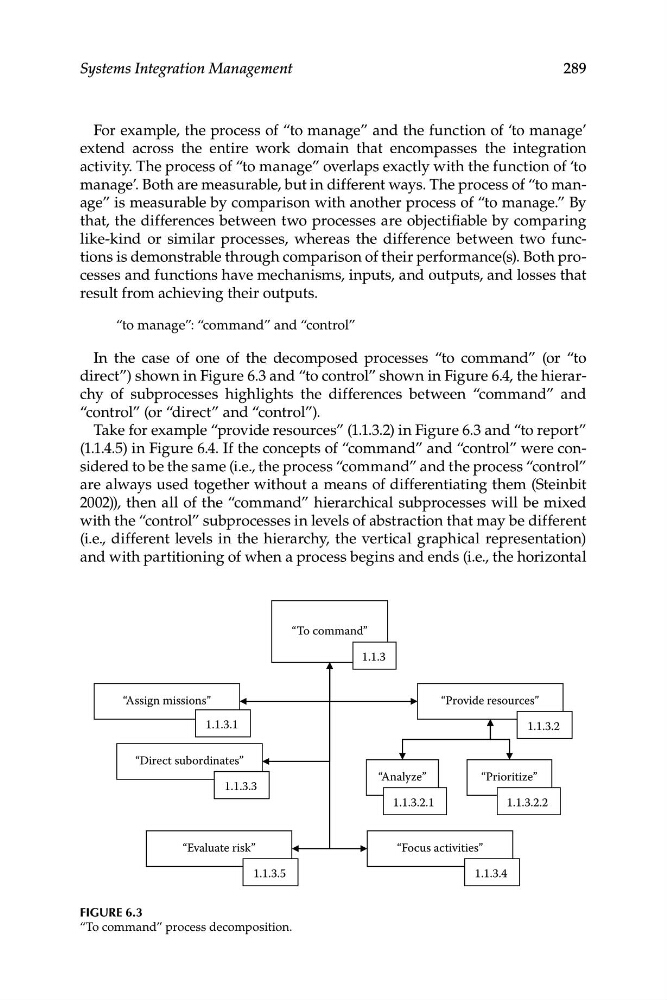
In the case of one of the decomposed processes “to command” (or “to
direct”) shown in Figure 6.3 and “to control” shown in Figure 6.4, the hierarchy of subprocesses highlights the differences between “command” and
“control” (or “direct” and “control”).
Take for example “provide resources” (1.1.3.2) in Figure 6.3 and “to report”
(1.1.4.5) in Figure 6.4. If the concepts of “command” and “control” were considered to be the same (i.e., the process “command” and the process “control”
are always used together without a means of differentiating them (Steinbit
2002)), then all of the “command” hierarchical subprocesses will be mixed
with the “control” subprocesses in levels of abstraction that may be different
(i.e., different levels in the hierarchy, the vertical graphical representation)
and with partitioning of when a process begins and ends (i.e., the horizontal
FIgure 6.3
“To command” process decomposition.
1.1.3
“Assign missions”
“Provide resources”
1.1.3.1
1.1.3.2
“Direct subordinates”
“Analyze”
“Prioritize”
1.1.3.3
1.1.3.2.1
1.1.3.2.2
“Evaluate risk”
“Focus activities”
1.1.3.5
1.1.3.4
289
Systems Integration Management
For example, the process of “to manage” and the function of ‘to manage’
extend across the entire work domain that encompasses the integration
activity. The process of “to manage” overlaps exactly with the function of ‘to
manage’. Both are measurable, but in different ways. The process of “to manage” is measurable by comparison with another process of “to manage.” By
that, the differences between two processes are objectifiable by comparing
like-kind or similar processes, whereas the difference between two functions is demonstrable through comparison of their performance(s). Both processes and functions have mechanisms, inputs, and outputs, and losses that
result from achieving their outputs.
“to manage”: “command” and “control”
In the case of one of the decomposed processes “to command” (or “to
direct”) shown in Figure 6.3 and “to control” shown in Figure 6.4, the hierarchy of subprocesses highlights the differences between “command” and
“control” (or “direct” and “control”).
Take for example “provide resources” (1.1.3.2) in Figure 6.3 and “to report”
(1.1.4.5) in Figure 6.4. If the concepts of “command” and “control” were considered to be the same (i.e., the process “command” and the process “control”
are always used together without a means of differentiating them (Steinbit
2002)), then all of the “command” hierarchical subprocesses will be mixed
with the “control” subprocesses in levels of abstraction that may be different
(i.e., different levels in the hierarchy, the vertical graphical representation)
and with partitioning of when a process begins and ends (i.e., the horizontal
FIgure 6.3
“To command” process decomposition.