

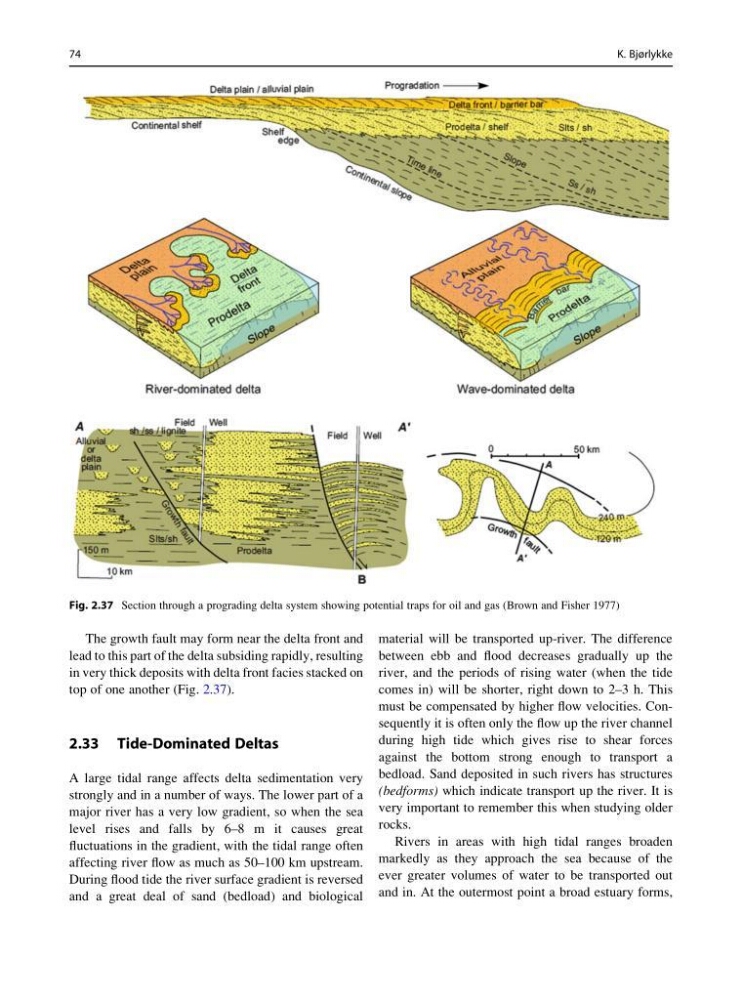
The growth fault may form near the delta front and
lead to this part of the delta subsiding rapidly, resulting
in very thick deposits with delta front facies stacked on
top of one another (Fig. 2.37).
2.33 Tide-Dominated Deltas
A large tidal range affects delta sedimentation very
strongly and in a number of ways. The lower part of a
major river has a very low gradient, so when the sea
level rises and falls by 6–8 m it causes great
fluctuations in the gradient, with the tidal range often
affecting river flow as much as 50–100 km upstream.
During flood tide the river surface gradient is reversed
and a great deal of sand (bedload) and biological
material will be transported up-river. The difference
between ebb and flood decreases gradually up the
river, and the periods of rising water (when the tide
comes in) will be shorter, right down to 2–3 h. This
must be compensated by higher flow velocities. Consequently it is often only the flow up the river channel
during high tide which gives rise to shear forces
against the bottom strong enough to transport a
bedload. Sand deposited in such rivers has structures
(bedforms) which indicate transport up the river. It is
very important to remember this when studying older
rocks.
Rivers in areas with high tidal ranges broaden
markedly as they approach the sea because of the
ever greater volumes of water to be transported out
and in. At the outermost point a broad estuary forms,
Fig. 2.37 Section through a prograding delta system showing potential traps for oil and gas (Brown and Fisher 1977)
74
K. Bjørlykke
lead to this part of the delta subsiding rapidly, resulting
in very thick deposits with delta front facies stacked on
top of one another (Fig. 2.37).
2.33 Tide-Dominated Deltas
A large tidal range affects delta sedimentation very
strongly and in a number of ways. The lower part of a
major river has a very low gradient, so when the sea
level rises and falls by 6–8 m it causes great
fluctuations in the gradient, with the tidal range often
affecting river flow as much as 50–100 km upstream.
During flood tide the river surface gradient is reversed
and a great deal of sand (bedload) and biological
material will be transported up-river. The difference
between ebb and flood decreases gradually up the
river, and the periods of rising water (when the tide
comes in) will be shorter, right down to 2–3 h. This
must be compensated by higher flow velocities. Consequently it is often only the flow up the river channel
during high tide which gives rise to shear forces
against the bottom strong enough to transport a
bedload. Sand deposited in such rivers has structures
(bedforms) which indicate transport up the river. It is
very important to remember this when studying older
rocks.
Rivers in areas with high tidal ranges broaden
markedly as they approach the sea because of the
ever greater volumes of water to be transported out
and in. At the outermost point a broad estuary forms,
Fig. 2.37 Section through a prograding delta system showing potential traps for oil and gas (Brown and Fisher 1977)
74
K. Bjørlykke