

they reach the delta front. The River Magdalene in
Venezuela is a very typical example. The thickness
and the lateral extent of the delta-front sand is a
measure of wave power. Powerful storms may, however, erode vast quantities of sediment, far more
than evenly distributed wave power would have
achieved.
Wave-dominated delta front facies have a typical
coarsening-upward sequence: from pro-delta clay to
increasingly sandy sediments and finally well-sorted
cross-bedded sediments with a low angle of dip, i.e. a
beach facies profile. We often find traces of plant roots
at the top of such sequences, and this shows that the
sand bank has had vegetation right down to the shoreline. It was probably protected by shoreline barriers
which absorb most of the wave energy. Vegetation can
offer protection against both fluvial and tidal erosion,
and mangrove swamps such as those in the Niger delta
are particularly effective. There will always be some
erosion on a delta front. Whether the delta progrades
or is broken down by marine forces depends on the
supply of sediment. The delta front will be fed with
sediment – particularly sand which migrates from the
channel mouth bar – along the beach in the wave zone.
We often call this “strike feeding” because sediment
transport is parallel with the strike of the shoreline, i.e.
along a horizontal line. This is in contrast to the
transport in channels, which is parallel with the dip
of the deposit.
If there is little erosion of the channel mouth bar,
the channels will extend far into the sea, and little
sediment, least of all sand, will be supplied to the
rest of the delta front.
2.32 Stability in a Delta
Sediments which are deposited in a delta possess very
high porosity, and clay- and silt-sized grains form a
very unstable structure after deposition. Clay and silt
have a low permeability, however, and will expel
water only very slowly. If sedimentation is rapid the
sediment load will increase faster than the water can
flow out, and overpressure will develop in the
porewater. This means that more of the overburden is
carried by the porewater, reducing the effective
stresses between the sediment grains and as a result
also the compaction. The friction between grains,
which is a function of the effective stresses, is greatly
diminished, and in consequence so is the shear
strength of the sediments. If the pore pressure attains
the pressure exerted by the overlying sediments, the
effective intergranular stresses will be equal to zero.
There is then no friction between the grains, and
the sediments can flow like a liquid (liquefaction).
The resulting instability may cause diapirs of mud to
be squeezed up into the sand bed (Fig. 2.33). The
Mississippi delta is characterised by rapid sedimentation, and we find diapirs of overpressurised clays.
Clay diapirs rise like salt diapirs because they are
less dense than the more compact clay, silt or sand,
which have lower water contents.
The stability of sediments also depends on the
chemical composition of the porewater. In freshwater,
clay mineral particles with negatively charged
surfaces will repel one another. In saltwater these
surface charges will be neutralised by cations (Na
+
,
K
+ etc.) so that clay minerals flocculate.
Deltas which prograde out into deep water will
develop a slope which may vary greatly. The force of
gravity acting on the sediments in the delta front and
on the slope produces shear stresses in the sediments.
When these stresses exceed the shear strength of the
sediments, the sediments will be deformed by some
sort of gravity-governed process. This may take place
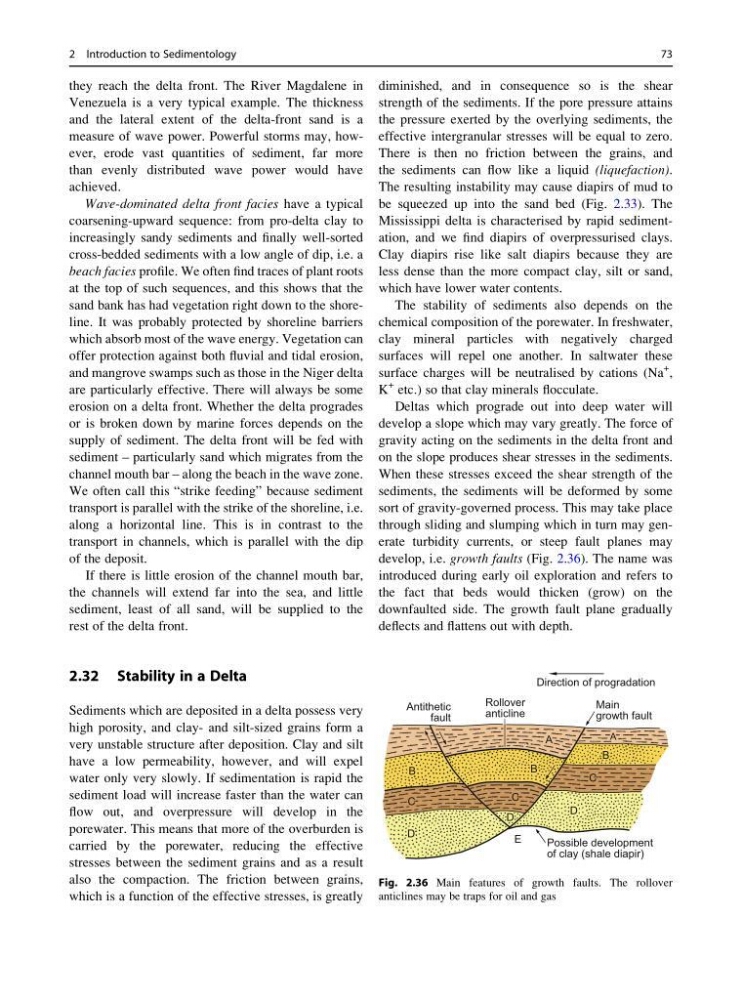
through sliding and slumping which in turn may generate turbidity currents, or steep fault planes may
develop, i.e. growth faults (Fig. 2.36). The name was
introduced during early oil exploration and refers to
the fact that beds would thicken (grow) on the
downfaulted side. The growth fault plane gradually
deflects and flattens out with depth.
A
A
B
B
B
C
C
C
D
D
D
E
Main
growth fault
Possible development
of clay (shale diapir)
Rollover
anticline
Antithetic
fault
Direction of progradation
Fig. 2.36 Main features of growth faults. The rollover
anticlines may be traps for oil and gas
2 Introduction to Sedimentology
73
Venezuela is a very typical example. The thickness
and the lateral extent of the delta-front sand is a
measure of wave power. Powerful storms may, however, erode vast quantities of sediment, far more
than evenly distributed wave power would have
achieved.
Wave-dominated delta front facies have a typical
coarsening-upward sequence: from pro-delta clay to
increasingly sandy sediments and finally well-sorted
cross-bedded sediments with a low angle of dip, i.e. a
beach facies profile. We often find traces of plant roots
at the top of such sequences, and this shows that the
sand bank has had vegetation right down to the shoreline. It was probably protected by shoreline barriers
which absorb most of the wave energy. Vegetation can
offer protection against both fluvial and tidal erosion,
and mangrove swamps such as those in the Niger delta
are particularly effective. There will always be some
erosion on a delta front. Whether the delta progrades
or is broken down by marine forces depends on the
supply of sediment. The delta front will be fed with
sediment – particularly sand which migrates from the
channel mouth bar – along the beach in the wave zone.
We often call this “strike feeding” because sediment
transport is parallel with the strike of the shoreline, i.e.
along a horizontal line. This is in contrast to the
transport in channels, which is parallel with the dip
of the deposit.
If there is little erosion of the channel mouth bar,
the channels will extend far into the sea, and little
sediment, least of all sand, will be supplied to the
rest of the delta front.
2.32 Stability in a Delta
Sediments which are deposited in a delta possess very
high porosity, and clay- and silt-sized grains form a
very unstable structure after deposition. Clay and silt
have a low permeability, however, and will expel
water only very slowly. If sedimentation is rapid the
sediment load will increase faster than the water can
flow out, and overpressure will develop in the
porewater. This means that more of the overburden is
carried by the porewater, reducing the effective
stresses between the sediment grains and as a result
also the compaction. The friction between grains,
which is a function of the effective stresses, is greatly
diminished, and in consequence so is the shear
strength of the sediments. If the pore pressure attains
the pressure exerted by the overlying sediments, the
effective intergranular stresses will be equal to zero.
There is then no friction between the grains, and
the sediments can flow like a liquid (liquefaction).
The resulting instability may cause diapirs of mud to
be squeezed up into the sand bed (Fig. 2.33). The
Mississippi delta is characterised by rapid sedimentation, and we find diapirs of overpressurised clays.
Clay diapirs rise like salt diapirs because they are
less dense than the more compact clay, silt or sand,
which have lower water contents.
The stability of sediments also depends on the
chemical composition of the porewater. In freshwater,
clay mineral particles with negatively charged
surfaces will repel one another. In saltwater these
surface charges will be neutralised by cations (Na
+
,
K
+ etc.) so that clay minerals flocculate.
Deltas which prograde out into deep water will
develop a slope which may vary greatly. The force of
gravity acting on the sediments in the delta front and
on the slope produces shear stresses in the sediments.
When these stresses exceed the shear strength of the
sediments, the sediments will be deformed by some
sort of gravity-governed process. This may take place
through sliding and slumping which in turn may generate turbidity currents, or steep fault planes may
develop, i.e. growth faults (Fig. 2.36). The name was
introduced during early oil exploration and refers to
the fact that beds would thicken (grow) on the
downfaulted side. The growth fault plane gradually
deflects and flattens out with depth.
A
A
B
B
B
C
C
C
D
D
D
E
Main
growth fault
Possible development
of clay (shale diapir)
Rollover
anticline
Antithetic
fault
Direction of progradation
Fig. 2.36 Main features of growth faults. The rollover
anticlines may be traps for oil and gas
2 Introduction to Sedimentology
73