

through deposition in their channels and on the levees,
so that the surface of the water in the channels may be
considerably higher than the surrounding plain. During floods the water may then break through the levee
and flow down from the channel to the plain, forming
temporary lakes several metres deep. The lower
Mississippi River is considerably higher than the
surrounding area, including New Orleans. The major
Chinese rivers have also built themselves up above the
surrounding countryside, so floods can cause very
great damage.
However, the stability of the levees will determine
how much a channel can build itself up, and clay-rich
sediments form stronger levees than sand and silt
because of their cohesiveness. When the levees give
way, sand will flow out of the channel and deposit
sandy sediments in fans or crevasse splays on the flood
plain. They are characterised by thin sand beds, often
fining upwards, with an erosional base in the proximal
part (nearest the channel). However, we may also find
small sequences which coarsen upwards as a result of
progradation of this fan, because grain size decreases
towards the edge of the fan.
2.27.1 Channel Shapes
We distinguish between relatively straight fluvial
channels and curved channels. Curved channels are
shaped rather like a sine curve. To describe the degree
of curvature we speak of high and low sinuosity.
Sinuosity is defined as the ratio between the length
along the channel and the length of a straight line
through the meander belt, i.e. the length of the river
valley. Meandering streams have a single channel and
by definition a sinuosity greater than 1.5.
Braided streams have a branched course, but in
most cases the river channels are fairly straight.
These rivers are branched because the river channel
is not very stable, and because sediment is deposited in
the middle of the channel, forming small islands or
bars. Braided streams typically develop in coarse
sediments containing little clay or silt which can
form stable leve ´es. A higher stream gradient gives
greater energy and greater erosion of the sides of the
channel. An abundant supply of sediment leads to
sediment being deposited more rapidly than it can be
eroded and transported onwards, resulting in the formation of deposits in the channel. Braided streams are
therefore also typical of areas where the velocity
declines somewhat, e.g. when a river widens onto a
plain after passing through a narrow valley. The velocity and flow will in most cases vary considerably with
time. When the river is low it will flow round bars of
sand and gravel, while at high water and with strong
currents sand bars will migrate as they are eroded on
the upstream side and accumulate deposits on the
downstream side. Gravel bars, on the other hand,
have rather complex patterns of erosion and
deposition.
Meandering rivers have a wavelength which is a
function of the breadth of the river. The wavelength is
approximately 11 times the breadth or 5 times the
radius of the river. There is also a relatively regular
ratio (about 7:1) between the breadth and depth of the
river.
Meandering rivers move in loops, with the greatest
velocity at the outer bank so that erosion is
concentrated there. The velocity along the inner bank
is much lower, so sediment is deposited there. The
flow velocity and shear forces against the bottom
also decrease upwards towards the top of the bank on
the inner side of the bend, and sediments are deposited
in a point bar which reflects the hydrodynamic
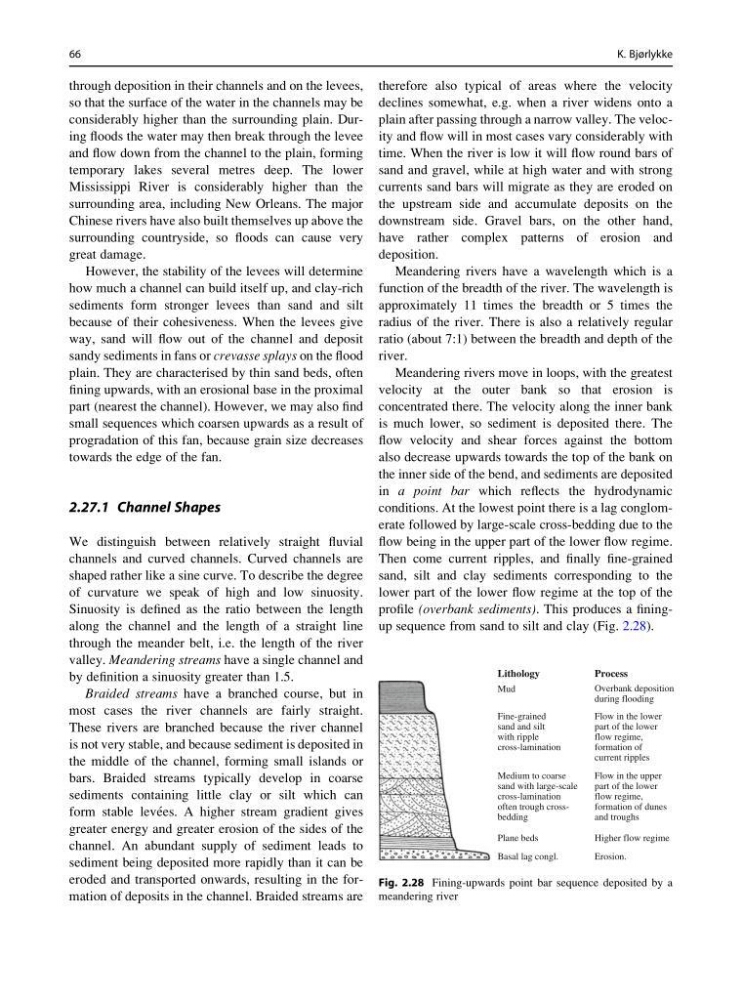
conditions. At the lowest point there is a lag conglomerate followed by large-scale cross-bedding due to the
flow being in the upper part of the lower flow regime.
Then come current ripples, and finally fine-grained
sand, silt and clay sediments corresponding to the
lower part of the lower flow regime at the top of the
profile (overbank sediments). This produces a finingup sequence from sand to silt and clay (Fig. 2.28).
Lithology
Process
Plane beds
Higher flow regime
Erosion.
Basal lag congl.
Mud
Overbank deposition
during flooding
Flow in the upper
part of the lower
flow regime,
formation of dunes
and troughs
Medium to coarse
sand with large-scale
cross-lamination
often trough crossbedding
Flow in the lower
part of the lower
flow regime,
formation of
current ripples
Fine-grained
sand and silt
with ripple
cross-lamination
Fig. 2.28 Fining-upwards point bar sequence deposited by a
meandering river
66
K. Bjørlykke
so that the surface of the water in the channels may be
considerably higher than the surrounding plain. During floods the water may then break through the levee
and flow down from the channel to the plain, forming
temporary lakes several metres deep. The lower
Mississippi River is considerably higher than the
surrounding area, including New Orleans. The major
Chinese rivers have also built themselves up above the
surrounding countryside, so floods can cause very
great damage.
However, the stability of the levees will determine
how much a channel can build itself up, and clay-rich
sediments form stronger levees than sand and silt
because of their cohesiveness. When the levees give
way, sand will flow out of the channel and deposit
sandy sediments in fans or crevasse splays on the flood
plain. They are characterised by thin sand beds, often
fining upwards, with an erosional base in the proximal
part (nearest the channel). However, we may also find
small sequences which coarsen upwards as a result of
progradation of this fan, because grain size decreases
towards the edge of the fan.
2.27.1 Channel Shapes
We distinguish between relatively straight fluvial
channels and curved channels. Curved channels are
shaped rather like a sine curve. To describe the degree
of curvature we speak of high and low sinuosity.
Sinuosity is defined as the ratio between the length
along the channel and the length of a straight line
through the meander belt, i.e. the length of the river
valley. Meandering streams have a single channel and
by definition a sinuosity greater than 1.5.
Braided streams have a branched course, but in
most cases the river channels are fairly straight.
These rivers are branched because the river channel
is not very stable, and because sediment is deposited in
the middle of the channel, forming small islands or
bars. Braided streams typically develop in coarse
sediments containing little clay or silt which can
form stable leve ´es. A higher stream gradient gives
greater energy and greater erosion of the sides of the
channel. An abundant supply of sediment leads to
sediment being deposited more rapidly than it can be
eroded and transported onwards, resulting in the formation of deposits in the channel. Braided streams are
therefore also typical of areas where the velocity
declines somewhat, e.g. when a river widens onto a
plain after passing through a narrow valley. The velocity and flow will in most cases vary considerably with
time. When the river is low it will flow round bars of
sand and gravel, while at high water and with strong
currents sand bars will migrate as they are eroded on
the upstream side and accumulate deposits on the
downstream side. Gravel bars, on the other hand,
have rather complex patterns of erosion and
deposition.
Meandering rivers have a wavelength which is a
function of the breadth of the river. The wavelength is
approximately 11 times the breadth or 5 times the
radius of the river. There is also a relatively regular
ratio (about 7:1) between the breadth and depth of the
river.
Meandering rivers move in loops, with the greatest
velocity at the outer bank so that erosion is
concentrated there. The velocity along the inner bank
is much lower, so sediment is deposited there. The
flow velocity and shear forces against the bottom
also decrease upwards towards the top of the bank on
the inner side of the bend, and sediments are deposited
in a point bar which reflects the hydrodynamic
conditions. At the lowest point there is a lag conglomerate followed by large-scale cross-bedding due to the
flow being in the upper part of the lower flow regime.
Then come current ripples, and finally fine-grained
sand, silt and clay sediments corresponding to the
lower part of the lower flow regime at the top of the
profile (overbank sediments). This produces a finingup sequence from sand to silt and clay (Fig. 2.28).
Lithology
Process
Plane beds
Higher flow regime
Erosion.
Basal lag congl.
Mud
Overbank deposition
during flooding
Flow in the upper
part of the lower
flow regime,
formation of dunes
and troughs
Medium to coarse
sand with large-scale
cross-lamination
often trough crossbedding
Flow in the lower
part of the lower
flow regime,
formation of
current ripples
Fine-grained
sand and silt
with ripple
cross-lamination
Fig. 2.28 Fining-upwards point bar sequence deposited by a
meandering river
66
K. Bjørlykke