

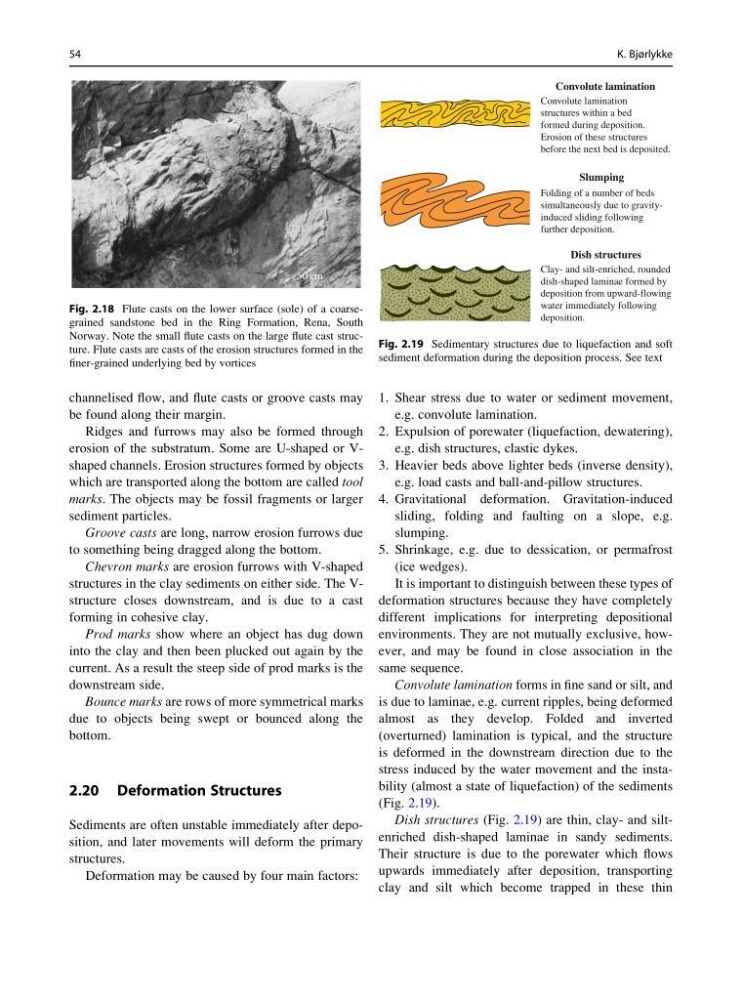
channelised flow, and flute casts or groove casts may
be found along their margin.
Ridges and furrows may also be formed through
erosion of the substratum. Some are U-shaped or Vshaped channels. Erosion structures formed by objects
which are transported along the bottom are called tool
marks. The objects may be fossil fragments or larger
sediment particles.
Groove casts are long, narrow erosion furrows due
to something being dragged along the bottom.
Chevron marks are erosion furrows with V-shaped
structures in the clay sediments on either side. The Vstructure closes downstream, and is due to a cast
forming in cohesive clay.
Prod marks show where an object has dug down
into the clay and then been plucked out again by the
current. As a result the steep side of prod marks is the
downstream side.
Bounce marks are rows of more symmetrical marks
due to objects being swept or bounced along the
bottom.
2.20 Deformation Structures
Sediments are often unstable immediately after deposition, and later movements will deform the primary
structures.
Deformation may be caused by four main factors:
1. Shear stress due to water or sediment movement,
e.g. convolute lamination.
2. Expulsion of porewater (liquefaction, dewatering),
e.g. dish structures, clastic dykes.
3. Heavier beds above lighter beds (inverse density),
e.g. load casts and ball-and-pillow structures.
4. Gravitational deformation. Gravitation-induced
sliding, folding and faulting on a slope, e.g.
slumping.
5. Shrinkage, e.g. due to dessication, or permafrost
(ice wedges).
It is important to distinguish between these types of
deformation structures because they have completely
different implications for interpreting depositional
environments. They are not mutually exclusive, however, and may be found in close association in the
same sequence.
Convolute lamination forms in fine sand or silt, and
is due to laminae, e.g. current ripples, being deformed
almost as they develop. Folded and inverted
(overturned) lamination is typical, and the structure
is deformed in the downstream direction due to the
stress induced by the water movement and the instability (almost a state of liquefaction) of the sediments
(Fig. 2.19).
Dish structures (Fig. 2.19) are thin, clay- and siltenriched dish-shaped laminae in sandy sediments.
Their structure is due to the porewater which flows
upwards immediately after deposition, transporting
clay and silt which become trapped in these thin
50 cm
Fig. 2.18 Flute casts on the lower surface (sole) of a coarsegrained sandstone bed in the Ring Formation, Rena, South
Norway. Note the small flute casts on the large flute cast structure. Flute casts are casts of the erosion structures formed in the
finer-grained underlying bed by vortices
Convolute lamination
Slumping
Dish structures
Convolute lamination
structures within a bed
formed during deposition.
Erosion of these structures
before the next bed is deposited.
Folding of a number of beds
simultaneously due to gravityinduced sliding following
further deposition.
Clay- and silt-enriched, rounded
dish-shaped laminae formed by
deposition from upward-flowing
water immediately following
deposition.
Fig. 2.19 Sedimentary structures due to liquefaction and soft
sediment deformation during the deposition process. See text
54
K. Bjørlykke
be found along their margin.
Ridges and furrows may also be formed through
erosion of the substratum. Some are U-shaped or Vshaped channels. Erosion structures formed by objects
which are transported along the bottom are called tool
marks. The objects may be fossil fragments or larger
sediment particles.
Groove casts are long, narrow erosion furrows due
to something being dragged along the bottom.
Chevron marks are erosion furrows with V-shaped
structures in the clay sediments on either side. The Vstructure closes downstream, and is due to a cast
forming in cohesive clay.
Prod marks show where an object has dug down
into the clay and then been plucked out again by the
current. As a result the steep side of prod marks is the
downstream side.
Bounce marks are rows of more symmetrical marks
due to objects being swept or bounced along the
bottom.
2.20 Deformation Structures
Sediments are often unstable immediately after deposition, and later movements will deform the primary
structures.
Deformation may be caused by four main factors:
1. Shear stress due to water or sediment movement,
e.g. convolute lamination.
2. Expulsion of porewater (liquefaction, dewatering),
e.g. dish structures, clastic dykes.
3. Heavier beds above lighter beds (inverse density),
e.g. load casts and ball-and-pillow structures.
4. Gravitational deformation. Gravitation-induced
sliding, folding and faulting on a slope, e.g.
slumping.
5. Shrinkage, e.g. due to dessication, or permafrost
(ice wedges).
It is important to distinguish between these types of
deformation structures because they have completely
different implications for interpreting depositional
environments. They are not mutually exclusive, however, and may be found in close association in the
same sequence.
Convolute lamination forms in fine sand or silt, and
is due to laminae, e.g. current ripples, being deformed
almost as they develop. Folded and inverted
(overturned) lamination is typical, and the structure
is deformed in the downstream direction due to the
stress induced by the water movement and the instability (almost a state of liquefaction) of the sediments
(Fig. 2.19).
Dish structures (Fig. 2.19) are thin, clay- and siltenriched dish-shaped laminae in sandy sediments.
Their structure is due to the porewater which flows
upwards immediately after deposition, transporting
clay and silt which become trapped in these thin
50 cm
Fig. 2.18 Flute casts on the lower surface (sole) of a coarsegrained sandstone bed in the Ring Formation, Rena, South
Norway. Note the small flute casts on the large flute cast structure. Flute casts are casts of the erosion structures formed in the
finer-grained underlying bed by vortices
Convolute lamination
Slumping
Dish structures
Convolute lamination
structures within a bed
formed during deposition.
Erosion of these structures
before the next bed is deposited.
Folding of a number of beds
simultaneously due to gravityinduced sliding following
further deposition.
Clay- and silt-enriched, rounded
dish-shaped laminae formed by
deposition from upward-flowing
water immediately following
deposition.
Fig. 2.19 Sedimentary structures due to liquefaction and soft
sediment deformation during the deposition process. See text
54
K. Bjørlykke