

Sandwaves often have current ripples (“smaller
dunes”) on their surface. This may also be the case
with dunes. Bedforms are a function of both flow
velocity and grain size. Current ripples are formed
only in silt and fine- to medium-grained sand, while
dunes require medium to coarse sand. Upper flow
regime plane beds which have an internal structure
of planar lamination are formed when the Froude
number is about 0.6–0.8. Plane beds typically develop
in beach sand. A well-developed lineation on the bedding surface parallel to the direction of sediment transport is typical of plane beds (Fig. 2.9). Antidunes are
formed by higher velocities in the upper flow regime;
the absolute flow velocities required are lower when
the water is shallow.
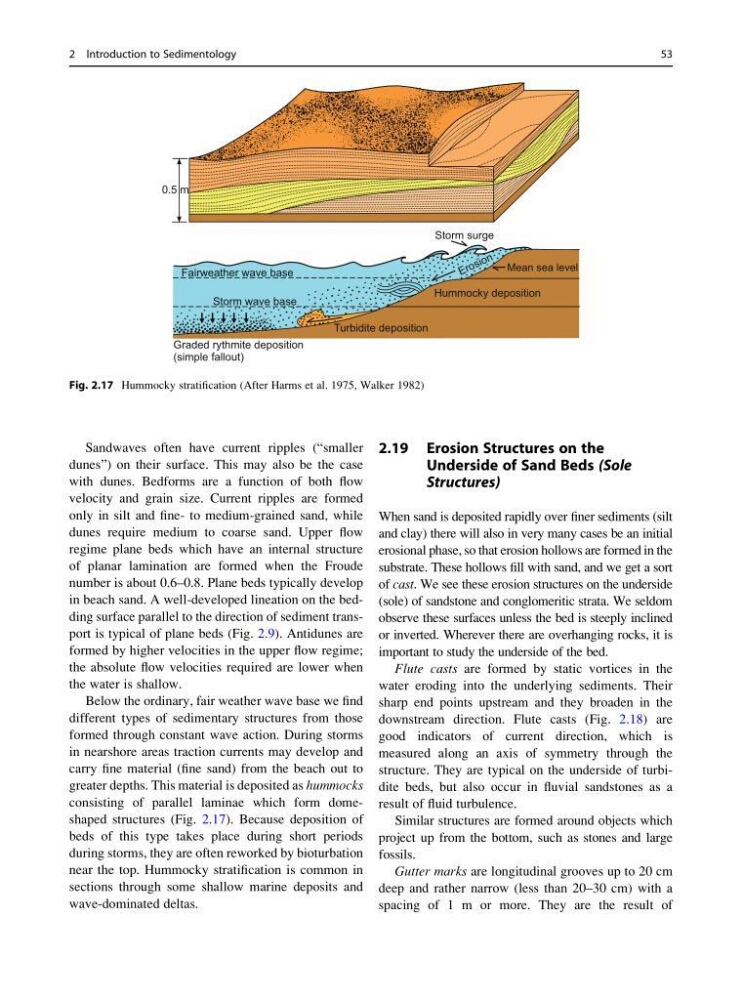
Below the ordinary, fair weather wave base we find
different types of sedimentary structures from those
formed through constant wave action. During storms
in nearshore areas traction currents may develop and
carry fine material (fine sand) from the beach out to
greater depths. This material is deposited as hummocks
consisting of parallel laminae which form domeshaped structures (Fig. 2.17). Because deposition of
beds of this type takes place during short periods
during storms, they are often reworked by bioturbation
near the top. Hummocky stratification is common in
sections through some shallow marine deposits and
wave-dominated deltas.
2.19 Erosion Structures on the
Underside of Sand Beds (Sole
Structures)
When sand is deposited rapidly over finer sediments (silt
and clay) there will also in very many cases be an initial
erosional phase, so that erosion hollows are formed in the
substrate. These hollows fill with sand, and we get a sort
of cast. We see these erosion structures on the underside
(sole) of sandstone and conglomeritic strata. We seldom
observe these surfaces unless the bed is steeply inclined
or inverted. Wherever there are overhanging rocks, it is
important to study the underside of the bed.
Flute casts are formed by static vortices in the
water eroding into the underlying sediments. Their
sharp end points upstream and they broaden in the
downstream direction. Flute casts (Fig. 2.18) are
good indicators of current direction, which is
measured along an axis of symmetry through the
structure. They are typical on the underside of turbidite beds, but also occur in fluvial sandstones as a
result of fluid turbulence.
Similar structures are formed around objects which
project up from the bottom, such as stones and large
fossils.
Gutter marks are longitudinal grooves up to 20 cm
deep and rather narrow (less than 20–30 cm) with a
spacing of 1 m or more. They are the result of
0.5 m
E r o s io n
Storm surge
Graded rythmite deposition
(simple fallout)
Turbidite deposition
Hummocky deposition
Mean sea level
Storm wave base
Fairweather wave base
Fig. 2.17 Hummocky stratification (After Harms et al. 1975, Walker 1982)
2 Introduction to Sedimentology
53
dunes”) on their surface. This may also be the case
with dunes. Bedforms are a function of both flow
velocity and grain size. Current ripples are formed
only in silt and fine- to medium-grained sand, while
dunes require medium to coarse sand. Upper flow
regime plane beds which have an internal structure
of planar lamination are formed when the Froude
number is about 0.6–0.8. Plane beds typically develop
in beach sand. A well-developed lineation on the bedding surface parallel to the direction of sediment transport is typical of plane beds (Fig. 2.9). Antidunes are
formed by higher velocities in the upper flow regime;
the absolute flow velocities required are lower when
the water is shallow.
Below the ordinary, fair weather wave base we find
different types of sedimentary structures from those
formed through constant wave action. During storms
in nearshore areas traction currents may develop and
carry fine material (fine sand) from the beach out to
greater depths. This material is deposited as hummocks
consisting of parallel laminae which form domeshaped structures (Fig. 2.17). Because deposition of
beds of this type takes place during short periods
during storms, they are often reworked by bioturbation
near the top. Hummocky stratification is common in
sections through some shallow marine deposits and
wave-dominated deltas.
2.19 Erosion Structures on the
Underside of Sand Beds (Sole
Structures)
When sand is deposited rapidly over finer sediments (silt
and clay) there will also in very many cases be an initial
erosional phase, so that erosion hollows are formed in the
substrate. These hollows fill with sand, and we get a sort
of cast. We see these erosion structures on the underside
(sole) of sandstone and conglomeritic strata. We seldom
observe these surfaces unless the bed is steeply inclined
or inverted. Wherever there are overhanging rocks, it is
important to study the underside of the bed.
Flute casts are formed by static vortices in the
water eroding into the underlying sediments. Their
sharp end points upstream and they broaden in the
downstream direction. Flute casts (Fig. 2.18) are
good indicators of current direction, which is
measured along an axis of symmetry through the
structure. They are typical on the underside of turbidite beds, but also occur in fluvial sandstones as a
result of fluid turbulence.
Similar structures are formed around objects which
project up from the bottom, such as stones and large
fossils.
Gutter marks are longitudinal grooves up to 20 cm
deep and rather narrow (less than 20–30 cm) with a
spacing of 1 m or more. They are the result of
0.5 m
E r o s io n
Storm surge
Graded rythmite deposition
(simple fallout)
Turbidite deposition
Hummocky deposition
Mean sea level
Storm wave base
Fairweather wave base
Fig. 2.17 Hummocky stratification (After Harms et al. 1975, Walker 1982)
2 Introduction to Sedimentology
53