

used to heat the water in the reservoir and it is important
to reduce the inflow of water from adjacent rocks. One
method includes freezing the ground at a distance from
the well to avoid the flow of water towards the well. It is
also possible to burn some of the oil in the subsurface to
provide heat to heat the oil.
It has also been proposed to heat the oil electrically,
possibly powered by a nuclear reactor to reduce the
CO 2 emissions from burning oil to produce heat.
The tar sands in Alberta, Canada (Athabasca) are of
Middle Cretaceous age (Aptian, 100 million years).
The main reservoir rock is the McMurray Formation, a sandstone representing fluvial to tidal
environments, and it is important to find thick
sequences of sand with few clay layers. The oil was
generated from older source rocks during the
Laramide folding of the Rocky Mountains to the
west and migrated into the Athabasca sands during
the Cretaceous when these fluival sandstone were
still at a relatively shallow depth. Starting in the
Eocene (50 million years) the sand was uplifted and
most of the overburden eroded. The oil was then
biodegraded by bacteria. These tar sands contain 1.7
trillion bbl (270 Â 10
9 m
3 ) of bitumen in-place, comparable in magnitude to the world’s total proven
reserves of conventional petroleum. There are currently large mining operations at Athabasca
(Fig. 23.2). At surface temperatures, which are low
in northern Canada, this tar sand is rather hard
(Fig. 23.3) because of the high viscosity of the oil.
The oil must be separated from the sand using hot
water (Fig. 23.4). The oil (tar) is very viscous and
may be denser than water (API <10).
Tar sand is produced by in situ mining where the
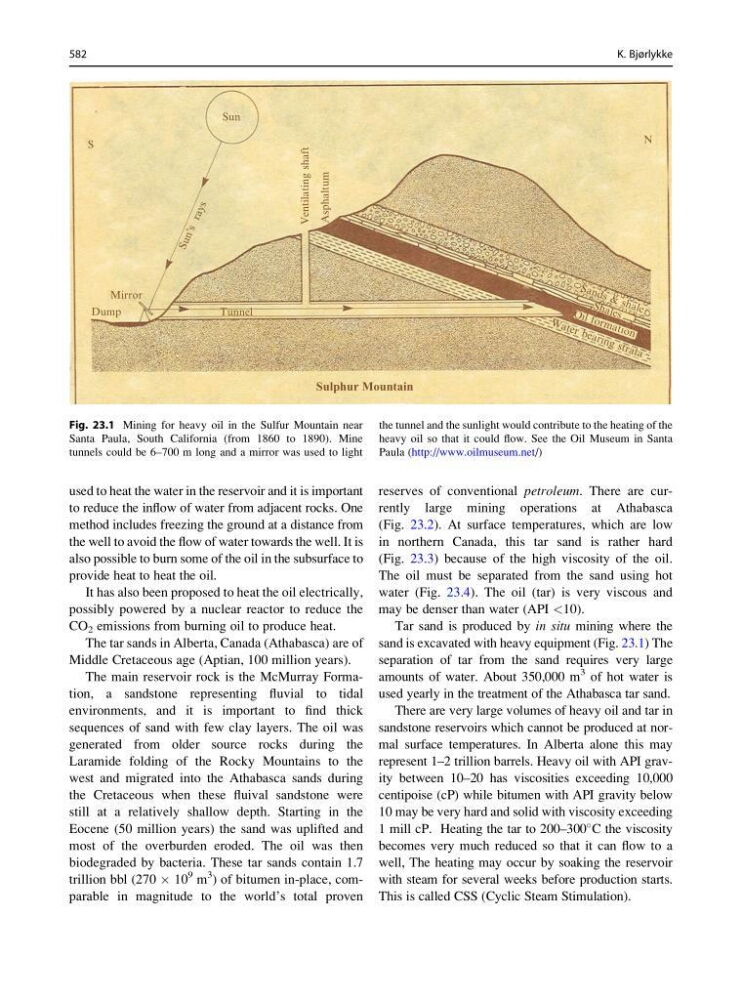
sand is excavated with heavy equipment (Fig. 23.1) The
separation of tar from the sand requires very large
amounts of water. About 350,000 m
3 of hot water is
used yearly in the treatment of the Athabasca tar sand.
There are very large volumes of heavy oil and tar in
sandstone reservoirs which cannot be produced at normal surface temperatures. In Alberta alone this may
represent 1–2 trillion barrels. Heavy oil with API gravity between 10–20 has viscosities exceeding 10,000
centipoise (cP) while bitumen with API gravity below
10 may be very hard and solid with viscosity exceeding
1 mill cP. Heating the tar to 200–300
C the viscosity
becomes very much reduced so that it can flow to a
well, The heating may occur by soaking the reservoir
with steam for several weeks before production starts.
This is called CSS (Cyclic Steam Stimulation).
Sulphur Mountain
Tunnel
Sun
S
Mirror
Dump
N
S a n d s & s h a le
S h a le s
O il fo rm a ti o n
W a te r b e a r in g s tr a ta
Ventilating shaft
Asphaltum
S u n ’s
r a y s
Fig. 23.1 Mining for heavy oil in the Sulfur Mountain near
Santa Paula, South California (from 1860 to 1890). Mine
tunnels could be 6–700 m long and a mirror was used to light
the tunnel and the sunlight would contribute to the heating of the
heavy oil so that it could flow. See the Oil Museum in Santa
Paula (http://www.oilmuseum.net/)
582
K. Bjørlykke
to reduce the inflow of water from adjacent rocks. One
method includes freezing the ground at a distance from
the well to avoid the flow of water towards the well. It is
also possible to burn some of the oil in the subsurface to
provide heat to heat the oil.
It has also been proposed to heat the oil electrically,
possibly powered by a nuclear reactor to reduce the
CO 2 emissions from burning oil to produce heat.
The tar sands in Alberta, Canada (Athabasca) are of
Middle Cretaceous age (Aptian, 100 million years).
The main reservoir rock is the McMurray Formation, a sandstone representing fluvial to tidal
environments, and it is important to find thick
sequences of sand with few clay layers. The oil was
generated from older source rocks during the
Laramide folding of the Rocky Mountains to the
west and migrated into the Athabasca sands during
the Cretaceous when these fluival sandstone were
still at a relatively shallow depth. Starting in the
Eocene (50 million years) the sand was uplifted and
most of the overburden eroded. The oil was then
biodegraded by bacteria. These tar sands contain 1.7
trillion bbl (270 Â 10
9 m
3 ) of bitumen in-place, comparable in magnitude to the world’s total proven
reserves of conventional petroleum. There are currently large mining operations at Athabasca
(Fig. 23.2). At surface temperatures, which are low
in northern Canada, this tar sand is rather hard
(Fig. 23.3) because of the high viscosity of the oil.
The oil must be separated from the sand using hot
water (Fig. 23.4). The oil (tar) is very viscous and
may be denser than water (API <10).
Tar sand is produced by in situ mining where the
sand is excavated with heavy equipment (Fig. 23.1) The
separation of tar from the sand requires very large
amounts of water. About 350,000 m
3 of hot water is
used yearly in the treatment of the Athabasca tar sand.
There are very large volumes of heavy oil and tar in
sandstone reservoirs which cannot be produced at normal surface temperatures. In Alberta alone this may
represent 1–2 trillion barrels. Heavy oil with API gravity between 10–20 has viscosities exceeding 10,000
centipoise (cP) while bitumen with API gravity below
10 may be very hard and solid with viscosity exceeding
1 mill cP. Heating the tar to 200–300
C the viscosity
becomes very much reduced so that it can flow to a
well, The heating may occur by soaking the reservoir
with steam for several weeks before production starts.
This is called CSS (Cyclic Steam Stimulation).
Sulphur Mountain
Tunnel
Sun
S
Mirror
Dump
N
S a n d s & s h a le
S h a le s
O il fo rm a ti o n
W a te r b e a r in g s tr a ta
Ventilating shaft
Asphaltum
S u n ’s
r a y s
Fig. 23.1 Mining for heavy oil in the Sulfur Mountain near
Santa Paula, South California (from 1860 to 1890). Mine
tunnels could be 6–700 m long and a mirror was used to light
the tunnel and the sunlight would contribute to the heating of the
heavy oil so that it could flow. See the Oil Museum in Santa
Paula (http://www.oilmuseum.net/)
582
K. Bjørlykke