

These issues are addressed in alternative upscaling
philosophy called geologically based upscaling,
which is based on separation of scales seen in the
sedimentological patterns. One goal here is to investigate if the static geogrid and the dynamic simulation
grid can be constructed at the same scale. The property
modelling will be based on a hierarchical procedure,
where the scales of the different heterogeneity levels
are identified. To identify the REV levels is essential
here as they define the smallest volume where the
measurements yield a proper representation of the
whole volume. The approach is used to provide a
systematic upscaling work flow from the finest scale
(pore level) to flow simulation grid level. For further
reading, see e.g. Liu et al. (2002), Pickup et al. (2005)
and Scaglioni et al. (2006).
If the project has enough time available, the ultimate check of the dynamic impact of upscaling is to
run simulations on the geogrid scale. Running a
dynamic simulation on a fine-scaled geomodel might
take weeks, however this can represent a very good
consistency check.
22.4.3 History Matching
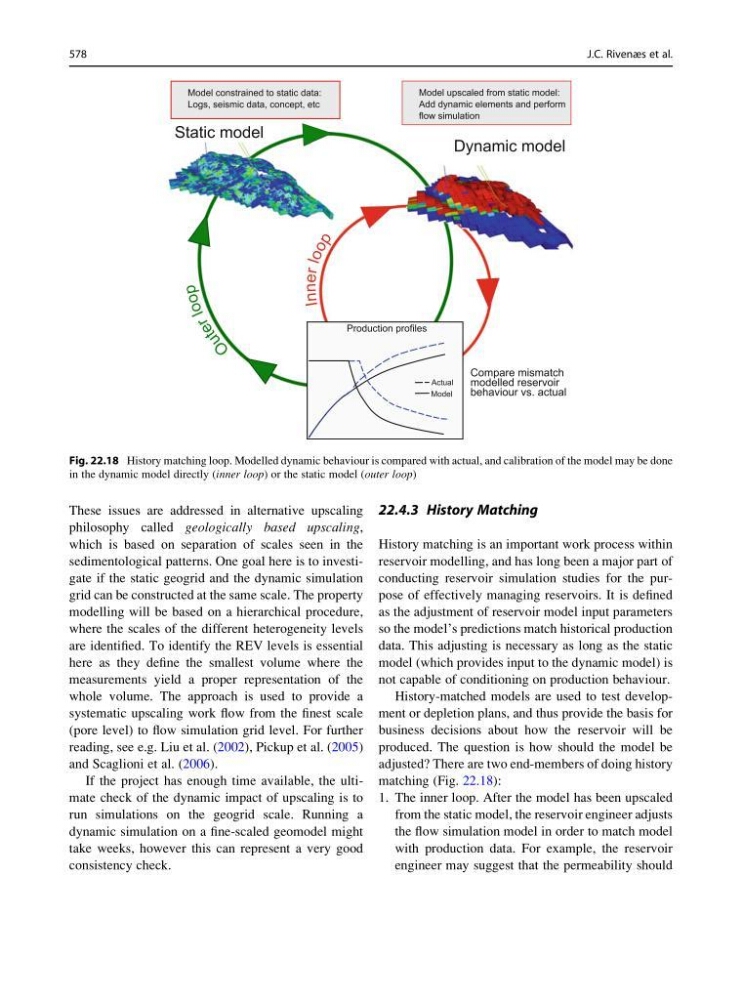
History matching is an important work process within
reservoir modelling, and has long been a major part of
conducting reservoir simulation studies for the purpose of effectively managing reservoirs. It is defined
as the adjustment of reservoir model input parameters
so the model’s predictions match historical production
data. This adjusting is necessary as long as the static
model (which provides input to the dynamic model) is
not capable of conditioning on production behaviour.
History-matched models are used to test development or depletion plans, and thus provide the basis for
business decisions about how the reservoir will be
produced. The question is how should the model be
adjusted? There are two end-members of doing history
matching (Fig. 22.18):
1. The inner loop. After the model has been upscaled
from the static model, the reservoir engineer adjusts
the flow simulation model in order to match model
with production data. For example, the reservoir
engineer may suggest that the permeability should
Fig. 22.18 History matching loop. Modelled dynamic behaviour is compared with actual, and calibration of the model may be done
in the dynamic model directly (inner loop) or the static model (outer loop)
578
J.C. Rivenæs et al.
philosophy called geologically based upscaling,
which is based on separation of scales seen in the
sedimentological patterns. One goal here is to investigate if the static geogrid and the dynamic simulation
grid can be constructed at the same scale. The property
modelling will be based on a hierarchical procedure,
where the scales of the different heterogeneity levels
are identified. To identify the REV levels is essential
here as they define the smallest volume where the
measurements yield a proper representation of the
whole volume. The approach is used to provide a
systematic upscaling work flow from the finest scale
(pore level) to flow simulation grid level. For further
reading, see e.g. Liu et al. (2002), Pickup et al. (2005)
and Scaglioni et al. (2006).
If the project has enough time available, the ultimate check of the dynamic impact of upscaling is to
run simulations on the geogrid scale. Running a
dynamic simulation on a fine-scaled geomodel might
take weeks, however this can represent a very good
consistency check.
22.4.3 History Matching
History matching is an important work process within
reservoir modelling, and has long been a major part of
conducting reservoir simulation studies for the purpose of effectively managing reservoirs. It is defined
as the adjustment of reservoir model input parameters
so the model’s predictions match historical production
data. This adjusting is necessary as long as the static
model (which provides input to the dynamic model) is
not capable of conditioning on production behaviour.
History-matched models are used to test development or depletion plans, and thus provide the basis for
business decisions about how the reservoir will be
produced. The question is how should the model be
adjusted? There are two end-members of doing history
matching (Fig. 22.18):
1. The inner loop. After the model has been upscaled
from the static model, the reservoir engineer adjusts
the flow simulation model in order to match model
with production data. For example, the reservoir
engineer may suggest that the permeability should
Fig. 22.18 History matching loop. Modelled dynamic behaviour is compared with actual, and calibration of the model may be done
in the dynamic model directly (inner loop) or the static model (outer loop)
578
J.C. Rivenæs et al.