

• A proper handling of scales from one data-type to
another is one of the most challenging tasks within
reservoir modelling.
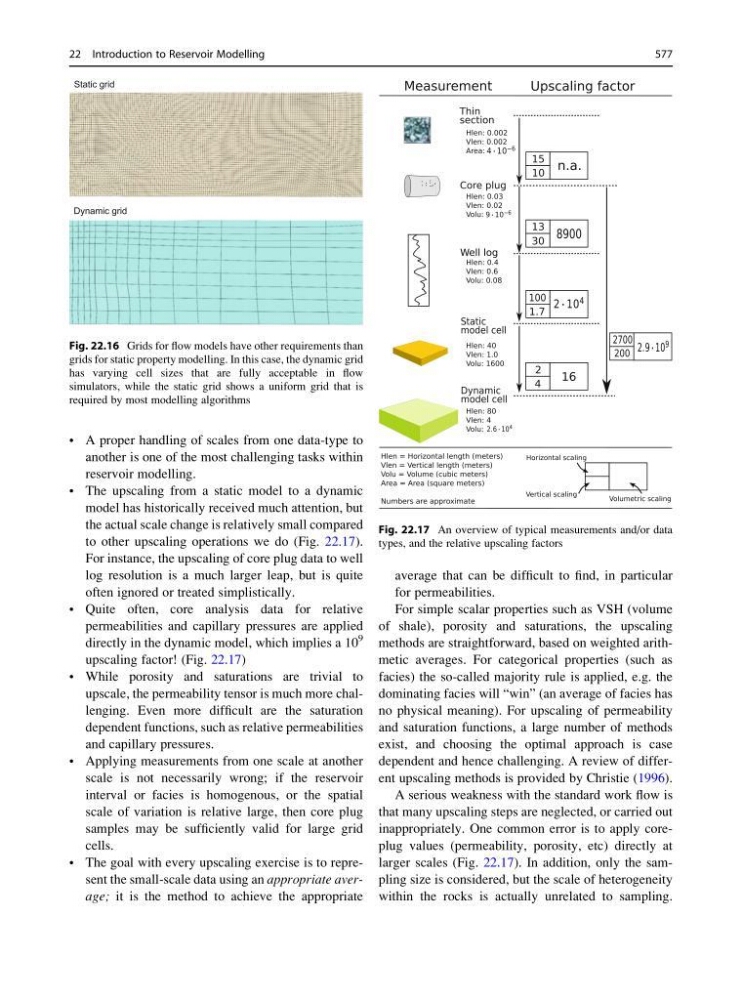
• The upscaling from a static model to a dynamic
model has historically received much attention, but
the actual scale change is relatively small compared
to other upscaling operations we do (Fig. 22.17).
For instance, the upscaling of core plug data to well
log resolution is a much larger leap, but is quite
often ignored or treated simplistically.
• Quite often, core analysis data for relative
permeabilities and capillary pressures are applied
directly in the dynamic model, which implies a 10
9
upscaling factor! (Fig. 22.17)
• While porosity and saturations are trivial to
upscale, the permeability tensor is much more challenging. Even more difficult are the saturation
dependent functions, such as relative permeabilities
and capillary pressures.
• Applying measurements from one scale at another
scale is not necessarily wrong; if the reservoir
interval or facies is homogenous, or the spatial
scale of variation is relative large, then core plug
samples may be sufficiently valid for large grid
cells.
• The goal with every upscaling exercise is to represent the small-scale data using an appropriate average; it is the method to achieve the appropriate
average that can be difficult to find, in particular
for permeabilities.
For simple scalar properties such as VSH (volume
of shale), porosity and saturations, the upscaling
methods are straightforward, based on weighted arithmetic averages. For categorical properties (such as
facies) the so-called majority rule is applied, e.g. the
dominating facies will “win” (an average of facies has
no physical meaning). For upscaling of permeability
and saturation functions, a large number of methods
exist, and choosing the optimal approach is case
dependent and hence challenging. A review of different upscaling methods is provided by Christie (1996).
A serious weakness with the standard work flow is
that many upscaling steps are neglected, or carried out
inappropriately. One common error is to apply coreplug values (permeability, porosity, etc) directly at
larger scales (Fig. 22.17). In addition, only the sampling size is considered, but the scale of heterogeneity
within the rocks is actually unrelated to sampling.
Fig. 22.16 Grids for flow models have other requirements than
grids for static property modelling. In this case, the dynamic grid
has varying cell sizes that are fully acceptable in flow
simulators, while the static grid shows a uniform grid that is
required by most modelling algorithms
Fig. 22.17 An overview of typical measurements and/or data
types, and the relative upscaling factors
22 Introduction to Reservoir Modelling
577
another is one of the most challenging tasks within
reservoir modelling.
• The upscaling from a static model to a dynamic
model has historically received much attention, but
the actual scale change is relatively small compared
to other upscaling operations we do (Fig. 22.17).
For instance, the upscaling of core plug data to well
log resolution is a much larger leap, but is quite
often ignored or treated simplistically.
• Quite often, core analysis data for relative
permeabilities and capillary pressures are applied
directly in the dynamic model, which implies a 10
9
upscaling factor! (Fig. 22.17)
• While porosity and saturations are trivial to
upscale, the permeability tensor is much more challenging. Even more difficult are the saturation
dependent functions, such as relative permeabilities
and capillary pressures.
• Applying measurements from one scale at another
scale is not necessarily wrong; if the reservoir
interval or facies is homogenous, or the spatial
scale of variation is relative large, then core plug
samples may be sufficiently valid for large grid
cells.
• The goal with every upscaling exercise is to represent the small-scale data using an appropriate average; it is the method to achieve the appropriate
average that can be difficult to find, in particular
for permeabilities.
For simple scalar properties such as VSH (volume
of shale), porosity and saturations, the upscaling
methods are straightforward, based on weighted arithmetic averages. For categorical properties (such as
facies) the so-called majority rule is applied, e.g. the
dominating facies will “win” (an average of facies has
no physical meaning). For upscaling of permeability
and saturation functions, a large number of methods
exist, and choosing the optimal approach is case
dependent and hence challenging. A review of different upscaling methods is provided by Christie (1996).
A serious weakness with the standard work flow is
that many upscaling steps are neglected, or carried out
inappropriately. One common error is to apply coreplug values (permeability, porosity, etc) directly at
larger scales (Fig. 22.17). In addition, only the sampling size is considered, but the scale of heterogeneity
within the rocks is actually unrelated to sampling.
Fig. 22.16 Grids for flow models have other requirements than
grids for static property modelling. In this case, the dynamic grid
has varying cell sizes that are fully acceptable in flow
simulators, while the static grid shows a uniform grid that is
required by most modelling algorithms
Fig. 22.17 An overview of typical measurements and/or data
types, and the relative upscaling factors
22 Introduction to Reservoir Modelling
577