

22.2.3.1 Sequence Stratigraphy and
Architectural Elements
The conceptual model is an important “driver” for
the resulting digital model, and understanding the
link between stratigraphy and reservoir architecture
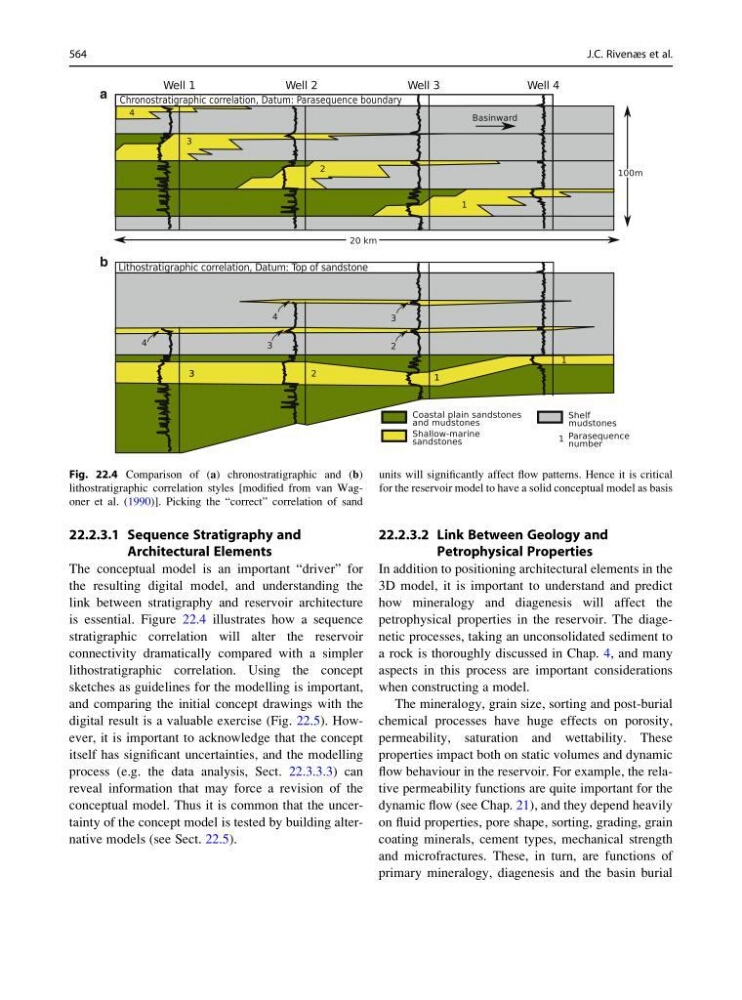
is essential. Figure 22.4 illustrates how a sequence
stratigraphic correlation will alter the reservoir
connectivity dramatically compared with a simpler
lithostratigraphic correlation. Using the concept
sketches as guidelines for the modelling is important,
and comparing the initial concept drawings with the
digital result is a valuable exercise (Fig. 22.5). However, it is important to acknowledge that the concept
itself has significant uncertainties, and the modelling
process (e.g. the data analysis, Sect. 22.3.3.3) can
reveal information that may force a revision of the
conceptual model. Thus it is common that the uncertainty of the concept model is tested by building alternative models (see Sect. 22.5).
22.2.3.2 Link Between Geology and
Petrophysical Properties
In addition to positioning architectural elements in the
3D model, it is important to understand and predict
how mineralogy and diagenesis will affect the
petrophysical properties in the reservoir. The diagenetic processes, taking an unconsolidated sediment to
a rock is thoroughly discussed in Chap. 4, and many
aspects in this process are important considerations
when constructing a model.
The mineralogy, grain size, sorting and post-burial
chemical processes have huge effects on porosity,
permeability, saturation and wettability. These
properties impact both on static volumes and dynamic
flow behaviour in the reservoir. For example, the relative permeability functions are quite important for the
dynamic flow (see Chap. 21), and they depend heavily
on fluid properties, pore shape, sorting, grading, grain
coating minerals, cement types, mechanical strength
and microfractures. These, in turn, are functions of
primary mineralogy, diagenesis and the basin burial
a
b
Fig. 22.4 Comparison of (a) chronostratigraphic and (b)
lithostratigraphic correlation styles [modified from van Wagoner et al. (1990)]. Picking the “correct” correlation of sand
units will significantly affect flow patterns. Hence it is critical
for the reservoir model to have a solid conceptual model as basis
564
J.C. Rivenæs et al.
Architectural Elements
The conceptual model is an important “driver” for
the resulting digital model, and understanding the
link between stratigraphy and reservoir architecture
is essential. Figure 22.4 illustrates how a sequence
stratigraphic correlation will alter the reservoir
connectivity dramatically compared with a simpler
lithostratigraphic correlation. Using the concept
sketches as guidelines for the modelling is important,
and comparing the initial concept drawings with the
digital result is a valuable exercise (Fig. 22.5). However, it is important to acknowledge that the concept
itself has significant uncertainties, and the modelling
process (e.g. the data analysis, Sect. 22.3.3.3) can
reveal information that may force a revision of the
conceptual model. Thus it is common that the uncertainty of the concept model is tested by building alternative models (see Sect. 22.5).
22.2.3.2 Link Between Geology and
Petrophysical Properties
In addition to positioning architectural elements in the
3D model, it is important to understand and predict
how mineralogy and diagenesis will affect the
petrophysical properties in the reservoir. The diagenetic processes, taking an unconsolidated sediment to
a rock is thoroughly discussed in Chap. 4, and many
aspects in this process are important considerations
when constructing a model.
The mineralogy, grain size, sorting and post-burial
chemical processes have huge effects on porosity,
permeability, saturation and wettability. These
properties impact both on static volumes and dynamic
flow behaviour in the reservoir. For example, the relative permeability functions are quite important for the
dynamic flow (see Chap. 21), and they depend heavily
on fluid properties, pore shape, sorting, grading, grain
coating minerals, cement types, mechanical strength
and microfractures. These, in turn, are functions of
primary mineralogy, diagenesis and the basin burial
a
b
Fig. 22.4 Comparison of (a) chronostratigraphic and (b)
lithostratigraphic correlation styles [modified from van Wagoner et al. (1990)]. Picking the “correct” correlation of sand
units will significantly affect flow patterns. Hence it is critical
for the reservoir model to have a solid conceptual model as basis
564
J.C. Rivenæs et al.