

Note that fine sand (about 0.1 mm) is the easiest
sediment to erode. On the other hand, finer-grained
particles remain in suspension for a long time at low
velocities. Flocculation of small clay particles to form
larger ones in seawater increases the settling velocity
of clays. Also “pelletisation”, through clay being eaten
by organisms, is important for the formation of many
fine-grained clay sediments.
2.10 Different Types of Sediment
Transport
We have shown that water or air flowing over a surface
exerts shear forces on the substratum so that sediment
can be transported by what we refer to as traction
currents. When we have a relatively low concentration
of sediment in water (or air) there is little increase in
the density and viscosity of the fluid phase. The flow
will then still have approximately the same
characteristics as it had without the sediment.
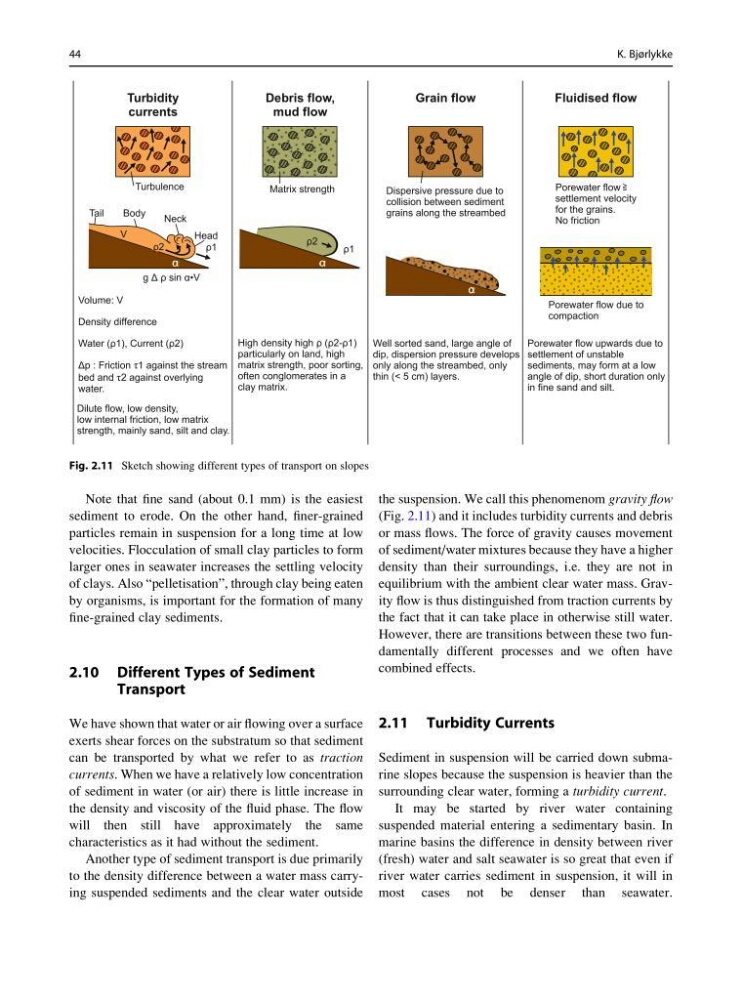
Another type of sediment transport is due primarily
to the density difference between a water mass carrying suspended sediments and the clear water outside
the suspension. We call this phenomenom gravity flow
(Fig. 2.11) and it includes turbidity currents and debris
or mass flows. The force of gravity causes movement
of sediment/water mixtures because they have a higher
density than their surroundings, i.e. they are not in
equilibrium with the ambient clear water mass. Gravity flow is thus distinguished from traction currents by
the fact that it can take place in otherwise still water.
However, there are transitions between these two fundamentally different processes and we often have
combined effects.
2.11 Turbidity Currents
Sediment in suspension will be carried down submarine slopes because the suspension is heavier than the
surrounding clear water, forming a turbidity current.
It may be started by river water containing
suspended material entering a sedimentary basin. In
marine basins the difference in density between river
(fresh) water and salt seawater is so great that even if
river water carries sediment in suspension, it will in
most cases not be denser than seawater.
Turbidity
currents
ρ
ρ
Δ
τ
τ
Debris flow,
mud flow
Grain flow
Fluidised flow
ρ ρ ρ
ρ
ρ
α
Δ ρ
α•
ρ
ρ
α
α
Fig. 2.11 Sketch showing different types of transport on slopes
44
K. Bjørlykke
sediment to erode. On the other hand, finer-grained
particles remain in suspension for a long time at low
velocities. Flocculation of small clay particles to form
larger ones in seawater increases the settling velocity
of clays. Also “pelletisation”, through clay being eaten
by organisms, is important for the formation of many
fine-grained clay sediments.
2.10 Different Types of Sediment
Transport
We have shown that water or air flowing over a surface
exerts shear forces on the substratum so that sediment
can be transported by what we refer to as traction
currents. When we have a relatively low concentration
of sediment in water (or air) there is little increase in
the density and viscosity of the fluid phase. The flow
will then still have approximately the same
characteristics as it had without the sediment.
Another type of sediment transport is due primarily
to the density difference between a water mass carrying suspended sediments and the clear water outside
the suspension. We call this phenomenom gravity flow
(Fig. 2.11) and it includes turbidity currents and debris
or mass flows. The force of gravity causes movement
of sediment/water mixtures because they have a higher
density than their surroundings, i.e. they are not in
equilibrium with the ambient clear water mass. Gravity flow is thus distinguished from traction currents by
the fact that it can take place in otherwise still water.
However, there are transitions between these two fundamentally different processes and we often have
combined effects.
2.11 Turbidity Currents
Sediment in suspension will be carried down submarine slopes because the suspension is heavier than the
surrounding clear water, forming a turbidity current.
It may be started by river water containing
suspended material entering a sedimentary basin. In
marine basins the difference in density between river
(fresh) water and salt seawater is so great that even if
river water carries sediment in suspension, it will in
most cases not be denser than seawater.
Turbidity
currents
ρ
ρ
Δ
τ
τ
Debris flow,
mud flow
Grain flow
Fluidised flow
ρ ρ ρ
ρ
ρ
α
Δ ρ
α•
ρ
ρ
α
α
Fig. 2.11 Sketch showing different types of transport on slopes
44
K. Bjørlykke