

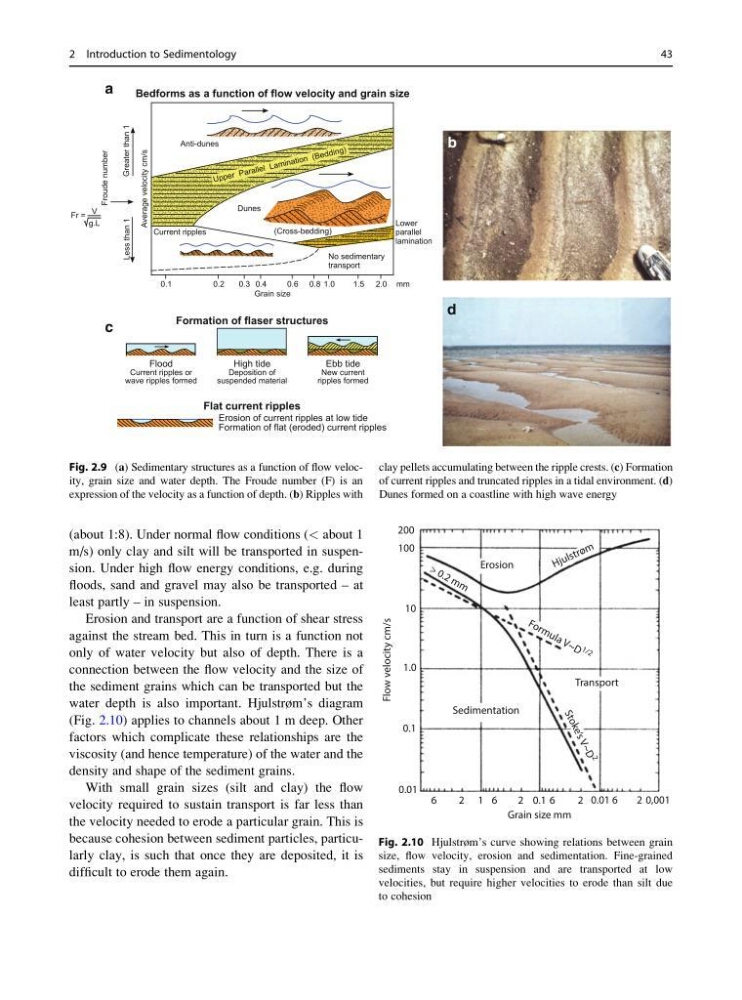
(about 1:8). Under normal flow conditions (< about 1
m/s) only clay and silt will be transported in suspension. Under high flow energy conditions, e.g. during
floods, sand and gravel may also be transported – at
least partly – in suspension.
Erosion and transport are a function of shear stress
against the stream bed. This in turn is a function not
only of water velocity but also of depth. There is a
connection between the flow velocity and the size of
the sediment grains which can be transported but the
water depth is also important. Hjulstrøm’s diagram
(Fig. 2.10) applies to channels about 1 m deep. Other
factors which complicate these relationships are the
viscosity (and hence temperature) of the water and the
density and shape of the sediment grains.
With small grain sizes (silt and clay) the flow
velocity required to sustain transport is far less than
the velocity needed to erode a particular grain. This is
because cohesion between sediment particles, particularly clay, is such that once they are deposited, it is
difficult to erode them again.
b
c
d
a
Current ripples
No sedimentary
transport
Dunes
(Cross-bedding)
Anti-dunes
Up pe r Pa ra lle l La m in at io n (B ed di ng )
Lower
parallel
lamination
0.1
0.2
0.3 0.4
0.6 0.8 1.0
1.5 2.0 mm
Grain size
Froude number
Greater than 1
Less than 1
Average velocity cm/s
V
g.L
Fr =
Bedforms as a function of flow velocity and grain size
Formation of flaser structures
Flood
Current ripples or
wave ripples formed
High tide
Deposition of
suspended material
Ebb tide
New current
ripples formed
Erosion of current ripples at low tide
Formation of flat (eroded) current ripples
Flat current ripples
Fig. 2.9 (a) Sedimentary structures as a function of flow velocity, grain size and water depth. The Froude number (F) is an
expression of the velocity as a function of depth. (b) Ripples with
clay pellets accumulating between the ripple crests. (c) Formation
of current ripples and truncated ripples in a tidal environment. (d)
Dunes formed on a coastline with high wave energy
200
100
10
1.0
0.1
0.01
Flow velocity cm/s
6
1 6
2 0.1 6
2 0.01 6
2 0,001
2
Grain size mm
Sedimentation
Transport
Erosion
H ju ls t r ø m
F o r m u la V ~ D 1 / 2
> 0 .2 m m
S
t
o
k
e
’s
V
~
D
2
Fig. 2.10 Hjulstrøm’s curve showing relations between grain
size, flow velocity, erosion and sedimentation. Fine-grained
sediments stay in suspension and are transported at low
velocities, but require higher velocities to erode than silt due
to cohesion
2 Introduction to Sedimentology
43
m/s) only clay and silt will be transported in suspension. Under high flow energy conditions, e.g. during
floods, sand and gravel may also be transported – at
least partly – in suspension.
Erosion and transport are a function of shear stress
against the stream bed. This in turn is a function not
only of water velocity but also of depth. There is a
connection between the flow velocity and the size of
the sediment grains which can be transported but the
water depth is also important. Hjulstrøm’s diagram
(Fig. 2.10) applies to channels about 1 m deep. Other
factors which complicate these relationships are the
viscosity (and hence temperature) of the water and the
density and shape of the sediment grains.
With small grain sizes (silt and clay) the flow
velocity required to sustain transport is far less than
the velocity needed to erode a particular grain. This is
because cohesion between sediment particles, particularly clay, is such that once they are deposited, it is
difficult to erode them again.
b
c
d
a
Current ripples
No sedimentary
transport
Dunes
(Cross-bedding)
Anti-dunes
Up pe r Pa ra lle l La m in at io n (B ed di ng )
Lower
parallel
lamination
0.1
0.2
0.3 0.4
0.6 0.8 1.0
1.5 2.0 mm
Grain size
Froude number
Greater than 1
Less than 1
Average velocity cm/s
V
g.L
Fr =
Bedforms as a function of flow velocity and grain size
Formation of flaser structures
Flood
Current ripples or
wave ripples formed
High tide
Deposition of
suspended material
Ebb tide
New current
ripples formed
Erosion of current ripples at low tide
Formation of flat (eroded) current ripples
Flat current ripples
Fig. 2.9 (a) Sedimentary structures as a function of flow velocity, grain size and water depth. The Froude number (F) is an
expression of the velocity as a function of depth. (b) Ripples with
clay pellets accumulating between the ripple crests. (c) Formation
of current ripples and truncated ripples in a tidal environment. (d)
Dunes formed on a coastline with high wave energy
200
100
10
1.0
0.1
0.01
Flow velocity cm/s
6
1 6
2 0.1 6
2 0.01 6
2 0,001
2
Grain size mm
Sedimentation
Transport
Erosion
H ju ls t r ø m
F o r m u la V ~ D 1 / 2
> 0 .2 m m
S
t
o
k
e
’s
V
~
D
2
Fig. 2.10 Hjulstrøm’s curve showing relations between grain
size, flow velocity, erosion and sedimentation. Fine-grained
sediments stay in suspension and are transported at low
velocities, but require higher velocities to erode than silt due
to cohesion
2 Introduction to Sedimentology
43