

some metres (1–50 m), depending on how strong the
waves are (and consequently the depth of the wave
base), we will have poorer sorted deposits because the
fine fractions will be deposited and mixed with
coarser-grained sediments which are carried out during storms.
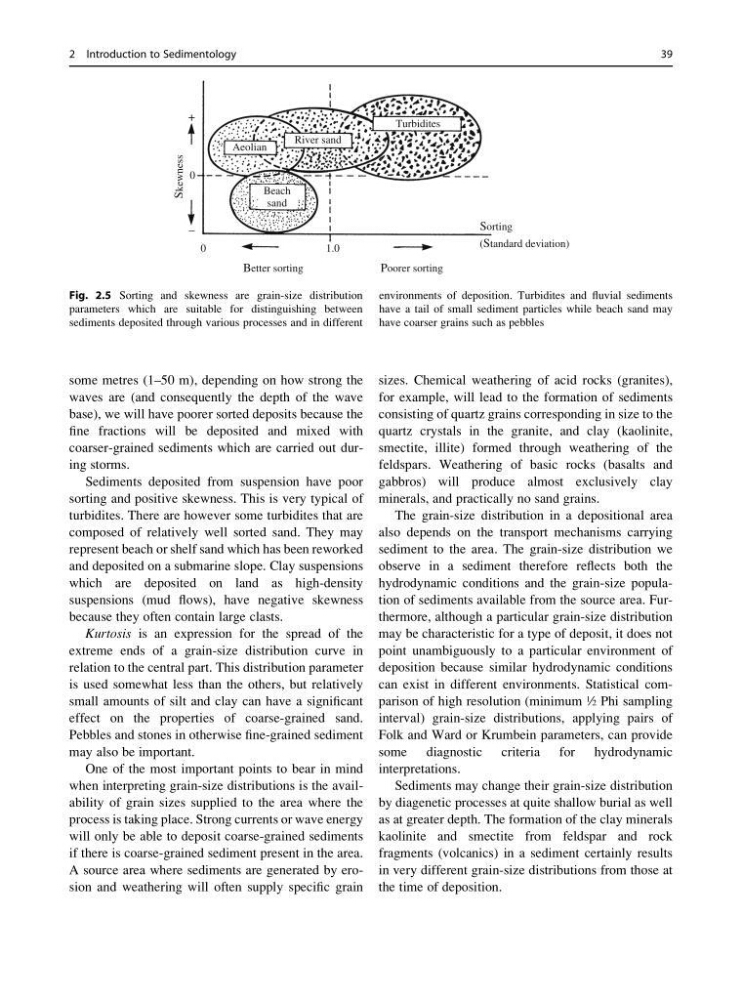
Sediments deposited from suspension have poor
sorting and positive skewness. This is very typical of
turbidites. There are however some turbidites that are
composed of relatively well sorted sand. They may
represent beach or shelf sand which has been reworked
and deposited on a submarine slope. Clay suspensions
which are deposited on land as high-density
suspensions (mud flows), have negative skewness
because they often contain large clasts.
Kurtosis is an expression for the spread of the
extreme ends of a grain-size distribution curve in
relation to the central part. This distribution parameter
is used somewhat less than the others, but relatively
small amounts of silt and clay can have a significant
effect on the properties of coarse-grained sand.
Pebbles and stones in otherwise fine-grained sediment
may also be important.
One of the most important points to bear in mind
when interpreting grain-size distributions is the availability of grain sizes supplied to the area where the
process is taking place. Strong currents or wave energy
will only be able to deposit coarse-grained sediments
if there is coarse-grained sediment present in the area.
A source area where sediments are generated by erosion and weathering will often supply specific grain
sizes. Chemical weathering of acid rocks (granites),
for example, will lead to the formation of sediments
consisting of quartz grains corresponding in size to the
quartz crystals in the granite, and clay (kaolinite,
smectite, illite) formed through weathering of the
feldspars. Weathering of basic rocks (basalts and
gabbros) will produce almost exclusively clay
minerals, and practically no sand grains.
The grain-size distribution in a depositional area
also depends on the transport mechanisms carrying
sediment to the area. The grain-size distribution we
observe in a sediment therefore reflects both the
hydrodynamic conditions and the grain-size population of sediments available from the source area. Furthermore, although a particular grain-size distribution
may be characteristic for a type of deposit, it does not
point unambiguously to a particular environment of
deposition because similar hydrodynamic conditions
can exist in different environments. Statistical comparison of high resolution (minimum ½ Phi sampling
interval) grain-size distributions, applying pairs of
Folk and Ward or Krumbein parameters, can provide
some diagnostic criteria for hydrodynamic
interpretations.
Sediments may change their grain-size distribution
by diagenetic processes at quite shallow burial as well
as at greater depth. The formation of the clay minerals
kaolinite and smectite from feldspar and rock
fragments (volcanics) in a sediment certainly results
in very different grain-size distributions from those at
the time of deposition.
0
0
1.0
Sorting
(Standard deviation)
Poorer sorting
Better sorting
Skewness
+
Aeolian
River sand
Turbidites
Beach
sand
–
Fig. 2.5 Sorting and skewness are grain-size distribution
parameters which are suitable for distinguishing between
sediments deposited through various processes and in different
environments of deposition. Turbidites and fluvial sediments
have a tail of small sediment particles while beach sand may
have coarser grains such as pebbles
2 Introduction to Sedimentology
39
waves are (and consequently the depth of the wave
base), we will have poorer sorted deposits because the
fine fractions will be deposited and mixed with
coarser-grained sediments which are carried out during storms.
Sediments deposited from suspension have poor
sorting and positive skewness. This is very typical of
turbidites. There are however some turbidites that are
composed of relatively well sorted sand. They may
represent beach or shelf sand which has been reworked
and deposited on a submarine slope. Clay suspensions
which are deposited on land as high-density
suspensions (mud flows), have negative skewness
because they often contain large clasts.
Kurtosis is an expression for the spread of the
extreme ends of a grain-size distribution curve in
relation to the central part. This distribution parameter
is used somewhat less than the others, but relatively
small amounts of silt and clay can have a significant
effect on the properties of coarse-grained sand.
Pebbles and stones in otherwise fine-grained sediment
may also be important.
One of the most important points to bear in mind
when interpreting grain-size distributions is the availability of grain sizes supplied to the area where the
process is taking place. Strong currents or wave energy
will only be able to deposit coarse-grained sediments
if there is coarse-grained sediment present in the area.
A source area where sediments are generated by erosion and weathering will often supply specific grain
sizes. Chemical weathering of acid rocks (granites),
for example, will lead to the formation of sediments
consisting of quartz grains corresponding in size to the
quartz crystals in the granite, and clay (kaolinite,
smectite, illite) formed through weathering of the
feldspars. Weathering of basic rocks (basalts and
gabbros) will produce almost exclusively clay
minerals, and practically no sand grains.
The grain-size distribution in a depositional area
also depends on the transport mechanisms carrying
sediment to the area. The grain-size distribution we
observe in a sediment therefore reflects both the
hydrodynamic conditions and the grain-size population of sediments available from the source area. Furthermore, although a particular grain-size distribution
may be characteristic for a type of deposit, it does not
point unambiguously to a particular environment of
deposition because similar hydrodynamic conditions
can exist in different environments. Statistical comparison of high resolution (minimum ½ Phi sampling
interval) grain-size distributions, applying pairs of
Folk and Ward or Krumbein parameters, can provide
some diagnostic criteria for hydrodynamic
interpretations.
Sediments may change their grain-size distribution
by diagenetic processes at quite shallow burial as well
as at greater depth. The formation of the clay minerals
kaolinite and smectite from feldspar and rock
fragments (volcanics) in a sediment certainly results
in very different grain-size distributions from those at
the time of deposition.
0
0
1.0
Sorting
(Standard deviation)
Poorer sorting
Better sorting
Skewness
+
Aeolian
River sand
Turbidites
Beach
sand
–
Fig. 2.5 Sorting and skewness are grain-size distribution
parameters which are suitable for distinguishing between
sediments deposited through various processes and in different
environments of deposition. Turbidites and fluvial sediments
have a tail of small sediment particles while beach sand may
have coarser grains such as pebbles
2 Introduction to Sedimentology
39