

where T(X) is the two-way travel time for a seismic
event, X is the actual source-receiver offset distance, V
is the NMO or stacking velocity for this reflection event
and T(0) is the two-way travel time for zero offset. A
sample-by-sample velocity is built at each of the
locations where time-velocity pairs are defined. For
any point before the first velocity location or beyond
the last location, the first or last velocity function is
used. Once the correct velocity function has been
interpolated, the exact moveout at each sample is
computed based on the actual source-to-receiver offset
and velocity at that time sample. NMO stretch is a
fundamental and long-standing problem in seismic
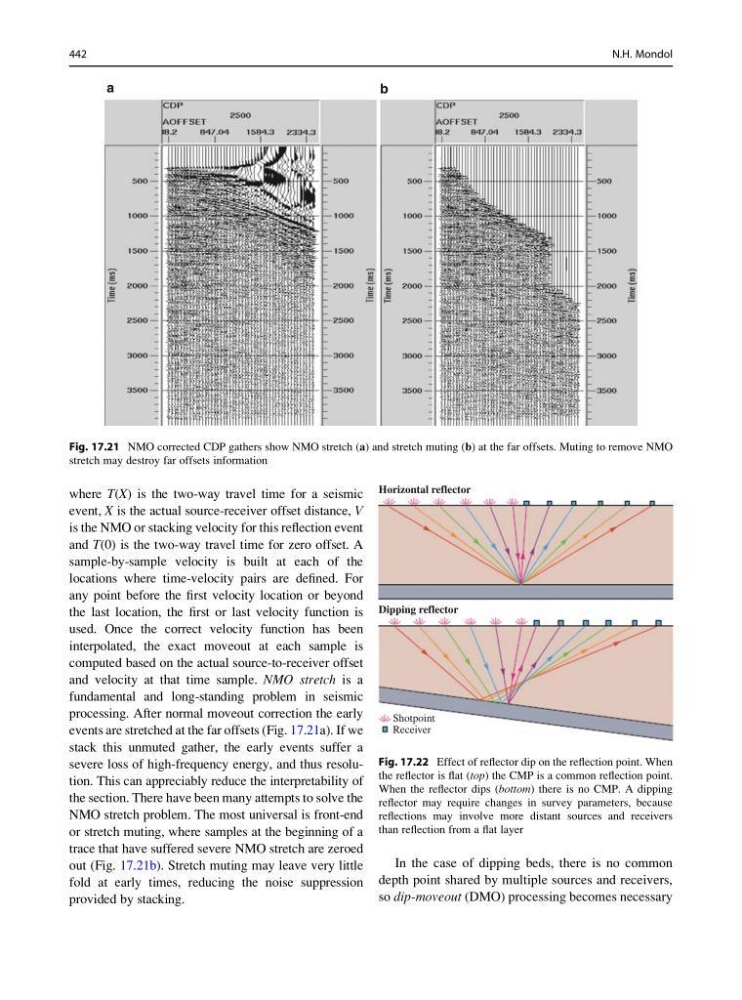
processing. After normal moveout correction the early
events are stretched at the far offsets (Fig. 17.21a). If we
stack this unmuted gather, the early events suffer a
severe loss of high-frequency energy, and thus resolution. This can appreciably reduce the interpretability of
the section. There have been many attempts to solve the
NMO stretch problem. The most universal is front-end
or stretch muting, where samples at the beginning of a
trace that have suffered severe NMO stretch are zeroed
out (Fig. 17.21b). Stretch muting may leave very little
fold at early times, reducing the noise suppression
provided by stacking.
In the case of dipping beds, there is no common
depth point shared by multiple sources and receivers,
so dip-moveout (DMO) processing becomes necessary
a
b
Fig. 17.21 NMO corrected CDP gathers show NMO stretch (a) and stretch muting (b) at the far offsets. Muting to remove NMO
stretch may destroy far offsets information
Shotpoint
Receiver
Dipping reflector
Horizontal reflector
Fig. 17.22 Effect of reflector dip on the reflection point. When
the reflector is flat (top) the CMP is a common reflection point.
When the reflector dips (bottom) there is no CMP. A dipping
reflector may require changes in survey parameters, because
reflections may involve more distant sources and receivers
than reflection from a flat layer
442
N.H. Mondol
event, X is the actual source-receiver offset distance, V
is the NMO or stacking velocity for this reflection event
and T(0) is the two-way travel time for zero offset. A
sample-by-sample velocity is built at each of the
locations where time-velocity pairs are defined. For
any point before the first velocity location or beyond
the last location, the first or last velocity function is
used. Once the correct velocity function has been
interpolated, the exact moveout at each sample is
computed based on the actual source-to-receiver offset
and velocity at that time sample. NMO stretch is a
fundamental and long-standing problem in seismic
processing. After normal moveout correction the early
events are stretched at the far offsets (Fig. 17.21a). If we
stack this unmuted gather, the early events suffer a
severe loss of high-frequency energy, and thus resolution. This can appreciably reduce the interpretability of
the section. There have been many attempts to solve the
NMO stretch problem. The most universal is front-end
or stretch muting, where samples at the beginning of a
trace that have suffered severe NMO stretch are zeroed
out (Fig. 17.21b). Stretch muting may leave very little
fold at early times, reducing the noise suppression
provided by stacking.
In the case of dipping beds, there is no common
depth point shared by multiple sources and receivers,
so dip-moveout (DMO) processing becomes necessary
a
b
Fig. 17.21 NMO corrected CDP gathers show NMO stretch (a) and stretch muting (b) at the far offsets. Muting to remove NMO
stretch may destroy far offsets information
Shotpoint
Receiver
Dipping reflector
Horizontal reflector
Fig. 17.22 Effect of reflector dip on the reflection point. When
the reflector is flat (top) the CMP is a common reflection point.
When the reflector dips (bottom) there is no CMP. A dipping
reflector may require changes in survey parameters, because
reflections may involve more distant sources and receivers
than reflection from a flat layer
442
N.H. Mondol