

The following routines are generally applied to raw 2D
seismic data in different processing stages:
• True Amplitude Recovery (TAR)
• Autocorrelation
• CMP sorting
• Deconvolution
• Trace Muting
• Velocity picking or velocity analysis
• NMO correction
• DMO correction
• Filtering (F-K and Bandpass filtering)
• Stacking and
• Migration
In the processing stage, bad measurements are
edited, datuming applied and corrections of waveenergy decay introduced. The true amplitude recovery
is applied to increase the amplitude at large travel
times. The autocorrelation and deconvolution are
done to compress the wavelet and to attenuate
multiples. Deconvolution – a technique that can compress the source signature and eliminate multiples – is
applied after sorting the data into CMP gathers. The
trace muting is applied to get rid of unwanted energy.
Contributions from the direct waves and possible head
waves are removed by trace muting. NMO correction
and F-K filtering are usually applied to attenuate
Facility noise
Before DGF
A i r b l a s t
S u r f a c e w a v e s
H a r m o n i c e n e r g y
Re ve rb era tin g en erg y
Vehicle
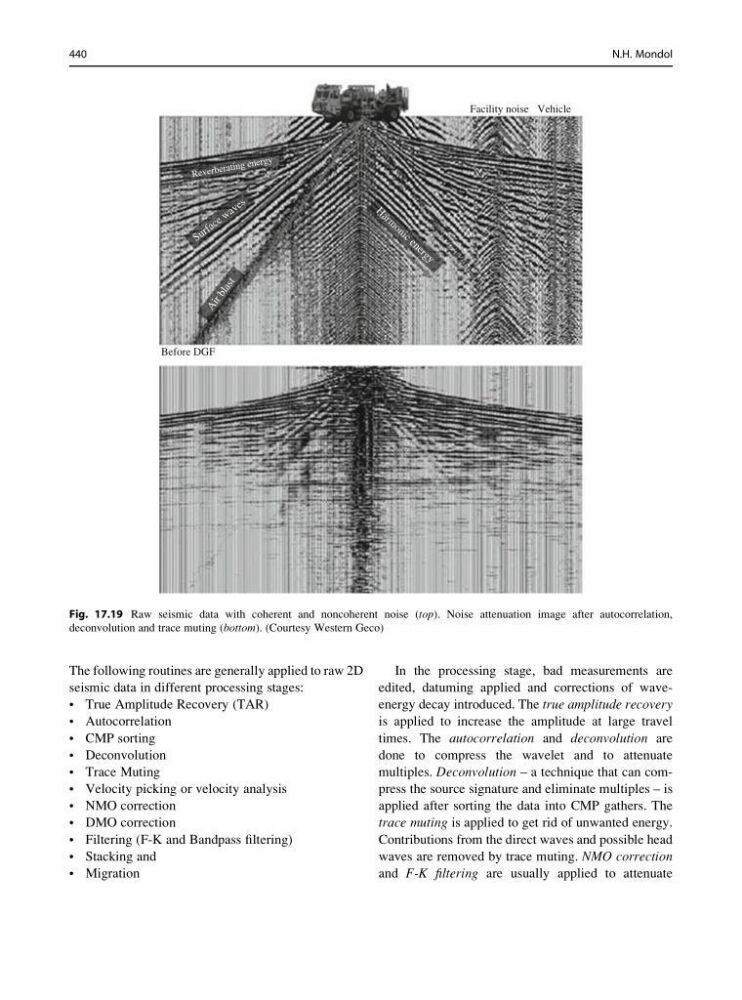
Fig. 17.19 Raw seismic data with coherent and noncoherent noise (top). Noise attenuation image after autocorrelation,
deconvolution and trace muting (bottom). (Courtesy Western Geco)
440
N.H. Mondol
seismic data in different processing stages:
• True Amplitude Recovery (TAR)
• Autocorrelation
• CMP sorting
• Deconvolution
• Trace Muting
• Velocity picking or velocity analysis
• NMO correction
• DMO correction
• Filtering (F-K and Bandpass filtering)
• Stacking and
• Migration
In the processing stage, bad measurements are
edited, datuming applied and corrections of waveenergy decay introduced. The true amplitude recovery
is applied to increase the amplitude at large travel
times. The autocorrelation and deconvolution are
done to compress the wavelet and to attenuate
multiples. Deconvolution – a technique that can compress the source signature and eliminate multiples – is
applied after sorting the data into CMP gathers. The
trace muting is applied to get rid of unwanted energy.
Contributions from the direct waves and possible head
waves are removed by trace muting. NMO correction
and F-K filtering are usually applied to attenuate
Facility noise
Before DGF
A i r b l a s t
S u r f a c e w a v e s
H a r m o n i c e n e r g y
Re ve rb era tin g en erg y
Vehicle
Fig. 17.19 Raw seismic data with coherent and noncoherent noise (top). Noise attenuation image after autocorrelation,
deconvolution and trace muting (bottom). (Courtesy Western Geco)
440
N.H. Mondol