

outward in all directions from the source and travel
through the interior of the Earth and have great significance in seismic exploration. P-waves move faster
than S-waves. The P-wave is a longitudinal wave,
the force applied in the direction that the P-wave is
travelling. The ground must move in that direction.
The ground or Earth is incompressible, so the energy is
transferred pretty quickly. In the S-wave, the medium
is displaced in a transverse way (up and down –
compared to the line of travel), and the medium must
move away from the material right next to it to cause
the shear and transmit the wave. This takes more time,
which is why the S-wave moves more slowly than the
P-wave in seismic events. S-waves do not travel
through fluids as fluid has no shearing capacity.
The basic principle of seismic survey is to initiate a
seismic pulse from a seismic source at or near the
Earth’s surface and record the amplitudes and travel
Time (s)
Fig. 17.1 Subsurface imaging by 2D (left) and 3D (right) seismic reflection data
R a y le ig h w a v e
Pa rti cl e m ot io n
Pa rti cl e m ot io n
P w a v e
Pa rti cl e m ot io n
S w a v e
Pa rti cl e m ot io n
L o v e w a v e
D ire ct io n of pr op ag at io n
D ire ct io n of pr op ag at io n
D ire ct io n of pr op ag at io n
D ire ct io n of pr op ag at io n
X
X
Z
Y
X
Z
Y
X
Z
Y
Y
Z
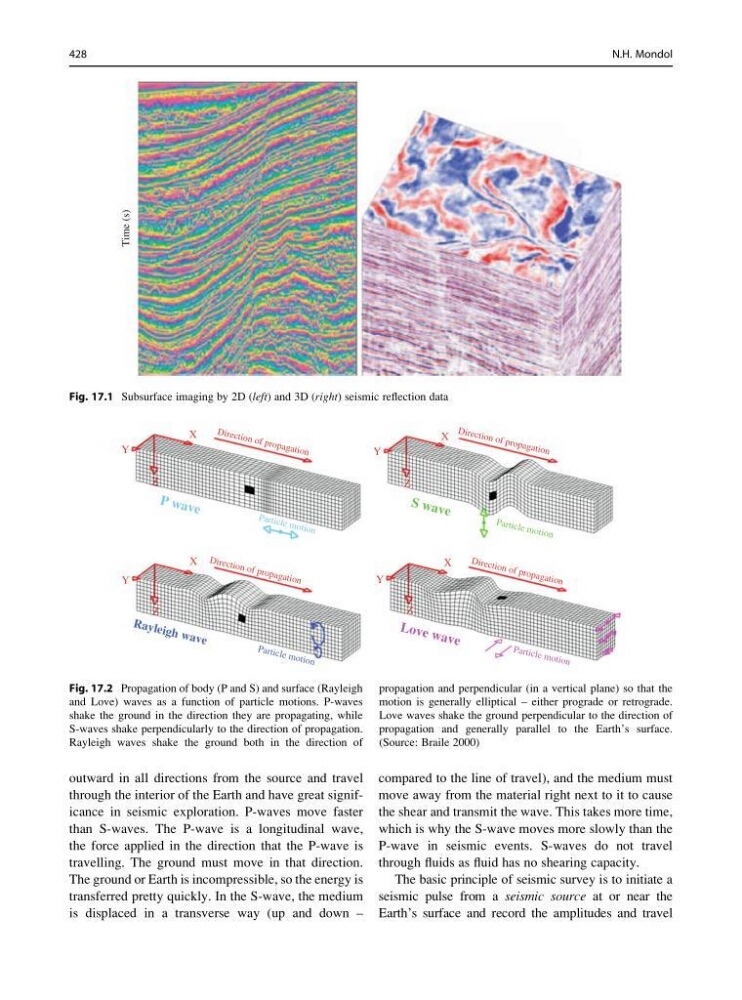
Fig. 17.2 Propagation of body (P and S) and surface (Rayleigh
and Love) waves as a function of particle motions. P-waves
shake the ground in the direction they are propagating, while
S-waves shake perpendicularly to the direction of propagation.
Rayleigh waves shake the ground both in the direction of
propagation and perpendicular (in a vertical plane) so that the
motion is generally elliptical – either prograde or retrograde.
Love waves shake the ground perpendicular to the direction of
propagation and generally parallel to the Earth’s surface.
(Source: Braile 2000)
428
N.H. Mondol
through the interior of the Earth and have great significance in seismic exploration. P-waves move faster
than S-waves. The P-wave is a longitudinal wave,
the force applied in the direction that the P-wave is
travelling. The ground must move in that direction.
The ground or Earth is incompressible, so the energy is
transferred pretty quickly. In the S-wave, the medium
is displaced in a transverse way (up and down –
compared to the line of travel), and the medium must
move away from the material right next to it to cause
the shear and transmit the wave. This takes more time,
which is why the S-wave moves more slowly than the
P-wave in seismic events. S-waves do not travel
through fluids as fluid has no shearing capacity.
The basic principle of seismic survey is to initiate a
seismic pulse from a seismic source at or near the
Earth’s surface and record the amplitudes and travel
Time (s)
Fig. 17.1 Subsurface imaging by 2D (left) and 3D (right) seismic reflection data
R a y le ig h w a v e
Pa rti cl e m ot io n
Pa rti cl e m ot io n
P w a v e
Pa rti cl e m ot io n
S w a v e
Pa rti cl e m ot io n
L o v e w a v e
D ire ct io n of pr op ag at io n
D ire ct io n of pr op ag at io n
D ire ct io n of pr op ag at io n
D ire ct io n of pr op ag at io n
X
X
Z
Y
X
Z
Y
X
Z
Y
Y
Z
Fig. 17.2 Propagation of body (P and S) and surface (Rayleigh
and Love) waves as a function of particle motions. P-waves
shake the ground in the direction they are propagating, while
S-waves shake perpendicularly to the direction of propagation.
Rayleigh waves shake the ground both in the direction of
propagation and perpendicular (in a vertical plane) so that the
motion is generally elliptical – either prograde or retrograde.
Love waves shake the ground perpendicular to the direction of
propagation and generally parallel to the Earth’s surface.
(Source: Braile 2000)
428
N.H. Mondol