

the capillary forces are a function of the wetting angle
and the pore size, and the buoyancy forces are a
function of the density of the petroleum and the thickness of the petroleum column. A shale may then be
able to hold a limited thickness of oil or gas column in
the reservoir (Schowalter 1979). There is nevertheless
considerable evidence that fine-grained shales buried
to 3–4 km have more than enough capillary force to
hold several hundred metres of oil column. In the case
of gas the density is lower, producing higher buoyancy, but the interfacial tension is also higher. Gas
may also to a much larger extent be dissolved in the
water phase and diffuse through the cap rock.
It may seem natural to assume that the extra pressure due to the buoyancy of the petroleum may be
critical with respect to the fracturing because the fracture pressure then is reached earlier. However, the
extra pressure of the petroleum column is balanced
by the capillary forces and does not change the water
pressure critical for reaching fracture pressure
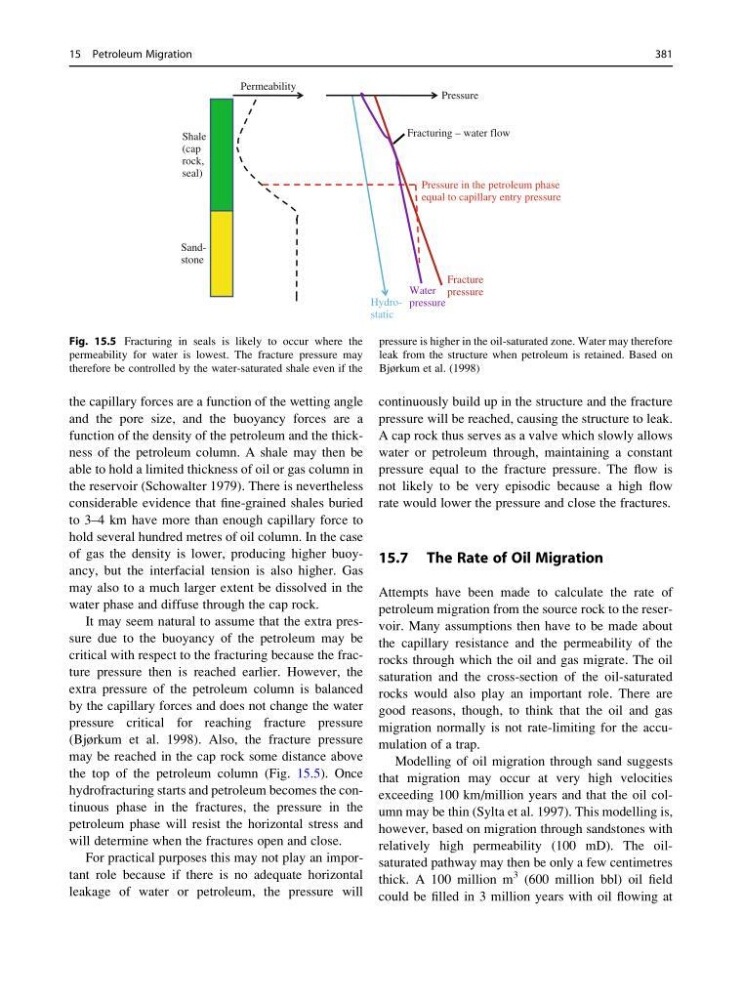
(Bjørkum et al. 1998). Also, the fracture pressure
may be reached in the cap rock some distance above
the top of the petroleum column (Fig. 15.5). Once
hydrofracturing starts and petroleum becomes the continuous phase in the fractures, the pressure in the
petroleum phase will resist the horizontal stress and
will determine when the fractures open and close.
For practical purposes this may not play an important role because if there is no adequate horizontal
leakage of water or petroleum, the pressure will
continuously build up in the structure and the fracture
pressure will be reached, causing the structure to leak.
A cap rock thus serves as a valve which slowly allows
water or petroleum through, maintaining a constant
pressure equal to the fracture pressure. The flow is
not likely to be very episodic because a high flow
rate would lower the pressure and close the fractures.
15.7 The Rate of Oil Migration
Attempts have been made to calculate the rate of
petroleum migration from the source rock to the reservoir. Many assumptions then have to be made about
the capillary resistance and the permeability of the
rocks through which the oil and gas migrate. The oil
saturation and the cross-section of the oil-saturated
rocks would also play an important role. There are
good reasons, though, to think that the oil and gas
migration normally is not rate-limiting for the accumulation of a trap.
Modelling of oil migration through sand suggests
that migration may occur at very high velocities
exceeding 100 km/million years and that the oil column may be thin (Sylta et al. 1997). This modelling is,
however, based on migration through sandstones with
relatively high permeability (100 mD). The oilsaturated pathway may then be only a few centimetres
thick. A 100 million m
3 (600 million bbl) oil field
could be filled in 3 million years with oil flowing at
Sandstone
Shale
(cap
rock,
seal)
Pressure
Permeability
Pressure in the petroleum phase
equal to capillary entry pressure
Hydrostatic
Fracture
pressure
Water
pressure
Fracturing – water flow
Fig. 15.5 Fracturing in seals is likely to occur where the
permeability for water is lowest. The fracture pressure may
therefore be controlled by the water-saturated shale even if the
pressure is higher in the oil-saturated zone. Water may therefore
leak from the structure when petroleum is retained. Based on
Bjørkum et al. (1998)
15 Petroleum Migration
381
and the pore size, and the buoyancy forces are a
function of the density of the petroleum and the thickness of the petroleum column. A shale may then be
able to hold a limited thickness of oil or gas column in
the reservoir (Schowalter 1979). There is nevertheless
considerable evidence that fine-grained shales buried
to 3–4 km have more than enough capillary force to
hold several hundred metres of oil column. In the case
of gas the density is lower, producing higher buoyancy, but the interfacial tension is also higher. Gas
may also to a much larger extent be dissolved in the
water phase and diffuse through the cap rock.
It may seem natural to assume that the extra pressure due to the buoyancy of the petroleum may be
critical with respect to the fracturing because the fracture pressure then is reached earlier. However, the
extra pressure of the petroleum column is balanced
by the capillary forces and does not change the water
pressure critical for reaching fracture pressure
(Bjørkum et al. 1998). Also, the fracture pressure
may be reached in the cap rock some distance above
the top of the petroleum column (Fig. 15.5). Once
hydrofracturing starts and petroleum becomes the continuous phase in the fractures, the pressure in the
petroleum phase will resist the horizontal stress and
will determine when the fractures open and close.
For practical purposes this may not play an important role because if there is no adequate horizontal
leakage of water or petroleum, the pressure will
continuously build up in the structure and the fracture
pressure will be reached, causing the structure to leak.
A cap rock thus serves as a valve which slowly allows
water or petroleum through, maintaining a constant
pressure equal to the fracture pressure. The flow is
not likely to be very episodic because a high flow
rate would lower the pressure and close the fractures.
15.7 The Rate of Oil Migration
Attempts have been made to calculate the rate of
petroleum migration from the source rock to the reservoir. Many assumptions then have to be made about
the capillary resistance and the permeability of the
rocks through which the oil and gas migrate. The oil
saturation and the cross-section of the oil-saturated
rocks would also play an important role. There are
good reasons, though, to think that the oil and gas
migration normally is not rate-limiting for the accumulation of a trap.
Modelling of oil migration through sand suggests
that migration may occur at very high velocities
exceeding 100 km/million years and that the oil column may be thin (Sylta et al. 1997). This modelling is,
however, based on migration through sandstones with
relatively high permeability (100 mD). The oilsaturated pathway may then be only a few centimetres
thick. A 100 million m
3 (600 million bbl) oil field
could be filled in 3 million years with oil flowing at
Sandstone
Shale
(cap
rock,
seal)
Pressure
Permeability
Pressure in the petroleum phase
equal to capillary entry pressure
Hydrostatic
Fracture
pressure
Water
pressure
Fracturing – water flow
Fig. 15.5 Fracturing in seals is likely to occur where the
permeability for water is lowest. The fracture pressure may
therefore be controlled by the water-saturated shale even if the
pressure is higher in the oil-saturated zone. Water may therefore
leak from the structure when petroleum is retained. Based on
Bjørkum et al. (1998)
15 Petroleum Migration
381