

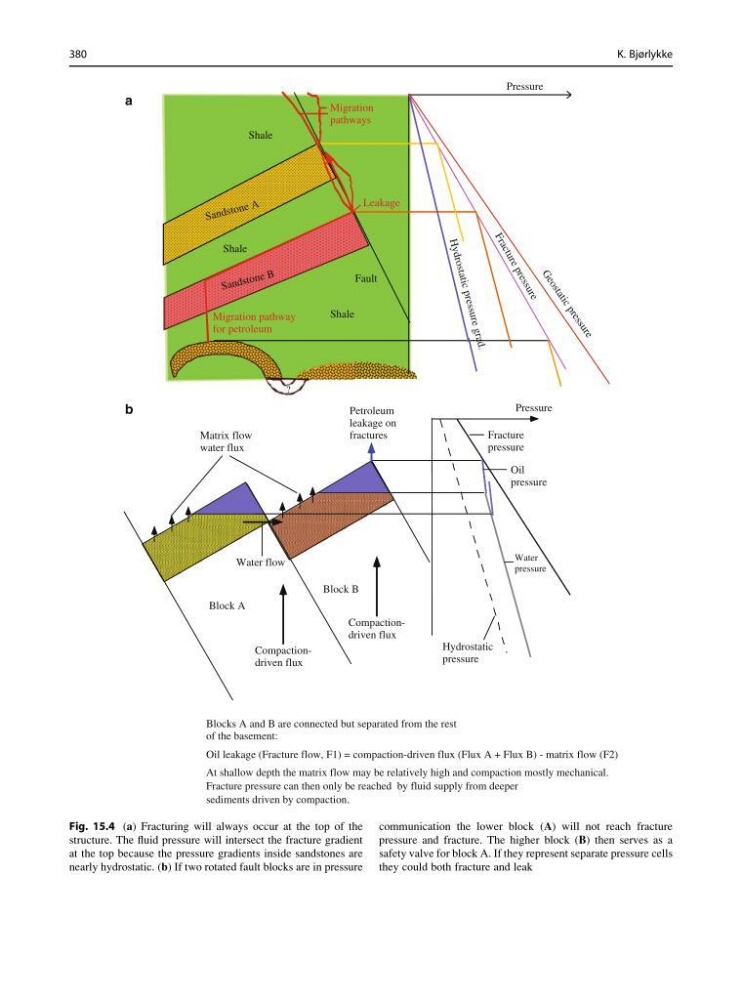
Blocks A and B are connected but separated from the rest
of the basement:
Oil leakage (Fracture flow, F1) = compaction-driven flux (Flux A + Flux B) - matrix flow (F2)
?
Pressure
G e o s t a t i c p r e s s u r e
H y d ro st at ic p re ss u re g ra d .
Migration pathway
for petroleum
Migration
pathways
Leakage
Fault
F r a c t u r e p r e s s u r e
S an ds to ne A
S an ds to ne B
Shale
Shale
Shale
Fracture
pressure
Hydrostatic
pressure
Water flow
Water
pressure
Petroleum
leakage on
fractures
Block A
Block B
Matrix flow
water flux
Compactiondriven flux
Compactiondriven flux
Pressure
Oil
pressure
a
b
At shallow depth the matrix flow may be relatively high and compaction mostly mechanical.
Fracture pressure can then only be reached by fluid supply from deeper
sediments driven by compaction.
Fig. 15.4 (a) Fracturing will always occur at the top of the
structure. The fluid pressure will intersect the fracture gradient
at the top because the pressure gradients inside sandstones are
nearly hydrostatic. (b) If two rotated fault blocks are in pressure
communication the lower block (A) will not reach fracture
pressure and fracture. The higher block (B) then serves as a
safety valve for block A. If they represent separate pressure cells
they could both fracture and leak
380
K. Bjørlykke
of the basement:
Oil leakage (Fracture flow, F1) = compaction-driven flux (Flux A + Flux B) - matrix flow (F2)
?
Pressure
G e o s t a t i c p r e s s u r e
H y d ro st at ic p re ss u re g ra d .
Migration pathway
for petroleum
Migration
pathways
Leakage
Fault
F r a c t u r e p r e s s u r e
S an ds to ne A
S an ds to ne B
Shale
Shale
Shale
Fracture
pressure
Hydrostatic
pressure
Water flow
Water
pressure
Petroleum
leakage on
fractures
Block A
Block B
Matrix flow
water flux
Compactiondriven flux
Compactiondriven flux
Pressure
Oil
pressure
a
b
At shallow depth the matrix flow may be relatively high and compaction mostly mechanical.
Fracture pressure can then only be reached by fluid supply from deeper
sediments driven by compaction.
Fig. 15.4 (a) Fracturing will always occur at the top of the
structure. The fluid pressure will intersect the fracture gradient
at the top because the pressure gradients inside sandstones are
nearly hydrostatic. (b) If two rotated fault blocks are in pressure
communication the lower block (A) will not reach fracture
pressure and fracture. The higher block (B) then serves as a
safety valve for block A. If they represent separate pressure cells
they could both fracture and leak
380
K. Bjørlykke