

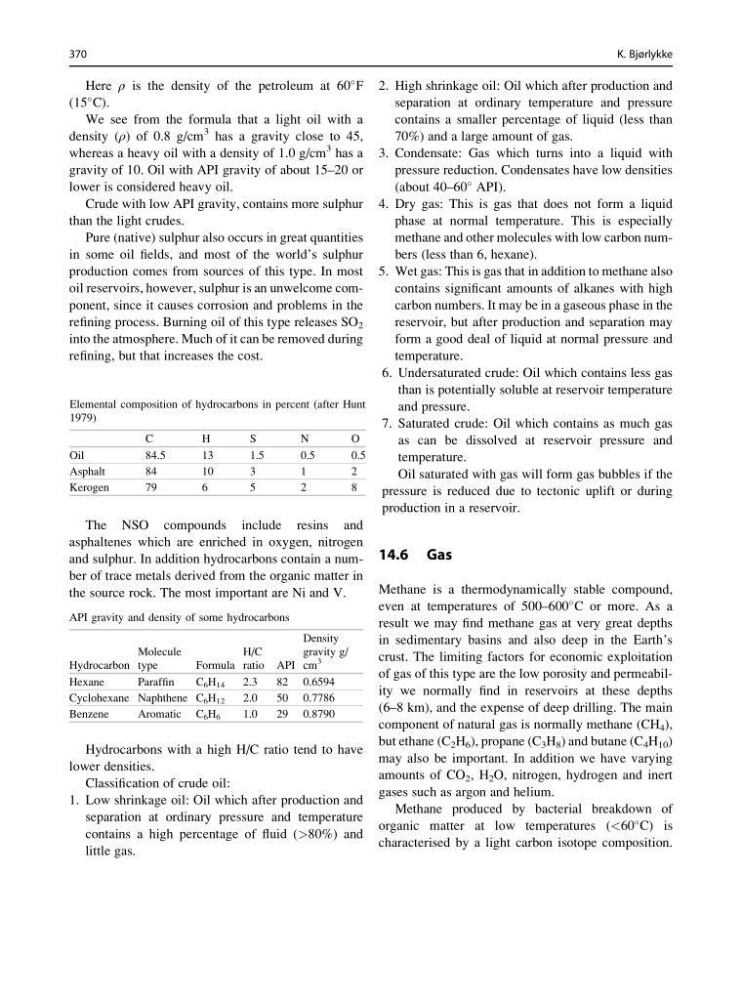
Here ρ is the density of the petroleum at 60
F
(15
C).
We see from the formula that a light oil with a
density (ρ) of 0.8 g/cm
3 has a gravity close to 45,
whereas a heavy oil with a density of 1.0 g/cm
3 has a
gravity of 10. Oil with API gravity of about 15–20 or
lower is considered heavy oil.
Crude with low API gravity, contains more sulphur
than the light crudes.
Pure (native) sulphur also occurs in great quantities
in some oil fields, and most of the world’s sulphur
production comes from sources of this type. In most
oil reservoirs, however, sulphur is an unwelcome component, since it causes corrosion and problems in the
refining process. Burning oil of this type releases SO 2
into the atmosphere. Much of it can be removed during
refining, but that increases the cost.
The NSO compounds include resins and
asphaltenes which are enriched in oxygen, nitrogen
and sulphur. In addition hydrocarbons contain a number of trace metals derived from the organic matter in
the source rock. The most important are Ni and V.
API gravity and density of some hydrocarbons
Hydrocarbon
Molecule
type
Formula
H/C
ratio API
Density
gravity g/
cm
3
Hexane
Paraffin
C 6 H 14
2.3
82 0.6594
Cyclohexane Naphthene C 6 H 12
2.0
50 0.7786
Benzene
Aromatic C 6 H 6
1.0
29 0.8790
Hydrocarbons with a high H/C ratio tend to have
lower densities.
Classification of crude oil:
1. Low shrinkage oil: Oil which after production and
separation at ordinary pressure and temperature
contains a high percentage of fluid (>80%) and
little gas.
2. High shrinkage oil: Oil which after production and
separation at ordinary temperature and pressure
contains a smaller percentage of liquid (less than
70%) and a large amount of gas.
3. Condensate: Gas which turns into a liquid with
pressure reduction. Condensates have low densities
(about 40–60
API).
4. Dry gas: This is gas that does not form a liquid
phase at normal temperature. This is especially
methane and other molecules with low carbon numbers (less than 6, hexane).
5. Wet gas: This is gas that in addition to methane also
contains significant amounts of alkanes with high
carbon numbers. It may be in a gaseous phase in the
reservoir, but after production and separation may
form a good deal of liquid at normal pressure and
temperature.
6. Undersaturated crude: Oil which contains less gas
than is potentially soluble at reservoir temperature
and pressure.
7. Saturated crude: Oil which contains as much gas
as can be dissolved at reservoir pressure and
temperature.
Oil saturated with gas will form gas bubbles if the
pressure is reduced due to tectonic uplift or during
production in a reservoir.
14.6 Gas
Methane is a thermodynamically stable compound,
even at temperatures of 500–600
C or more. As a
result we may find methane gas at very great depths
in sedimentary basins and also deep in the Earth’s
crust. The limiting factors for economic exploitation
of gas of this type are the low porosity and permeability we normally find in reservoirs at these depths
(6–8 km), and the expense of deep drilling. The main
component of natural gas is normally methane (CH 4 ),
but ethane (C 2 H 6 ), propane (C 3 H 8 ) and butane (C 4 H 10 )
may also be important. In addition we have varying
amounts of CO 2 , H 2 O, nitrogen, hydrogen and inert
gases such as argon and helium.
Methane produced by bacterial breakdown of
organic matter at low temperatures (<60
C) is
characterised by a light carbon isotope composition.
Elemental composition of hydrocarbons in percent (after Hunt
1979)
C
H
S
N
O
Oil
84.5
13
1.5
0.5
0.5
Asphalt
84
10
3
1
2
Kerogen
79
6
5
2
8
370
K. Bjørlykke
F
(15
C).
We see from the formula that a light oil with a
density (ρ) of 0.8 g/cm
3 has a gravity close to 45,
whereas a heavy oil with a density of 1.0 g/cm
3 has a
gravity of 10. Oil with API gravity of about 15–20 or
lower is considered heavy oil.
Crude with low API gravity, contains more sulphur
than the light crudes.
Pure (native) sulphur also occurs in great quantities
in some oil fields, and most of the world’s sulphur
production comes from sources of this type. In most
oil reservoirs, however, sulphur is an unwelcome component, since it causes corrosion and problems in the
refining process. Burning oil of this type releases SO 2
into the atmosphere. Much of it can be removed during
refining, but that increases the cost.
The NSO compounds include resins and
asphaltenes which are enriched in oxygen, nitrogen
and sulphur. In addition hydrocarbons contain a number of trace metals derived from the organic matter in
the source rock. The most important are Ni and V.
API gravity and density of some hydrocarbons
Hydrocarbon
Molecule
type
Formula
H/C
ratio API
Density
gravity g/
cm
3
Hexane
Paraffin
C 6 H 14
2.3
82 0.6594
Cyclohexane Naphthene C 6 H 12
2.0
50 0.7786
Benzene
Aromatic C 6 H 6
1.0
29 0.8790
Hydrocarbons with a high H/C ratio tend to have
lower densities.
Classification of crude oil:
1. Low shrinkage oil: Oil which after production and
separation at ordinary pressure and temperature
contains a high percentage of fluid (>80%) and
little gas.
2. High shrinkage oil: Oil which after production and
separation at ordinary temperature and pressure
contains a smaller percentage of liquid (less than
70%) and a large amount of gas.
3. Condensate: Gas which turns into a liquid with
pressure reduction. Condensates have low densities
(about 40–60
API).
4. Dry gas: This is gas that does not form a liquid
phase at normal temperature. This is especially
methane and other molecules with low carbon numbers (less than 6, hexane).
5. Wet gas: This is gas that in addition to methane also
contains significant amounts of alkanes with high
carbon numbers. It may be in a gaseous phase in the
reservoir, but after production and separation may
form a good deal of liquid at normal pressure and
temperature.
6. Undersaturated crude: Oil which contains less gas
than is potentially soluble at reservoir temperature
and pressure.
7. Saturated crude: Oil which contains as much gas
as can be dissolved at reservoir pressure and
temperature.
Oil saturated with gas will form gas bubbles if the
pressure is reduced due to tectonic uplift or during
production in a reservoir.
14.6 Gas
Methane is a thermodynamically stable compound,
even at temperatures of 500–600
C or more. As a
result we may find methane gas at very great depths
in sedimentary basins and also deep in the Earth’s
crust. The limiting factors for economic exploitation
of gas of this type are the low porosity and permeability we normally find in reservoirs at these depths
(6–8 km), and the expense of deep drilling. The main
component of natural gas is normally methane (CH 4 ),
but ethane (C 2 H 6 ), propane (C 3 H 8 ) and butane (C 4 H 10 )
may also be important. In addition we have varying
amounts of CO 2 , H 2 O, nitrogen, hydrogen and inert
gases such as argon and helium.
Methane produced by bacterial breakdown of
organic matter at low temperatures (<60
C) is
characterised by a light carbon isotope composition.
Elemental composition of hydrocarbons in percent (after Hunt
1979)
C
H
S
N
O
Oil
84.5
13
1.5
0.5
0.5
Asphalt
84
10
3
1
2
Kerogen
79
6
5
2
8
370
K. Bjørlykke