

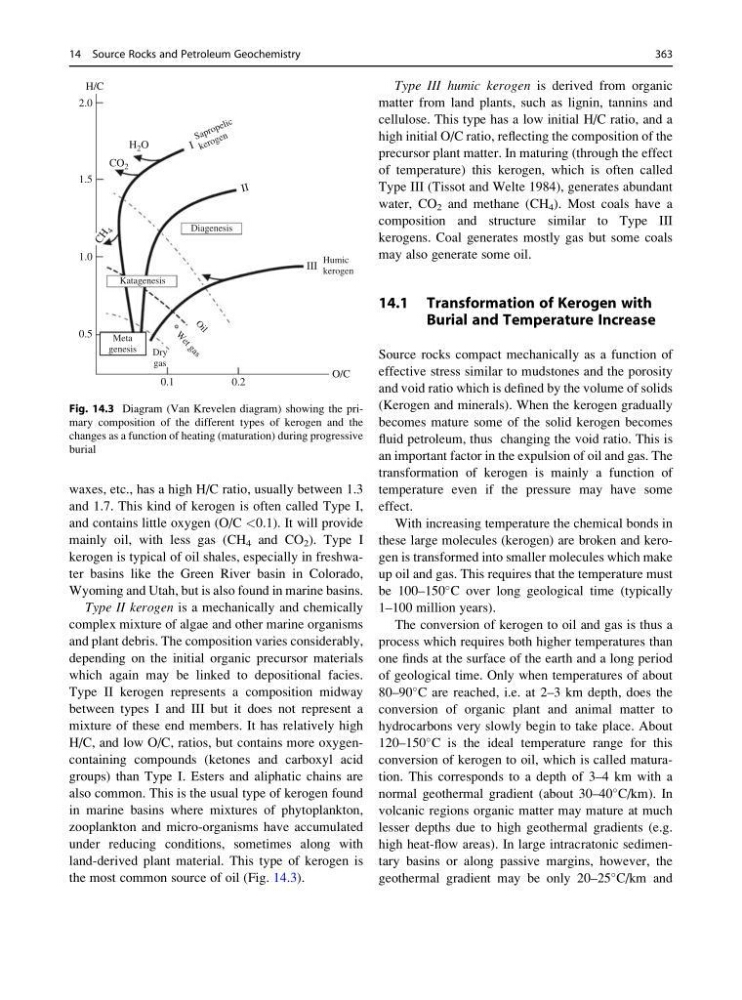
waxes, etc., has a high H/C ratio, usually between 1.3
and 1.7. This kind of kerogen is often called Type I,
and contains little oxygen (O/C <0.1). It will provide
mainly oil, with less gas (CH 4 and CO 2 ). Type I
kerogen is typical of oil shales, especially in freshwater basins like the Green River basin in Colorado,
Wyoming and Utah, but is also found in marine basins.
Type II kerogen is a mechanically and chemically
complex mixture of algae and other marine organisms
and plant debris. The composition varies considerably,
depending on the initial organic precursor materials
which again may be linked to depositional facies.
Type II kerogen represents a composition midway
between types I and III but it does not represent a
mixture of these end members. It has relatively high
H/C, and low O/C, ratios, but contains more oxygencontaining compounds (ketones and carboxyl acid
groups) than Type I. Esters and aliphatic chains are
also common. This is the usual type of kerogen found
in marine basins where mixtures of phytoplankton,
zooplankton and micro-organisms have accumulated
under reducing conditions, sometimes along with
land-derived plant material. This type of kerogen is
the most common source of oil (Fig. 14.3).
Type III humic kerogen is derived from organic
matter from land plants, such as lignin, tannins and
cellulose. This type has a low initial H/C ratio, and a
high initial O/C ratio, reflecting the composition of the
precursor plant matter. In maturing (through the effect
of temperature) this kerogen, which is often called
Type III (Tissot and Welte 1984), generates abundant
water, CO 2 and methane (CH 4 ). Most coals have a
composition and structure similar to Type III
kerogens. Coal generates mostly gas but some coals
may also generate some oil.
14.1 Transformation of Kerogen with
Burial and Temperature Increase
Source rocks compact mechanically as a function of
effective stress similar to mudstones and the porosity
and void ratio which is defined by the volume of solids
(Kerogen and minerals). When the kerogen gradually
becomes mature some of the solid kerogen becomes
fluid petroleum, thus changing the void ratio. This is
an important factor in the expulsion of oil and gas. The
transformation of kerogen is mainly a function of
temperature even if the pressure may have some
effect.
With increasing temperature the chemical bonds in
these large molecules (kerogen) are broken and kerogen is transformed into smaller molecules which make
up oil and gas. This requires that the temperature must
be 100–150
C over long geological time (typically
1–100 million years).
The conversion of kerogen to oil and gas is thus a
process which requires both higher temperatures than
one finds at the surface of the earth and a long period
of geological time. Only when temperatures of about
80–90
C are reached, i.e. at 2–3 km depth, does the
conversion of organic plant and animal matter to
hydrocarbons very slowly begin to take place. About
120–150
C is the ideal temperature range for this
conversion of kerogen to oil, which is called maturation. This corresponds to a depth of 3–4 km with a
normal geothermal gradient (about 30–40
C/km). In
volcanic regions organic matter may mature at much
lesser depths due to high geothermal gradients (e.g.
high heat-flow areas). In large intracratonic sedimentary basins or along passive margins, however, the
geothermal gradient may be only 20–25
C/km and
2.0
1.5
1.0
0.5
0.1
0.2
O/C
Meta
genesis
Dry
gas
Katagenesis
Diagenesis
CO 2
H 2 O
C H
4
III
Humic
kerogen
O
i
l
W
e
t
g
a
s
S a p ro p e li c
k e ro g e n
II
I
H/C
Fig. 14.3 Diagram (Van Krevelen diagram) showing the primary composition of the different types of kerogen and the
changes as a function of heating (maturation) during progressive
burial
14 Source Rocks and Petroleum Geochemistry
363
and 1.7. This kind of kerogen is often called Type I,
and contains little oxygen (O/C <0.1). It will provide
mainly oil, with less gas (CH 4 and CO 2 ). Type I
kerogen is typical of oil shales, especially in freshwater basins like the Green River basin in Colorado,
Wyoming and Utah, but is also found in marine basins.
Type II kerogen is a mechanically and chemically
complex mixture of algae and other marine organisms
and plant debris. The composition varies considerably,
depending on the initial organic precursor materials
which again may be linked to depositional facies.
Type II kerogen represents a composition midway
between types I and III but it does not represent a
mixture of these end members. It has relatively high
H/C, and low O/C, ratios, but contains more oxygencontaining compounds (ketones and carboxyl acid
groups) than Type I. Esters and aliphatic chains are
also common. This is the usual type of kerogen found
in marine basins where mixtures of phytoplankton,
zooplankton and micro-organisms have accumulated
under reducing conditions, sometimes along with
land-derived plant material. This type of kerogen is
the most common source of oil (Fig. 14.3).
Type III humic kerogen is derived from organic
matter from land plants, such as lignin, tannins and
cellulose. This type has a low initial H/C ratio, and a
high initial O/C ratio, reflecting the composition of the
precursor plant matter. In maturing (through the effect
of temperature) this kerogen, which is often called
Type III (Tissot and Welte 1984), generates abundant
water, CO 2 and methane (CH 4 ). Most coals have a
composition and structure similar to Type III
kerogens. Coal generates mostly gas but some coals
may also generate some oil.
14.1 Transformation of Kerogen with
Burial and Temperature Increase
Source rocks compact mechanically as a function of
effective stress similar to mudstones and the porosity
and void ratio which is defined by the volume of solids
(Kerogen and minerals). When the kerogen gradually
becomes mature some of the solid kerogen becomes
fluid petroleum, thus changing the void ratio. This is
an important factor in the expulsion of oil and gas. The
transformation of kerogen is mainly a function of
temperature even if the pressure may have some
effect.
With increasing temperature the chemical bonds in
these large molecules (kerogen) are broken and kerogen is transformed into smaller molecules which make
up oil and gas. This requires that the temperature must
be 100–150
C over long geological time (typically
1–100 million years).
The conversion of kerogen to oil and gas is thus a
process which requires both higher temperatures than
one finds at the surface of the earth and a long period
of geological time. Only when temperatures of about
80–90
C are reached, i.e. at 2–3 km depth, does the
conversion of organic plant and animal matter to
hydrocarbons very slowly begin to take place. About
120–150
C is the ideal temperature range for this
conversion of kerogen to oil, which is called maturation. This corresponds to a depth of 3–4 km with a
normal geothermal gradient (about 30–40
C/km). In
volcanic regions organic matter may mature at much
lesser depths due to high geothermal gradients (e.g.
high heat-flow areas). In large intracratonic sedimentary basins or along passive margins, however, the
geothermal gradient may be only 20–25
C/km and
2.0
1.5
1.0
0.5
0.1
0.2
O/C
Meta
genesis
Dry
gas
Katagenesis
Diagenesis
CO 2
H 2 O
C H
4
III
Humic
kerogen
O
i
l
W
e
t
g
a
s
S a p ro p e li c
k e ro g e n
II
I
H/C
Fig. 14.3 Diagram (Van Krevelen diagram) showing the primary composition of the different types of kerogen and the
changes as a function of heating (maturation) during progressive
burial
14 Source Rocks and Petroleum Geochemistry
363