

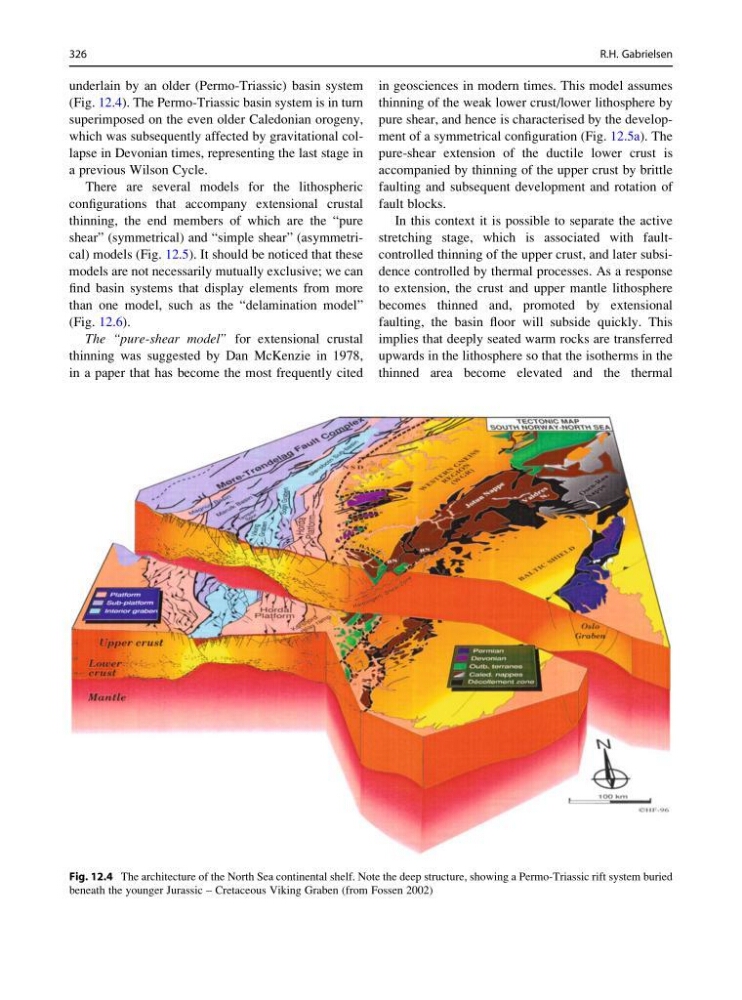
underlain by an older (Permo-Triassic) basin system
(Fig. 12.4). The Permo-Triassic basin system is in turn
superimposed on the even older Caledonian orogeny,
which was subsequently affected by gravitational collapse in Devonian times, representing the last stage in
a previous Wilson Cycle.
There are several models for the lithospheric
configurations that accompany extensional crustal
thinning, the end members of which are the “pure
shear” (symmetrical) and “simple shear” (asymmetrical) models (Fig. 12.5). It should be noticed that these
models are not necessarily mutually exclusive; we can
find basin systems that display elements from more
than one model, such as the “delamination model”
(Fig. 12.6).
The “pure-shear model” for extensional crustal
thinning was suggested by Dan McKenzie in 1978,
in a paper that has become the most frequently cited
in geosciences in modern times. This model assumes
thinning of the weak lower crust/lower lithosphere by
pure shear, and hence is characterised by the development of a symmetrical configuration (Fig. 12.5a). The
pure-shear extension of the ductile lower crust is
accompanied by thinning of the upper crust by brittle
faulting and subsequent development and rotation of
fault blocks.
In this context it is possible to separate the active
stretching stage, which is associated with faultcontrolled thinning of the upper crust, and later subsidence controlled by thermal processes. As a response
to extension, the crust and upper mantle lithosphere
becomes thinned and, promoted by extensional
faulting, the basin floor will subside quickly. This
implies that deeply seated warm rocks are transferred
upwards in the lithosphere so that the isotherms in the
thinned area become elevated and the thermal
Fig. 12.4 The architecture of the North Sea continental shelf. Note the deep structure, showing a Permo-Triassic rift system buried
beneath the younger Jurassic – Cretaceous Viking Graben (from Fossen 2002)
326
R.H. Gabrielsen
(Fig. 12.4). The Permo-Triassic basin system is in turn
superimposed on the even older Caledonian orogeny,
which was subsequently affected by gravitational collapse in Devonian times, representing the last stage in
a previous Wilson Cycle.
There are several models for the lithospheric
configurations that accompany extensional crustal
thinning, the end members of which are the “pure
shear” (symmetrical) and “simple shear” (asymmetrical) models (Fig. 12.5). It should be noticed that these
models are not necessarily mutually exclusive; we can
find basin systems that display elements from more
than one model, such as the “delamination model”
(Fig. 12.6).
The “pure-shear model” for extensional crustal
thinning was suggested by Dan McKenzie in 1978,
in a paper that has become the most frequently cited
in geosciences in modern times. This model assumes
thinning of the weak lower crust/lower lithosphere by
pure shear, and hence is characterised by the development of a symmetrical configuration (Fig. 12.5a). The
pure-shear extension of the ductile lower crust is
accompanied by thinning of the upper crust by brittle
faulting and subsequent development and rotation of
fault blocks.
In this context it is possible to separate the active
stretching stage, which is associated with faultcontrolled thinning of the upper crust, and later subsidence controlled by thermal processes. As a response
to extension, the crust and upper mantle lithosphere
becomes thinned and, promoted by extensional
faulting, the basin floor will subside quickly. This
implies that deeply seated warm rocks are transferred
upwards in the lithosphere so that the isotherms in the
thinned area become elevated and the thermal
Fig. 12.4 The architecture of the North Sea continental shelf. Note the deep structure, showing a Permo-Triassic rift system buried
beneath the younger Jurassic – Cretaceous Viking Graben (from Fossen 2002)
326
R.H. Gabrielsen