

is produced by pressure solution of quartz and other
minerals in contact with layers enriched in clay
minerals.
The transition from mudstones to shales does not
only involve a marked increase in stiffness and velocity but also an increase in the anisotropy. This is due to
the reorientation of clay minerals during diagenesis so
that the velocity parallel to bedding will be higher than
perpendicular to bedding. In addition the resistivity
will to a large extent be controlled by the orientation
of the clay minerals and the quartz cementation in
mudrocks and shales.
0
1 0
2 0
3 0
4 0
5 0
Vertical effective stress (MPa)
400
800
1200
0
1 0
2 0
3 0
4 0
5 0
Vertical effective stress (MPa)
2
4
6
V
p / V
s
Kaolinite (100%)
Smectite (20%), Kaolinite (80%)
Smectite (40%), Kaolinite (60%)
Smectite (60%), Kaolinite (40%)
Smectite (80%), Kaolinite (20%)
Smectite (100%)
Generalized best fit lines
Best fit lines for specific sample
0
1 0
2 0
3 0
4 0
5 0
Vertical effective stress (MPa)
1600
2000
2400
V
p (m/s)
V
s (m/s)
a
c
b
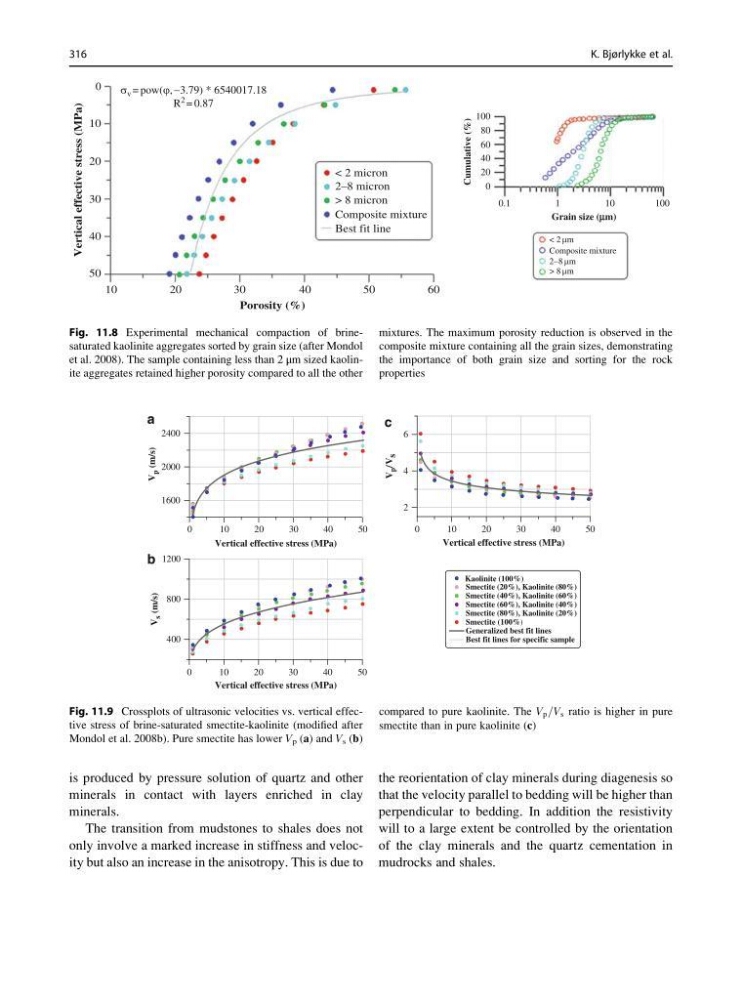
Fig. 11.9 Crossplots of ultrasonic velocities vs. vertical effective stress of brine-saturated smectite-kaolinite (modified after
Mondol et al. 2008b). Pure smectite has lower V p (a) and V s (b)
compared to pure kaolinite. The V p =V s ratio is higher in pure
smectite than in pure kaolinite (c)
0
10
20
30
40
50
< 2 micron
> 8 micron
Composite mixture
< 2 μm
> 8 μm
2−8 μm
Composite mixture
Best fit line
2–8 micron
Porosity (%)
Vertical effective stress (MPa)
10
20
30
40
50
60
100
80
60
40
20
0
Grain size (mm)
Cumulative (%)
0.1
1
10
100
σ v = pow(ϕ, −3.79) * 6540017.18
R
2 = 0.87
Fig. 11.8 Experimental mechanical compaction of brinesaturated kaolinite aggregates sorted by grain size (after Mondol
et al. 2008). The sample containing less than 2 μm sized kaolinite aggregates retained higher porosity compared to all the other
mixtures. The maximum porosity reduction is observed in the
composite mixture containing all the grain sizes, demonstrating
the importance of both grain size and sorting for the rock
properties
316
K. Bjørlykke et al.
minerals in contact with layers enriched in clay
minerals.
The transition from mudstones to shales does not
only involve a marked increase in stiffness and velocity but also an increase in the anisotropy. This is due to
the reorientation of clay minerals during diagenesis so
that the velocity parallel to bedding will be higher than
perpendicular to bedding. In addition the resistivity
will to a large extent be controlled by the orientation
of the clay minerals and the quartz cementation in
mudrocks and shales.
0
1 0
2 0
3 0
4 0
5 0
Vertical effective stress (MPa)
400
800
1200
0
1 0
2 0
3 0
4 0
5 0
Vertical effective stress (MPa)
2
4
6
V
p / V
s
Kaolinite (100%)
Smectite (20%), Kaolinite (80%)
Smectite (40%), Kaolinite (60%)
Smectite (60%), Kaolinite (40%)
Smectite (80%), Kaolinite (20%)
Smectite (100%)
Generalized best fit lines
Best fit lines for specific sample
0
1 0
2 0
3 0
4 0
5 0
Vertical effective stress (MPa)
1600
2000
2400
V
p (m/s)
V
s (m/s)
a
c
b
Fig. 11.9 Crossplots of ultrasonic velocities vs. vertical effective stress of brine-saturated smectite-kaolinite (modified after
Mondol et al. 2008b). Pure smectite has lower V p (a) and V s (b)
compared to pure kaolinite. The V p =V s ratio is higher in pure
smectite than in pure kaolinite (c)
0
10
20
30
40
50
< 2 micron
> 8 micron
Composite mixture
< 2 μm
> 8 μm
2−8 μm
Composite mixture
Best fit line
2–8 micron
Porosity (%)
Vertical effective stress (MPa)
10
20
30
40
50
60
100
80
60
40
20
0
Grain size (mm)
Cumulative (%)
0.1
1
10
100
σ v = pow(ϕ, −3.79) * 6540017.18
R
2 = 0.87
Fig. 11.8 Experimental mechanical compaction of brinesaturated kaolinite aggregates sorted by grain size (after Mondol
et al. 2008). The sample containing less than 2 μm sized kaolinite aggregates retained higher porosity compared to all the other
mixtures. The maximum porosity reduction is observed in the
composite mixture containing all the grain sizes, demonstrating
the importance of both grain size and sorting for the rock
properties
316
K. Bjørlykke et al.