

freshwater clays. Slow weathering and leaching of
saltwater (Na
+
, K
+
) from marine clays uplifted by
glacial unloading in Scandinavia may therefore lead
to slope instability and “quick clay” slides. Experimental compaction of clays confirms that their compressibility and shear strength are a function of the
salinity of the porewater.
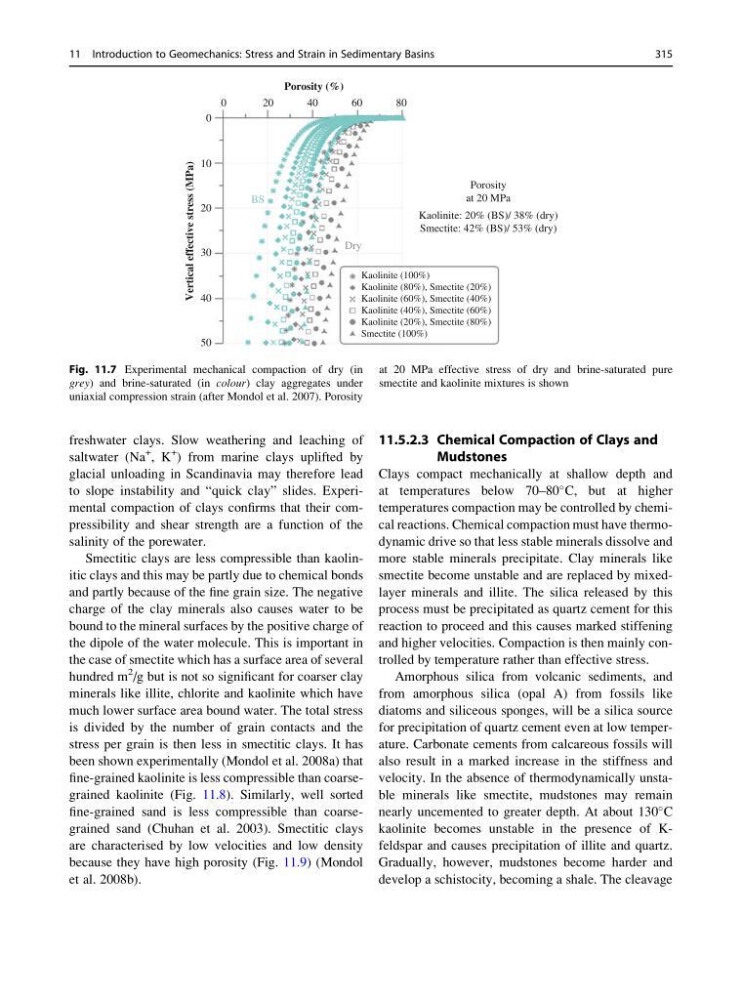
Smectitic clays are less compressible than kaolinitic clays and this may be partly due to chemical bonds
and partly because of the fine grain size. The negative
charge of the clay minerals also causes water to be
bound to the mineral surfaces by the positive charge of
the dipole of the water molecule. This is important in
the case of smectite which has a surface area of several
hundred m
2 /g but is not so significant for coarser clay
minerals like illite, chlorite and kaolinite which have
much lower surface area bound water. The total stress
is divided by the number of grain contacts and the
stress per grain is then less in smectitic clays. It has
been shown experimentally (Mondol et al. 2008a) that
fine-grained kaolinite is less compressible than coarsegrained kaolinite (Fig. 11.8). Similarly, well sorted
fine-grained sand is less compressible than coarsegrained sand (Chuhan et al. 2003). Smectitic clays
are characterised by low velocities and low density
because they have high porosity (Fig. 11.9) (Mondol
et al. 2008b).
11.5.2.3 Chemical Compaction of Clays and
Mudstones
Clays compact mechanically at shallow depth and
at temperatures below 70–80
C, but at higher
temperatures compaction may be controlled by chemical reactions. Chemical compaction must have thermodynamic drive so that less stable minerals dissolve and
more stable minerals precipitate. Clay minerals like
smectite become unstable and are replaced by mixedlayer minerals and illite. The silica released by this
process must be precipitated as quartz cement for this
reaction to proceed and this causes marked stiffening
and higher velocities. Compaction is then mainly controlled by temperature rather than effective stress.
Amorphous silica from volcanic sediments, and
from amorphous silica (opal A) from fossils like
diatoms and siliceous sponges, will be a silica source
for precipitation of quartz cement even at low temperature. Carbonate cements from calcareous fossils will
also result in a marked increase in the stiffness and
velocity. In the absence of thermodynamically unstable minerals like smectite, mudstones may remain
nearly uncemented to greater depth. At about 130
C
kaolinite becomes unstable in the presence of Kfeldspar and causes precipitation of illite and quartz.
Gradually, however, mudstones become harder and
develop a schistocity, becoming a shale. The cleavage
0
0
2 0
4 0
6 0
8 0
Porosity
at 20 MPa
Kaolinite: 20% (BS)/ 38% (dry)
Smectite: 42% (BS)/ 53% (dry)
BS
Kaolinite (100%)
Kaolinite (80%), Smectite (20%)
Kaolinite (60%), Smectite (40%)
Kaolinite (40%), Smectite (60%)
Kaolinite (20%), Smectite (80%)
Smectite (100%)
Porosity (%)
10
20
Vertical effective stress (MPa)
30
40
50
Fig. 11.7 Experimental mechanical compaction of dry (in
grey) and brine-saturated (in colour) clay aggregates under
uniaxial compression strain (after Mondol et al. 2007). Porosity
at 20 MPa effective stress of dry and brine-saturated pure
smectite and kaolinite mixtures is shown
11 Introduction to Geomechanics: Stress and Strain in Sedimentary Basins
315
saltwater (Na
+
, K
+
) from marine clays uplifted by
glacial unloading in Scandinavia may therefore lead
to slope instability and “quick clay” slides. Experimental compaction of clays confirms that their compressibility and shear strength are a function of the
salinity of the porewater.
Smectitic clays are less compressible than kaolinitic clays and this may be partly due to chemical bonds
and partly because of the fine grain size. The negative
charge of the clay minerals also causes water to be
bound to the mineral surfaces by the positive charge of
the dipole of the water molecule. This is important in
the case of smectite which has a surface area of several
hundred m
2 /g but is not so significant for coarser clay
minerals like illite, chlorite and kaolinite which have
much lower surface area bound water. The total stress
is divided by the number of grain contacts and the
stress per grain is then less in smectitic clays. It has
been shown experimentally (Mondol et al. 2008a) that
fine-grained kaolinite is less compressible than coarsegrained kaolinite (Fig. 11.8). Similarly, well sorted
fine-grained sand is less compressible than coarsegrained sand (Chuhan et al. 2003). Smectitic clays
are characterised by low velocities and low density
because they have high porosity (Fig. 11.9) (Mondol
et al. 2008b).
11.5.2.3 Chemical Compaction of Clays and
Mudstones
Clays compact mechanically at shallow depth and
at temperatures below 70–80
C, but at higher
temperatures compaction may be controlled by chemical reactions. Chemical compaction must have thermodynamic drive so that less stable minerals dissolve and
more stable minerals precipitate. Clay minerals like
smectite become unstable and are replaced by mixedlayer minerals and illite. The silica released by this
process must be precipitated as quartz cement for this
reaction to proceed and this causes marked stiffening
and higher velocities. Compaction is then mainly controlled by temperature rather than effective stress.
Amorphous silica from volcanic sediments, and
from amorphous silica (opal A) from fossils like
diatoms and siliceous sponges, will be a silica source
for precipitation of quartz cement even at low temperature. Carbonate cements from calcareous fossils will
also result in a marked increase in the stiffness and
velocity. In the absence of thermodynamically unstable minerals like smectite, mudstones may remain
nearly uncemented to greater depth. At about 130
C
kaolinite becomes unstable in the presence of Kfeldspar and causes precipitation of illite and quartz.
Gradually, however, mudstones become harder and
develop a schistocity, becoming a shale. The cleavage
0
0
2 0
4 0
6 0
8 0
Porosity
at 20 MPa
Kaolinite: 20% (BS)/ 38% (dry)
Smectite: 42% (BS)/ 53% (dry)
BS
Kaolinite (100%)
Kaolinite (80%), Smectite (20%)
Kaolinite (60%), Smectite (40%)
Kaolinite (40%), Smectite (60%)
Kaolinite (20%), Smectite (80%)
Smectite (100%)
Porosity (%)
10
20
Vertical effective stress (MPa)
30
40
50
Fig. 11.7 Experimental mechanical compaction of dry (in
grey) and brine-saturated (in colour) clay aggregates under
uniaxial compression strain (after Mondol et al. 2007). Porosity
at 20 MPa effective stress of dry and brine-saturated pure
smectite and kaolinite mixtures is shown
11 Introduction to Geomechanics: Stress and Strain in Sedimentary Basins
315