

vertical stress (σ v ). For a sedimentary basin with a
fairly horizontal surface, and without major lateral
variations in the sediment compressibility, the vertical
stress at any point can simply be computed as:
σ v ¼ ρ b gh
(11.1)
where ρ b is the average sediment bulk density (solids +
fluids) of the overlying sequence, h is the sediment
thickness and g is the acceleration of gravity. This is
the vertical total stress or the lithostatic stress. It may
be calculated more accurately by integrating the varying density over the depth of the sediment column. The
sediment density varies with the density of the grains,
mainly minerals, the porosity and the density of the
pore fluids which could be water, oil or gas. The
effective vertical stress (σ
0
v ) is defined as the difference
between the vertical total stress (σ v ) and the pore
pressure (u):
σ
0
v ¼ σ v À u
(11.2)
This is the effective stress which is sometimes
called the average intergranular stresses because it is
transmitted through the grain framework. It is the
effective stress that governs the mechanical compaction of sediments where little chemical compaction
(cementation) has taken place. Stress (σ) is force (F)
divided by the area of contact (A). In coarse-grained
sediments like sandstones the area of contact may be
very small and the stresses between the grains rather
high. It should be noted that the local intergranular
particle-to-particle contact stress is many times higher
than the effective stress as defined here, due to the
small area of contact. The total overburden weight is
carried by the mineral grain framework and the pore
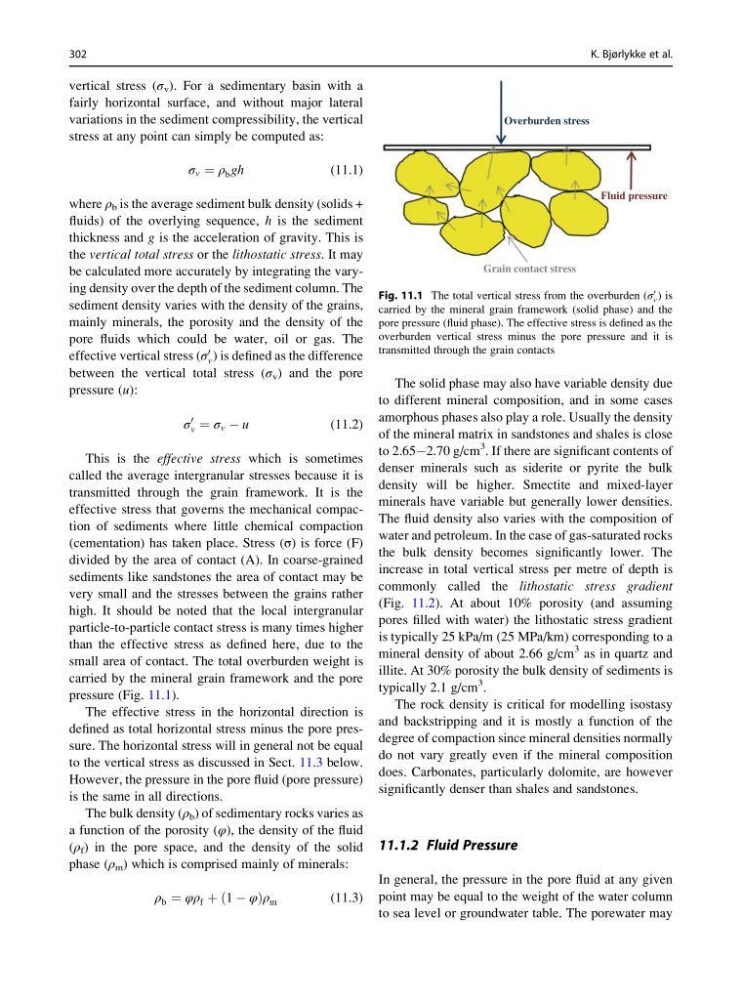
pressure (Fig. 11.1).
The effective stress in the horizontal direction is
defined as total horizontal stress minus the pore pressure. The horizontal stress will in general not be equal
to the vertical stress as discussed in Sect. 11.3 below.
However, the pressure in the pore fluid (pore pressure)
is the same in all directions.
The bulk density (ρ b ) of sedimentary rocks varies as
a function of the porosity (φ), the density of the fluid
(ρ f ) in the pore space, and the density of the solid
phase (ρ m ) which is comprised mainly of minerals:
ρ b ¼ φρ f þ ð1 À φÞρ m
(11.3)
The solid phase may also have variable density due
to different mineral composition, and in some cases
amorphous phases also play a role. Usually the density
of the mineral matrix in sandstones and shales is close
to 2.65À2.70 g/cm
3 . If there are significant contents of
denser minerals such as siderite or pyrite the bulk
density will be higher. Smectite and mixed-layer
minerals have variable but generally lower densities.
The fluid density also varies with the composition of
water and petroleum. In the case of gas-saturated rocks
the bulk density becomes significantly lower. The
increase in total vertical stress per metre of depth is
commonly called the lithostatic stress gradient
(Fig. 11.2). At about 10% porosity (and assuming
pores filled with water) the lithostatic stress gradient
is typically 25 kPa/m (25 MPa/km) corresponding to a
mineral density of about 2.66 g/cm
3 as in quartz and
illite. At 30% porosity the bulk density of sediments is
typically 2.1 g/cm
3 .
The rock density is critical for modelling isostasy
and backstripping and it is mostly a function of the
degree of compaction since mineral densities normally
do not vary greatly even if the mineral composition
does. Carbonates, particularly dolomite, are however
significantly denser than shales and sandstones.
11.1.2 Fluid Pressure
In general, the pressure in the pore fluid at any given
point may be equal to the weight of the water column
to sea level or groundwater table. The porewater may
Overburden stress
Fluid pressure
Grain contact stress
Fig. 11.1 The total vertical stress from the overburden (σ
0
v ) is
carried by the mineral grain framework (solid phase) and the
pore pressure (fluid phase). The effective stress is defined as the
overburden vertical stress minus the pore pressure and it is
transmitted through the grain contacts
302
K. Bjørlykke et al.
fairly horizontal surface, and without major lateral
variations in the sediment compressibility, the vertical
stress at any point can simply be computed as:
σ v ¼ ρ b gh
(11.1)
where ρ b is the average sediment bulk density (solids +
fluids) of the overlying sequence, h is the sediment
thickness and g is the acceleration of gravity. This is
the vertical total stress or the lithostatic stress. It may
be calculated more accurately by integrating the varying density over the depth of the sediment column. The
sediment density varies with the density of the grains,
mainly minerals, the porosity and the density of the
pore fluids which could be water, oil or gas. The
effective vertical stress (σ
0
v ) is defined as the difference
between the vertical total stress (σ v ) and the pore
pressure (u):
σ
0
v ¼ σ v À u
(11.2)
This is the effective stress which is sometimes
called the average intergranular stresses because it is
transmitted through the grain framework. It is the
effective stress that governs the mechanical compaction of sediments where little chemical compaction
(cementation) has taken place. Stress (σ) is force (F)
divided by the area of contact (A). In coarse-grained
sediments like sandstones the area of contact may be
very small and the stresses between the grains rather
high. It should be noted that the local intergranular
particle-to-particle contact stress is many times higher
than the effective stress as defined here, due to the
small area of contact. The total overburden weight is
carried by the mineral grain framework and the pore
pressure (Fig. 11.1).
The effective stress in the horizontal direction is
defined as total horizontal stress minus the pore pressure. The horizontal stress will in general not be equal
to the vertical stress as discussed in Sect. 11.3 below.
However, the pressure in the pore fluid (pore pressure)
is the same in all directions.
The bulk density (ρ b ) of sedimentary rocks varies as
a function of the porosity (φ), the density of the fluid
(ρ f ) in the pore space, and the density of the solid
phase (ρ m ) which is comprised mainly of minerals:
ρ b ¼ φρ f þ ð1 À φÞρ m
(11.3)
The solid phase may also have variable density due
to different mineral composition, and in some cases
amorphous phases also play a role. Usually the density
of the mineral matrix in sandstones and shales is close
to 2.65À2.70 g/cm
3 . If there are significant contents of
denser minerals such as siderite or pyrite the bulk
density will be higher. Smectite and mixed-layer
minerals have variable but generally lower densities.
The fluid density also varies with the composition of
water and petroleum. In the case of gas-saturated rocks
the bulk density becomes significantly lower. The
increase in total vertical stress per metre of depth is
commonly called the lithostatic stress gradient
(Fig. 11.2). At about 10% porosity (and assuming
pores filled with water) the lithostatic stress gradient
is typically 25 kPa/m (25 MPa/km) corresponding to a
mineral density of about 2.66 g/cm
3 as in quartz and
illite. At 30% porosity the bulk density of sediments is
typically 2.1 g/cm
3 .
The rock density is critical for modelling isostasy
and backstripping and it is mostly a function of the
degree of compaction since mineral densities normally
do not vary greatly even if the mineral composition
does. Carbonates, particularly dolomite, are however
significantly denser than shales and sandstones.
11.1.2 Fluid Pressure
In general, the pressure in the pore fluid at any given
point may be equal to the weight of the water column
to sea level or groundwater table. The porewater may
Overburden stress
Fluid pressure
Grain contact stress
Fig. 11.1 The total vertical stress from the overburden (σ
0
v ) is
carried by the mineral grain framework (solid phase) and the
pore pressure (fluid phase). The effective stress is defined as the
overburden vertical stress minus the pore pressure and it is
transmitted through the grain contacts
302
K. Bjørlykke et al.