

Trough in Southern California is a good example and
much of the Los Angeles and Ventura basins
originated in this way during the Pliocene.
The basins are very deep holes in the continental
crust, and are sometimes floored with volcanic rocks.
Because of the limited size of the basins and the
continued uplift of the areas surrounding them, we
get a very high rate of sedimentation. In the
Miocene-Pliocene basins in California, 5–8 km or
more of sediments have been deposited in roughly as
many million years. This corresponds to an average of
1 mm/year, which is a very high figure in this context.
The sediments consist largely of proximal turbidites
along the edge of the basin and distal turbidites and
fine-grained clay sediments in the more central, deeper
parts. In the Ventura Basin which continues into the
Santa Barbara Channel, there are about 15 km of
young sediments (<4–5 million years) which have
been folded and which contain large amounts of oil.
Basins of this type provide almost ideal conditions
for oil accumulation and are amongst the richest oil
regions in the USA. Very few basins can compete with
the California strike-slip related basins in terms of
barrels of oil per square kilometre. This is because
these deep basins often have reducing conditions in
their bottom water due to limited circulation of
oxidised water. We therefore get organic-rich
sediments deposited. Turbidite sandstones, particularly the more proximal parts, often have sufficiently
high porosity to become reservoir rocks. Even if the
porosity is not especially high, turbidite deposits often
form thick sequences that extend over large areas. The
reservoir quality can also be controlled by turbidite
lobes or channels with levees.
Sea level
Shelf
sand/carbonate
Submarine
canyons
Highstand Sea level
Onlap
Sand-rich turbidites and
traction current
deposited sands
Offlap
Lowstand Sea level
Sea level
Progradational onlap
sequence
Slope prodelta
Muds and turbitites
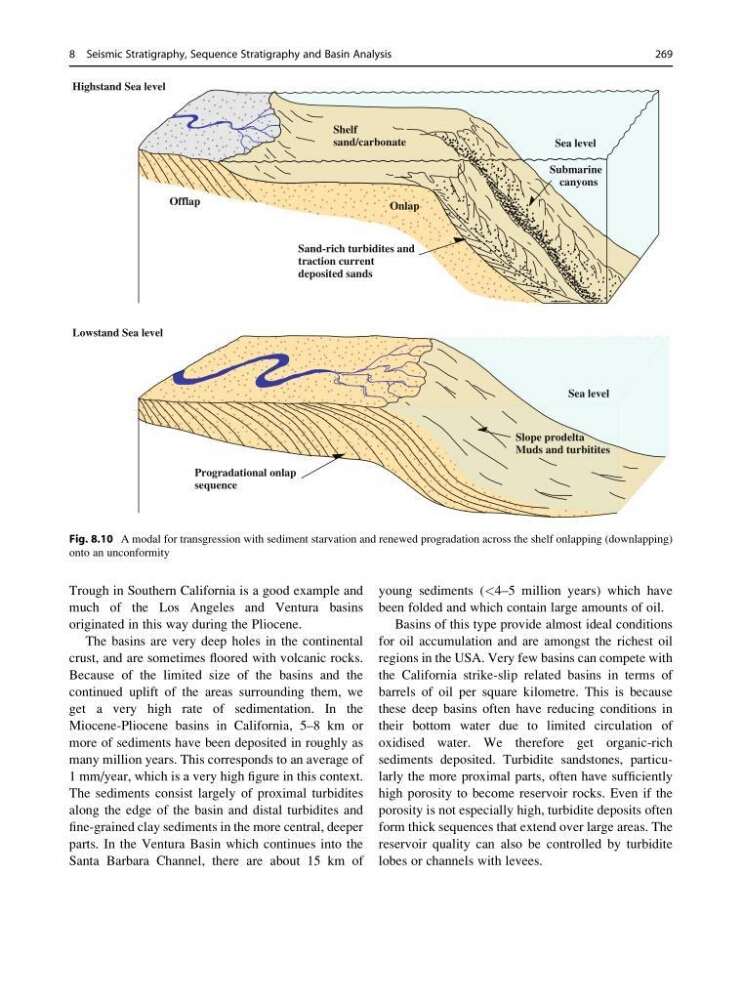
Fig. 8.10 A modal for transgression with sediment starvation and renewed progradation across the shelf onlapping (downlapping)
onto an unconformity
8 Seismic Stratigraphy, Sequence Stratigraphy and Basin Analysis
269
much of the Los Angeles and Ventura basins
originated in this way during the Pliocene.
The basins are very deep holes in the continental
crust, and are sometimes floored with volcanic rocks.
Because of the limited size of the basins and the
continued uplift of the areas surrounding them, we
get a very high rate of sedimentation. In the
Miocene-Pliocene basins in California, 5–8 km or
more of sediments have been deposited in roughly as
many million years. This corresponds to an average of
1 mm/year, which is a very high figure in this context.
The sediments consist largely of proximal turbidites
along the edge of the basin and distal turbidites and
fine-grained clay sediments in the more central, deeper
parts. In the Ventura Basin which continues into the
Santa Barbara Channel, there are about 15 km of
young sediments (<4–5 million years) which have
been folded and which contain large amounts of oil.
Basins of this type provide almost ideal conditions
for oil accumulation and are amongst the richest oil
regions in the USA. Very few basins can compete with
the California strike-slip related basins in terms of
barrels of oil per square kilometre. This is because
these deep basins often have reducing conditions in
their bottom water due to limited circulation of
oxidised water. We therefore get organic-rich
sediments deposited. Turbidite sandstones, particularly the more proximal parts, often have sufficiently
high porosity to become reservoir rocks. Even if the
porosity is not especially high, turbidite deposits often
form thick sequences that extend over large areas. The
reservoir quality can also be controlled by turbidite
lobes or channels with levees.
Sea level
Shelf
sand/carbonate
Submarine
canyons
Highstand Sea level
Onlap
Sand-rich turbidites and
traction current
deposited sands
Offlap
Lowstand Sea level
Sea level
Progradational onlap
sequence
Slope prodelta
Muds and turbitites
Fig. 8.10 A modal for transgression with sediment starvation and renewed progradation across the shelf onlapping (downlapping)
onto an unconformity
8 Seismic Stratigraphy, Sequence Stratigraphy and Basin Analysis
269