

sea level
Post-rift age
Ocean depth without sediment
loading (km)
Thickness of continental crust
2
0
–2
–4
–6
0
20
40
60
80
100 mill.
Oc ea ni c cr us t
30 km
25 km
20 km
10 km
SPREADING RIDGE
SEA LEVEL
c
CARBONATE
COMPENSATION
TURBIDITES
SILICA
SILICA
TURBIDITES
MANGANESE
NODULES
O R
O
L
B
F
A
N
S
A
A
E
L
C
T
O
b
a
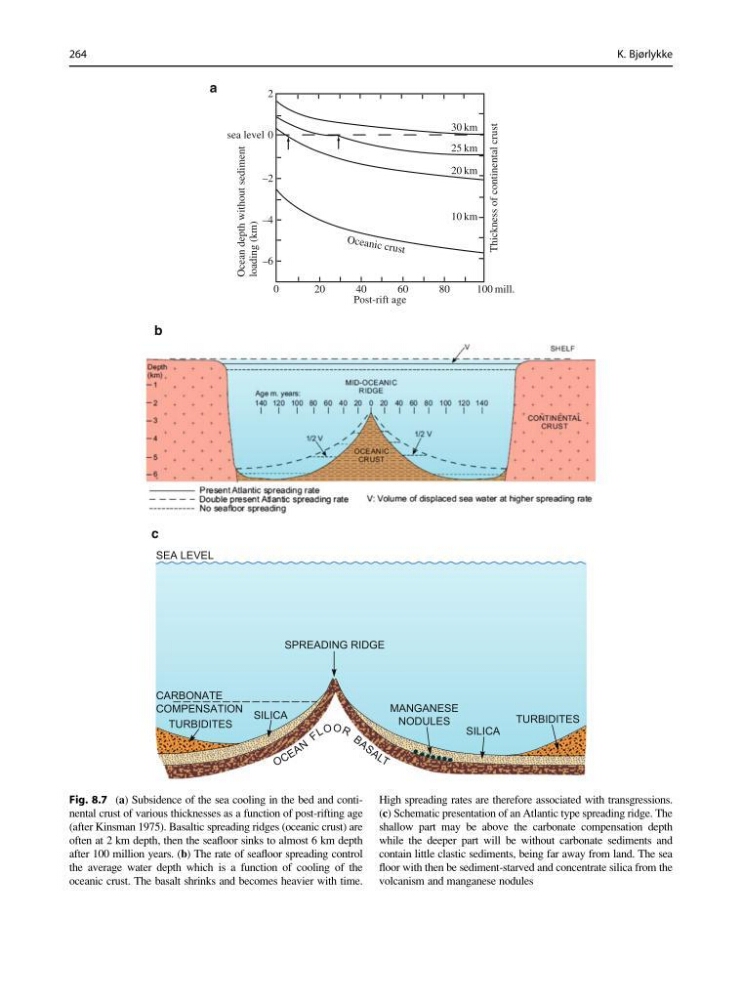
Fig. 8.7 (a) Subsidence of the sea cooling in the bed and continental crust of various thicknesses as a function of post-rifting age
(after Kinsman 1975). Basaltic spreading ridges (oceanic crust) are
often at 2 km depth, then the seafloor sinks to almost 6 km depth
after 100 million years. (b) The rate of seafloor spreading control
the average water depth which is a function of cooling of the
oceanic crust. The basalt shrinks and becomes heavier with time.
High spreading rates are therefore associated with transgressions.
(c) Schematic presentation of an Atlantic type spreading ridge. The
shallow part may be above the carbonate compensation depth
while the deeper part will be without carbonate sediments and
contain little clastic sediments, being far away from land. The sea
floor with then be sediment-starved and concentrate silica from the
volcanism and manganese nodules
264
K. Bjørlykke
Post-rift age
Ocean depth without sediment
loading (km)
Thickness of continental crust
2
0
–2
–4
–6
0
20
40
60
80
100 mill.
Oc ea ni c cr us t
30 km
25 km
20 km
10 km
SPREADING RIDGE
SEA LEVEL
c
CARBONATE
COMPENSATION
TURBIDITES
SILICA
SILICA
TURBIDITES
MANGANESE
NODULES
O R
O
L
B
F
A
N
S
A
A
E
L
C
T
O
b
a
Fig. 8.7 (a) Subsidence of the sea cooling in the bed and continental crust of various thicknesses as a function of post-rifting age
(after Kinsman 1975). Basaltic spreading ridges (oceanic crust) are
often at 2 km depth, then the seafloor sinks to almost 6 km depth
after 100 million years. (b) The rate of seafloor spreading control
the average water depth which is a function of cooling of the
oceanic crust. The basalt shrinks and becomes heavier with time.
High spreading rates are therefore associated with transgressions.
(c) Schematic presentation of an Atlantic type spreading ridge. The
shallow part may be above the carbonate compensation depth
while the deeper part will be without carbonate sediments and
contain little clastic sediments, being far away from land. The sea
floor with then be sediment-starved and concentrate silica from the
volcanism and manganese nodules
264
K. Bjørlykke