

If the pores are filled with gas instead of liquid (water
or oil), the velocity reduction will be even greater
because the sound travels much more slowly through
gas than through a liquid. Whyllie’s equation is however
not an accurate description of the relation between porosity and velocity.
V r thus approaches V m at zero porosity, and for
sandstone V m is about 5.5–6 m/s.
If we know the velocity of the rock matrix and the
fluid we should be able to calculate the porosity as a
function of velocity, but the Wyllie equation is very
much a simplification. Rocks with the same porosities
can have rather different velocities depending on the
type of grain contacts and the distribution of cement.
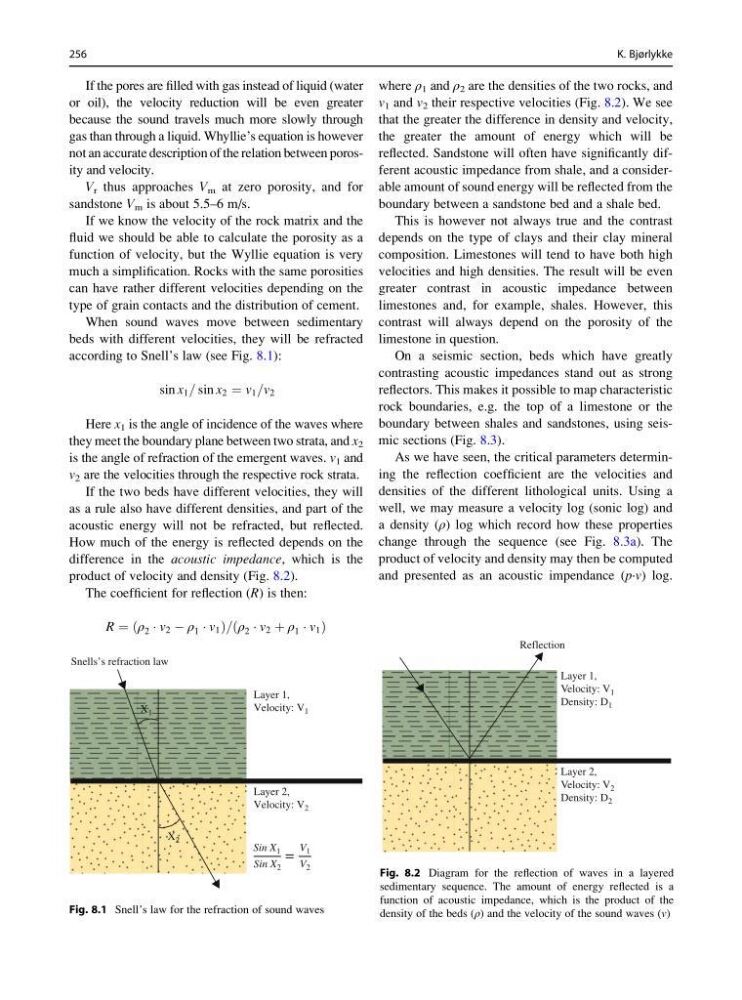
When sound waves move between sedimentary
beds with different velocities, they will be refracted
according to Snell’s law (see Fig. 8.1):
sin x 1 = sin x 2 ¼ v 1 =v 2
Here x 1 is the angle of incidence of the waves where
they meet the boundary plane between two strata, and x 2
is the angle of refraction of the emergent waves. v 1 and
v 2 are the velocities through the respective rock strata.
If the two beds have different velocities, they will
as a rule also have different densities, and part of the
acoustic energy will not be refracted, but reflected.
How much of the energy is reflected depends on the
difference in the acoustic impedance, which is the
product of velocity and density (Fig. 8.2).
The coefficient for reflection (R) is then:
R ¼ ρ 2 Á v 2 À ρ 1 Á v 1
ð
Þ = ρ 2 Á v 2 þ ρ 1 Á v 1
ð
Þ
where ρ 1 and ρ 2 are the densities of the two rocks, and
v 1 and v 2 their respective velocities (Fig. 8.2). We see
that the greater the difference in density and velocity,
the greater the amount of energy which will be
reflected. Sandstone will often have significantly different acoustic impedance from shale, and a considerable amount of sound energy will be reflected from the
boundary between a sandstone bed and a shale bed.
This is however not always true and the contrast
depends on the type of clays and their clay mineral
composition. Limestones will tend to have both high
velocities and high densities. The result will be even
greater contrast in acoustic impedance between
limestones and, for example, shales. However, this
contrast will always depend on the porosity of the
limestone in question.
On a seismic section, beds which have greatly
contrasting acoustic impedances stand out as strong
reflectors. This makes it possible to map characteristic
rock boundaries, e.g. the top of a limestone or the
boundary between shales and sandstones, using seismic sections (Fig. 8.3).
As we have seen, the critical parameters determining the reflection coefficient are the velocities and
densities of the different lithological units. Using a
well, we may measure a velocity log (sonic log) and
a density (ρ) log which record how these properties
change through the sequence (see Fig. 8.3a). The
product of velocity and density may then be computed
and presented as an acoustic impendance (p·v) log.
Layer 1,
Velocity: V 1
Layer 2,
Velocity: V 2
Sin X 1
V 1
V 2
Sin X 2
X 1
X 2
Snells’s refraction law
Fig. 8.1 Snell’s law for the refraction of sound waves
Layer 1,
Velocity: V 1
Density: D 1
Layer 2,
Velocity: V 2
Density: D 2
Reflection
Fig. 8.2 Diagram for the reflection of waves in a layered
sedimentary sequence. The amount of energy reflected is a
function of acoustic impedance, which is the product of the
density of the beds (ρ) and the velocity of the sound waves (v)
256
K. Bjørlykke
or oil), the velocity reduction will be even greater
because the sound travels much more slowly through
gas than through a liquid. Whyllie’s equation is however
not an accurate description of the relation between porosity and velocity.
V r thus approaches V m at zero porosity, and for
sandstone V m is about 5.5–6 m/s.
If we know the velocity of the rock matrix and the
fluid we should be able to calculate the porosity as a
function of velocity, but the Wyllie equation is very
much a simplification. Rocks with the same porosities
can have rather different velocities depending on the
type of grain contacts and the distribution of cement.
When sound waves move between sedimentary
beds with different velocities, they will be refracted
according to Snell’s law (see Fig. 8.1):
sin x 1 = sin x 2 ¼ v 1 =v 2
Here x 1 is the angle of incidence of the waves where
they meet the boundary plane between two strata, and x 2
is the angle of refraction of the emergent waves. v 1 and
v 2 are the velocities through the respective rock strata.
If the two beds have different velocities, they will
as a rule also have different densities, and part of the
acoustic energy will not be refracted, but reflected.
How much of the energy is reflected depends on the
difference in the acoustic impedance, which is the
product of velocity and density (Fig. 8.2).
The coefficient for reflection (R) is then:
R ¼ ρ 2 Á v 2 À ρ 1 Á v 1
ð
Þ = ρ 2 Á v 2 þ ρ 1 Á v 1
ð
Þ
where ρ 1 and ρ 2 are the densities of the two rocks, and
v 1 and v 2 their respective velocities (Fig. 8.2). We see
that the greater the difference in density and velocity,
the greater the amount of energy which will be
reflected. Sandstone will often have significantly different acoustic impedance from shale, and a considerable amount of sound energy will be reflected from the
boundary between a sandstone bed and a shale bed.
This is however not always true and the contrast
depends on the type of clays and their clay mineral
composition. Limestones will tend to have both high
velocities and high densities. The result will be even
greater contrast in acoustic impedance between
limestones and, for example, shales. However, this
contrast will always depend on the porosity of the
limestone in question.
On a seismic section, beds which have greatly
contrasting acoustic impedances stand out as strong
reflectors. This makes it possible to map characteristic
rock boundaries, e.g. the top of a limestone or the
boundary between shales and sandstones, using seismic sections (Fig. 8.3).
As we have seen, the critical parameters determining the reflection coefficient are the velocities and
densities of the different lithological units. Using a
well, we may measure a velocity log (sonic log) and
a density (ρ) log which record how these properties
change through the sequence (see Fig. 8.3a). The
product of velocity and density may then be computed
and presented as an acoustic impendance (p·v) log.
Layer 1,
Velocity: V 1
Layer 2,
Velocity: V 2
Sin X 1
V 1
V 2
Sin X 2
X 1
X 2
Snells’s refraction law
Fig. 8.1 Snell’s law for the refraction of sound waves
Layer 1,
Velocity: V 1
Density: D 1
Layer 2,
Velocity: V 2
Density: D 2
Reflection
Fig. 8.2 Diagram for the reflection of waves in a layered
sedimentary sequence. The amount of energy reflected is a
function of acoustic impedance, which is the product of the
density of the beds (ρ) and the velocity of the sound waves (v)
256
K. Bjørlykke