

occur together in vertical successions are those that
can occur side by side in nature”.
7.6
Radiometric Dating Methods
7.6.1 Concept of Dating
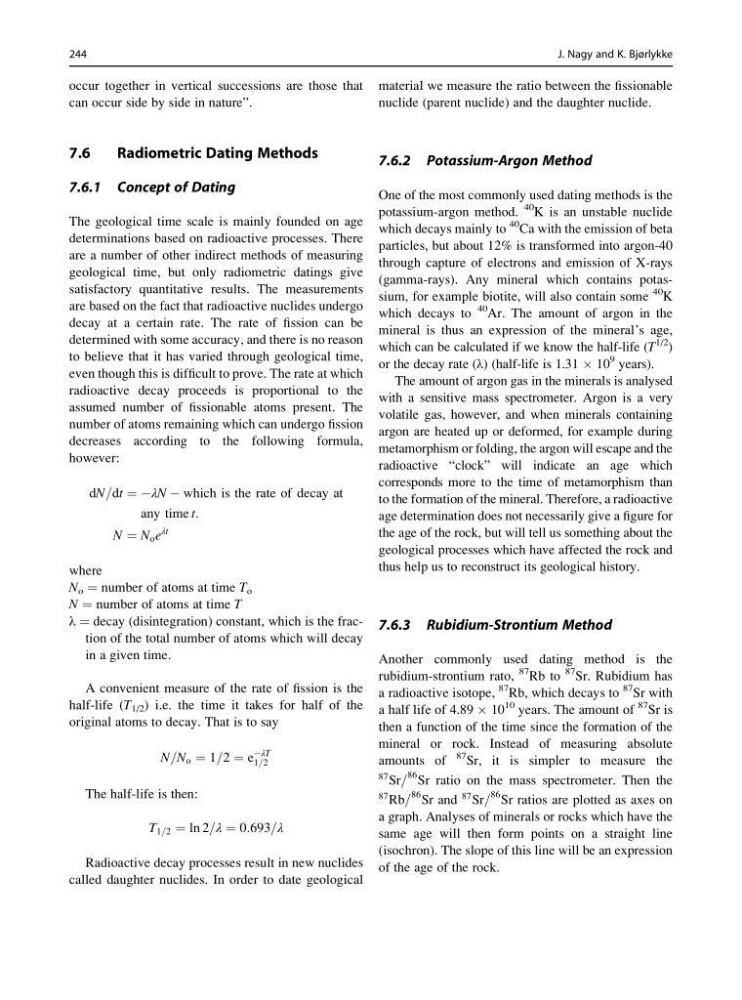
The geological time scale is mainly founded on age
determinations based on radioactive processes. There
are a number of other indirect methods of measuring
geological time, but only radiometric datings give
satisfactory quantitative results. The measurements
are based on the fact that radioactive nuclides undergo
decay at a certain rate. The rate of fission can be
determined with some accuracy, and there is no reason
to believe that it has varied through geological time,
even though this is difficult to prove. The rate at which
radioactive decay proceeds is proportional to the
assumed number of fissionable atoms present. The
number of atoms remaining which can undergo fission
decreases according to the following formula,
however:
dN=dt ¼ ÀλN À which is the rate of decay at
any time t:
N ¼ N o e
λt
where
N o ¼ number of atoms at time T o
N ¼ number of atoms at time T
λ ¼ decay (disintegration) constant, which is the fraction of the total number of atoms which will decay
in a given time.
A convenient measure of the rate of fission is the
half-life (T 1/2 ) i.e. the time it takes for half of the
original atoms to decay. That is to say
N=N o ¼ 1=2 ¼ e
ÀλT
1=2
The half-life is then:
T 1=2 ¼ ln 2=λ ¼ 0:693=λ
Radioactive decay processes result in new nuclides
called daughter nuclides. In order to date geological
material we measure the ratio between the fissionable
nuclide (parent nuclide) and the daughter nuclide.
7.6.2 Potassium-Argon Method
One of the most commonly used dating methods is the
potassium-argon method.
40 K is an unstable nuclide
which decays mainly to
40 Ca with the emission of beta
particles, but about 12% is transformed into argon-40
through capture of electrons and emission of X-rays
(gamma-rays). Any mineral which contains potassium, for example biotite, will also contain some
40
K
which decays to
40 Ar. The amount of argon in the
mineral is thus an expression of the mineral’s age,
which can be calculated if we know the half-life (T
1/2
)
or the decay rate (λ) (half-life is 1.31 Â 10
9 years).
The amount of argon gas in the minerals is analysed
with a sensitive mass spectrometer. Argon is a very
volatile gas, however, and when minerals containing
argon are heated up or deformed, for example during
metamorphism or folding, the argon will escape and the
radioactive “clock” will indicate an age which
corresponds more to the time of metamorphism than
to the formation of the mineral. Therefore, a radioactive
age determination does not necessarily give a figure for
the age of the rock, but will tell us something about the
geological processes which have affected the rock and
thus help us to reconstruct its geological history.
7.6.3 Rubidium-Strontium Method
Another commonly used dating method is the
rubidium-strontium rato,
87 Rb to
87 Sr. Rubidium has
a radioactive isotope,
87 Rb, which decays to
87 Sr with
a half life of 4.89 Â 10
10 years. The amount of
87 Sr is
then a function of the time since the formation of the
mineral or rock. Instead of measuring absolute
amounts of
87 Sr, it is simpler to measure the
87 Sr=
86 Sr ratio on the mass spectrometer. Then the
87 Rb=
86 Sr and
87 Sr=
86 Sr ratios are plotted as axes on
a graph. Analyses of minerals or rocks which have the
same age will then form points on a straight line
(isochron). The slope of this line will be an expression
of the age of the rock.
244
J. Nagy and K. Bjørlykke
can occur side by side in nature”.
7.6
Radiometric Dating Methods
7.6.1 Concept of Dating
The geological time scale is mainly founded on age
determinations based on radioactive processes. There
are a number of other indirect methods of measuring
geological time, but only radiometric datings give
satisfactory quantitative results. The measurements
are based on the fact that radioactive nuclides undergo
decay at a certain rate. The rate of fission can be
determined with some accuracy, and there is no reason
to believe that it has varied through geological time,
even though this is difficult to prove. The rate at which
radioactive decay proceeds is proportional to the
assumed number of fissionable atoms present. The
number of atoms remaining which can undergo fission
decreases according to the following formula,
however:
dN=dt ¼ ÀλN À which is the rate of decay at
any time t:
N ¼ N o e
λt
where
N o ¼ number of atoms at time T o
N ¼ number of atoms at time T
λ ¼ decay (disintegration) constant, which is the fraction of the total number of atoms which will decay
in a given time.
A convenient measure of the rate of fission is the
half-life (T 1/2 ) i.e. the time it takes for half of the
original atoms to decay. That is to say
N=N o ¼ 1=2 ¼ e
ÀλT
1=2
The half-life is then:
T 1=2 ¼ ln 2=λ ¼ 0:693=λ
Radioactive decay processes result in new nuclides
called daughter nuclides. In order to date geological
material we measure the ratio between the fissionable
nuclide (parent nuclide) and the daughter nuclide.
7.6.2 Potassium-Argon Method
One of the most commonly used dating methods is the
potassium-argon method.
40 K is an unstable nuclide
which decays mainly to
40 Ca with the emission of beta
particles, but about 12% is transformed into argon-40
through capture of electrons and emission of X-rays
(gamma-rays). Any mineral which contains potassium, for example biotite, will also contain some
40
K
which decays to
40 Ar. The amount of argon in the
mineral is thus an expression of the mineral’s age,
which can be calculated if we know the half-life (T
1/2
)
or the decay rate (λ) (half-life is 1.31 Â 10
9 years).
The amount of argon gas in the minerals is analysed
with a sensitive mass spectrometer. Argon is a very
volatile gas, however, and when minerals containing
argon are heated up or deformed, for example during
metamorphism or folding, the argon will escape and the
radioactive “clock” will indicate an age which
corresponds more to the time of metamorphism than
to the formation of the mineral. Therefore, a radioactive
age determination does not necessarily give a figure for
the age of the rock, but will tell us something about the
geological processes which have affected the rock and
thus help us to reconstruct its geological history.
7.6.3 Rubidium-Strontium Method
Another commonly used dating method is the
rubidium-strontium rato,
87 Rb to
87 Sr. Rubidium has
a radioactive isotope,
87 Rb, which decays to
87 Sr with
a half life of 4.89 Â 10
10 years. The amount of
87 Sr is
then a function of the time since the formation of the
mineral or rock. Instead of measuring absolute
amounts of
87 Sr, it is simpler to measure the
87 Sr=
86 Sr ratio on the mass spectrometer. Then the
87 Rb=
86 Sr and
87 Sr=
86 Sr ratios are plotted as axes on
a graph. Analyses of minerals or rocks which have the
same age will then form points on a straight line
(isochron). The slope of this line will be an expression
of the age of the rock.
244
J. Nagy and K. Bjørlykke