

discuss geological history in relation to the biological
development on the Earth, for example, it can be useful
to speak about the Phanerozoic aeon which covers the
Palaeozoic, Mesozoic and Cenozoic eras. The Precambrian is divided into two aeons: the Proterozoic
(542–2,500 million years ago) and the Archean
(2,500–4,000 million years ago).
7.5
The Relation Between
Lithostratigraphy, Biostratigraphy
and Chronostratigraphy
These three types of stratigraphy are based on different
criteria, and geological experience has shown that it is
useful to maintain this tripartite division. Stratigraphical boundaries defined in these three ways may sometimes nearly coincide, but usually show considerable
divergences particularly over larger distances. This
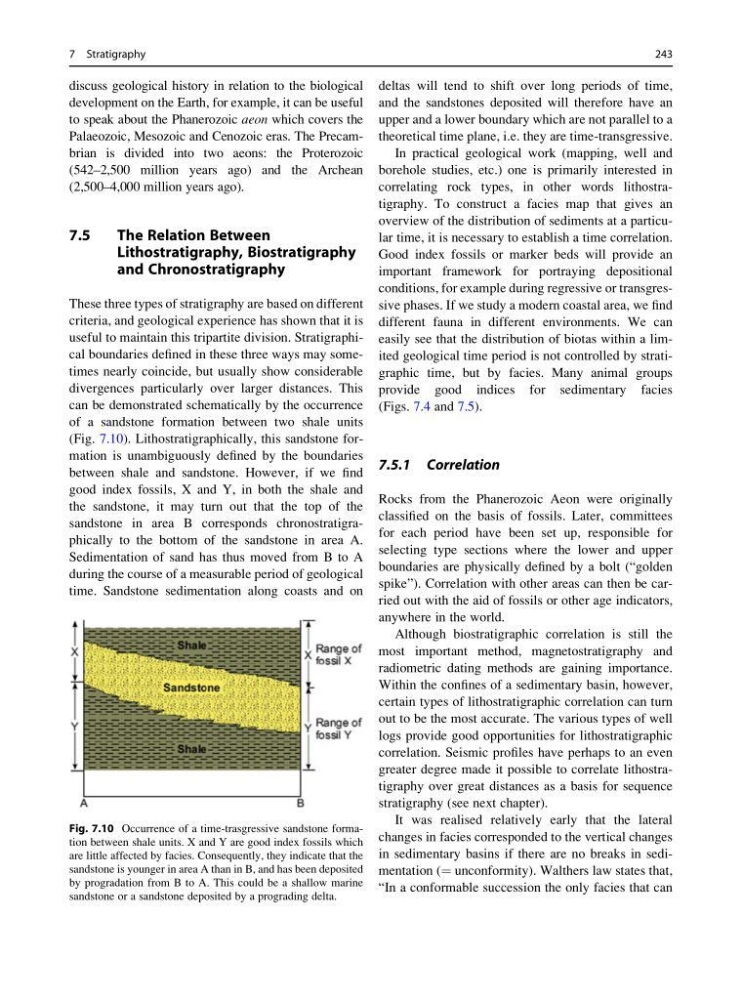
can be demonstrated schematically by the occurrence
of a sandstone formation between two shale units
(Fig. 7.10). Lithostratigraphically, this sandstone formation is unambiguously defined by the boundaries
between shale and sandstone. However, if we find
good index fossils, X and Y, in both the shale and
the sandstone, it may turn out that the top of the
sandstone in area B corresponds chronostratigraphically to the bottom of the sandstone in area A.
Sedimentation of sand has thus moved from B to A
during the course of a measurable period of geological
time. Sandstone sedimentation along coasts and on
deltas will tend to shift over long periods of time,
and the sandstones deposited will therefore have an
upper and a lower boundary which are not parallel to a
theoretical time plane, i.e. they are time-transgressive.
In practical geological work (mapping, well and
borehole studies, etc.) one is primarily interested in
correlating rock types, in other words lithostratigraphy. To construct a facies map that gives an
overview of the distribution of sediments at a particular time, it is necessary to establish a time correlation.
Good index fossils or marker beds will provide an
important framework for portraying depositional
conditions, for example during regressive or transgressive phases. If we study a modern coastal area, we find
different fauna in different environments. We can
easily see that the distribution of biotas within a limited geological time period is not controlled by stratigraphic time, but by facies. Many animal groups
provide good indices for sedimentary facies
(Figs. 7.4 and 7.5).
7.5.1 Correlation
Rocks from the Phanerozoic Aeon were originally
classified on the basis of fossils. Later, committees
for each period have been set up, responsible for
selecting type sections where the lower and upper
boundaries are physically defined by a bolt (“golden
spike”). Correlation with other areas can then be carried out with the aid of fossils or other age indicators,
anywhere in the world.
Although biostratigraphic correlation is still the
most important method, magnetostratigraphy and
radiometric dating methods are gaining importance.
Within the confines of a sedimentary basin, however,
certain types of lithostratigraphic correlation can turn
out to be the most accurate. The various types of well
logs provide good opportunities for lithostratigraphic
correlation. Seismic profiles have perhaps to an even
greater degree made it possible to correlate lithostratigraphy over great distances as a basis for sequence
stratigraphy (see next chapter).
It was realised relatively early that the lateral
changes in facies corresponded to the vertical changes
in sedimentary basins if there are no breaks in sedimentation (¼ unconformity). Walthers law states that,
“In a conformable succession the only facies that can
Fig. 7.10 Occurrence of a time-trasgressive sandstone formation between shale units. X and Y are good index fossils which
are little affected by facies. Consequently, they indicate that the
sandstone is younger in area A than in B, and has been deposited
by progradation from B to A. This could be a shallow marine
sandstone or a sandstone deposited by a prograding delta.
7 Stratigraphy
243
development on the Earth, for example, it can be useful
to speak about the Phanerozoic aeon which covers the
Palaeozoic, Mesozoic and Cenozoic eras. The Precambrian is divided into two aeons: the Proterozoic
(542–2,500 million years ago) and the Archean
(2,500–4,000 million years ago).
7.5
The Relation Between
Lithostratigraphy, Biostratigraphy
and Chronostratigraphy
These three types of stratigraphy are based on different
criteria, and geological experience has shown that it is
useful to maintain this tripartite division. Stratigraphical boundaries defined in these three ways may sometimes nearly coincide, but usually show considerable
divergences particularly over larger distances. This
can be demonstrated schematically by the occurrence
of a sandstone formation between two shale units
(Fig. 7.10). Lithostratigraphically, this sandstone formation is unambiguously defined by the boundaries
between shale and sandstone. However, if we find
good index fossils, X and Y, in both the shale and
the sandstone, it may turn out that the top of the
sandstone in area B corresponds chronostratigraphically to the bottom of the sandstone in area A.
Sedimentation of sand has thus moved from B to A
during the course of a measurable period of geological
time. Sandstone sedimentation along coasts and on
deltas will tend to shift over long periods of time,
and the sandstones deposited will therefore have an
upper and a lower boundary which are not parallel to a
theoretical time plane, i.e. they are time-transgressive.
In practical geological work (mapping, well and
borehole studies, etc.) one is primarily interested in
correlating rock types, in other words lithostratigraphy. To construct a facies map that gives an
overview of the distribution of sediments at a particular time, it is necessary to establish a time correlation.
Good index fossils or marker beds will provide an
important framework for portraying depositional
conditions, for example during regressive or transgressive phases. If we study a modern coastal area, we find
different fauna in different environments. We can
easily see that the distribution of biotas within a limited geological time period is not controlled by stratigraphic time, but by facies. Many animal groups
provide good indices for sedimentary facies
(Figs. 7.4 and 7.5).
7.5.1 Correlation
Rocks from the Phanerozoic Aeon were originally
classified on the basis of fossils. Later, committees
for each period have been set up, responsible for
selecting type sections where the lower and upper
boundaries are physically defined by a bolt (“golden
spike”). Correlation with other areas can then be carried out with the aid of fossils or other age indicators,
anywhere in the world.
Although biostratigraphic correlation is still the
most important method, magnetostratigraphy and
radiometric dating methods are gaining importance.
Within the confines of a sedimentary basin, however,
certain types of lithostratigraphic correlation can turn
out to be the most accurate. The various types of well
logs provide good opportunities for lithostratigraphic
correlation. Seismic profiles have perhaps to an even
greater degree made it possible to correlate lithostratigraphy over great distances as a basis for sequence
stratigraphy (see next chapter).
It was realised relatively early that the lateral
changes in facies corresponded to the vertical changes
in sedimentary basins if there are no breaks in sedimentation (¼ unconformity). Walthers law states that,
“In a conformable succession the only facies that can
Fig. 7.10 Occurrence of a time-trasgressive sandstone formation between shale units. X and Y are good index fossils which
are little affected by facies. Consequently, they indicate that the
sandstone is younger in area A than in B, and has been deposited
by progradation from B to A. This could be a shallow marine
sandstone or a sandstone deposited by a prograding delta.
7 Stratigraphy
243