

biozone ought to belong to a fossil group which
underwent rapid biological evolution and had a global
distribution. It should not have had special environmental requirements, and should have been cosmopolitan
with respect to habitat. One such fossil group is the
graptolites, which are common in Cambro-Silurian
shales. They were planktonic and drifted in the surface
seawater. However, even this type of plankton may
show a distribution pattern which is influenced by
ocean currents and temperatures etc. At the present,
microfossils are being used more and more for biostratigraphic correlation particularly by the petroleum industry. Several animal and plant groups (e.g. conodonts,
planktonic foraminifera, radiolarians and spores and
pollen) have wide distributions and have the advantage
that even small samples, e.g. from boreholes, provide
adequate material for statistical treatment.
Although fossils are always helpful in stratigraphic
correlations, we now avoid defining important geological boundaries, for example that between the Ordovician and the Silurian, by means of fossil occurrences.
Such a boundary would have to be moved whenever
one found a new occurrence of a certain fossil. The
geological periods are at the present defined by international committees which select a type section with
continuous sedimentation and preferably fossiliferous
record, and the boundary is physically marked as a
fixed point in the section. The boundary is then unambiguously defined. All available means can then be
used, including fossils, to correlate the boundary
with other areas. This is the principle of the arbitrary
boundary. In reality it is not entirely arbitrary. We try
to put it on a section with optimal potential for correlation with other areas and the global time scale
(Fig. 7.9).
Geologists used to define a stratigraphic boundary
at a break (hiatus) in the sedimentary record. However,
sediments later found elsewhere that had been deposited in the period represented by the hiatus, could not
be assigned to either unit. For example, the boundary
between the Tertiary and Cretaceous was defined in
England where a hiatus is developed between these
systems. As a result it was difficult to reach agreement
on whether sediments which were deposited for example in Denmark during this period (Danian), should
belong to the Cretaceous or the Tertiary.
7.4
Time Stratigraphy
Chronostratigraphy is an attempt to correlate rocks
deposited at the same time, across larger areas. The
accuracy achievable with chronostratigraphic correlation depends on whether the sediments contain evidence of well-defined geological events which were
simultaneous across the region. These events may be
biological (e.g. appearance of particular species), sedimentological (e.g. deposition of ash layers) or geophysical (e.g. reversals of the Earth’s magnetic field).
Stratigraphical research has a long tradition of
correlating synchronous events in geological history.
Such correlations are independent of an absolute time
scale. Only after the development of radiometric dating
methods did it become possible to set up a series of
Open ocean
Shelf
Inner
Middle
Outer
Time
ma
Appearance
Disappearance
Taxon
chronozone
Biozone boundary
Local range zone
Extinction
Evolutionary
appearance
Total range
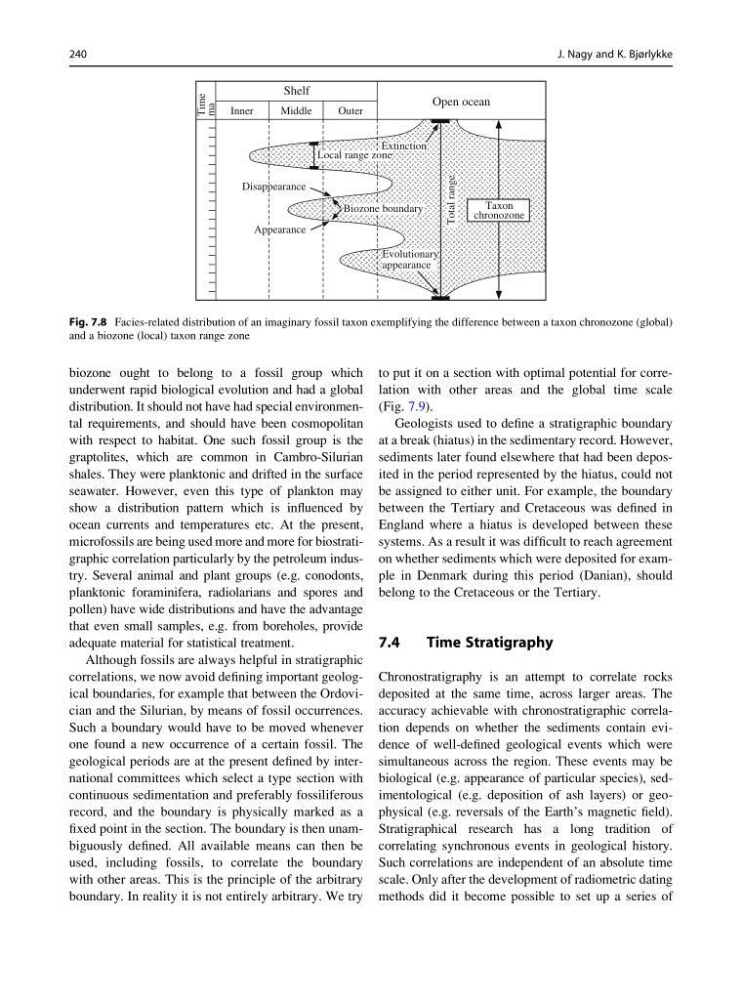
Fig. 7.8 Facies-related distribution of an imaginary fossil taxon exemplifying the difference between a taxon chronozone (global)
and a biozone (local) taxon range zone
240
J. Nagy and K. Bjørlykke
underwent rapid biological evolution and had a global
distribution. It should not have had special environmental requirements, and should have been cosmopolitan
with respect to habitat. One such fossil group is the
graptolites, which are common in Cambro-Silurian
shales. They were planktonic and drifted in the surface
seawater. However, even this type of plankton may
show a distribution pattern which is influenced by
ocean currents and temperatures etc. At the present,
microfossils are being used more and more for biostratigraphic correlation particularly by the petroleum industry. Several animal and plant groups (e.g. conodonts,
planktonic foraminifera, radiolarians and spores and
pollen) have wide distributions and have the advantage
that even small samples, e.g. from boreholes, provide
adequate material for statistical treatment.
Although fossils are always helpful in stratigraphic
correlations, we now avoid defining important geological boundaries, for example that between the Ordovician and the Silurian, by means of fossil occurrences.
Such a boundary would have to be moved whenever
one found a new occurrence of a certain fossil. The
geological periods are at the present defined by international committees which select a type section with
continuous sedimentation and preferably fossiliferous
record, and the boundary is physically marked as a
fixed point in the section. The boundary is then unambiguously defined. All available means can then be
used, including fossils, to correlate the boundary
with other areas. This is the principle of the arbitrary
boundary. In reality it is not entirely arbitrary. We try
to put it on a section with optimal potential for correlation with other areas and the global time scale
(Fig. 7.9).
Geologists used to define a stratigraphic boundary
at a break (hiatus) in the sedimentary record. However,
sediments later found elsewhere that had been deposited in the period represented by the hiatus, could not
be assigned to either unit. For example, the boundary
between the Tertiary and Cretaceous was defined in
England where a hiatus is developed between these
systems. As a result it was difficult to reach agreement
on whether sediments which were deposited for example in Denmark during this period (Danian), should
belong to the Cretaceous or the Tertiary.
7.4
Time Stratigraphy
Chronostratigraphy is an attempt to correlate rocks
deposited at the same time, across larger areas. The
accuracy achievable with chronostratigraphic correlation depends on whether the sediments contain evidence of well-defined geological events which were
simultaneous across the region. These events may be
biological (e.g. appearance of particular species), sedimentological (e.g. deposition of ash layers) or geophysical (e.g. reversals of the Earth’s magnetic field).
Stratigraphical research has a long tradition of
correlating synchronous events in geological history.
Such correlations are independent of an absolute time
scale. Only after the development of radiometric dating
methods did it become possible to set up a series of
Open ocean
Shelf
Inner
Middle
Outer
Time
ma
Appearance
Disappearance
Taxon
chronozone
Biozone boundary
Local range zone
Extinction
Evolutionary
appearance
Total range
Fig. 7.8 Facies-related distribution of an imaginary fossil taxon exemplifying the difference between a taxon chronozone (global)
and a biozone (local) taxon range zone
240
J. Nagy and K. Bjørlykke