

7.3.3.2 Other Biozones
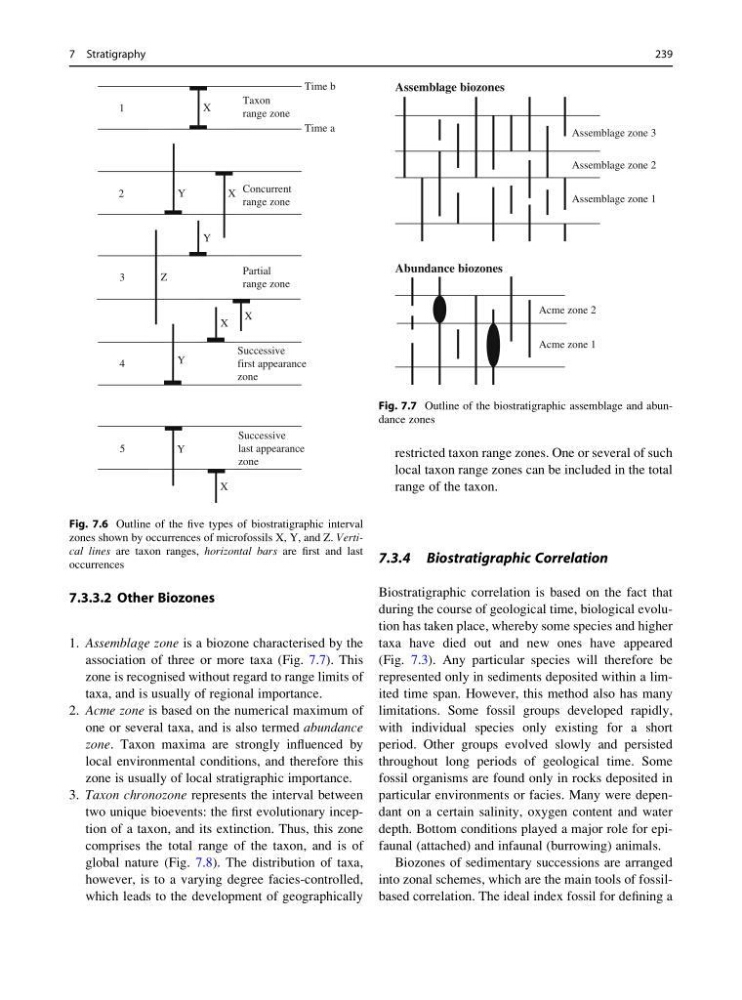
1. Assemblage zone is a biozone characterised by the
association of three or more taxa (Fig. 7.7). This
zone is recognised without regard to range limits of
taxa, and is usually of regional importance.
2. Acme zone is based on the numerical maximum of
one or several taxa, and is also termed abundance
zone. Taxon maxima are strongly influenced by
local environmental conditions, and therefore this
zone is usually of local stratigraphic importance.
3. Taxon chronozone represents the interval between
two unique bioevents: the first evolutionary inception of a taxon, and its extinction. Thus, this zone
comprises the total range of the taxon, and is of
global nature (Fig. 7.8). The distribution of taxa,
however, is to a varying degree facies-controlled,
which leads to the development of geographically
restricted taxon range zones. One or several of such
local taxon range zones can be included in the total
range of the taxon.
7.3.4 Biostratigraphic Correlation
Biostratigraphic correlation is based on the fact that
during the course of geological time, biological evolution has taken place, whereby some species and higher
taxa have died out and new ones have appeared
(Fig. 7.3). Any particular species will therefore be
represented only in sediments deposited within a limited time span. However, this method also has many
limitations. Some fossil groups developed rapidly,
with individual species only existing for a short
period. Other groups evolved slowly and persisted
throughout long periods of geological time. Some
fossil organisms are found only in rocks deposited in
particular environments or facies. Many were dependant on a certain salinity, oxygen content and water
depth. Bottom conditions played a major role for epifaunal (attached) and infaunal (burrowing) animals.
Biozones of sedimentary successions are arranged
into zonal schemes, which are the main tools of fossilbased correlation. The ideal index fossil for defining a
Assemblage biozones
Abundance biozones
Assemblage zone 3
Assemblage zone 2
Assemblage zone 1
Acme zone 2
Acme zone 1
Fig. 7.7 Outline of the biostratigraphic assemblage and abundance zones
Taxon
range zone
Concurrent
range zone
Partial
range zone
Successive
first appearance
zone
Successive
last appearance
zone
Time b
Time a
1
X
2
X
Y
Y
3
Z
Y
Y
4
5
X
X
X
Fig. 7.6 Outline of the five types of biostratigraphic interval
zones shown by occurrences of microfossils X, Y, and Z. Vertical lines are taxon ranges, horizontal bars are first and last
occurrences
7 Stratigraphy
239
1. Assemblage zone is a biozone characterised by the
association of three or more taxa (Fig. 7.7). This
zone is recognised without regard to range limits of
taxa, and is usually of regional importance.
2. Acme zone is based on the numerical maximum of
one or several taxa, and is also termed abundance
zone. Taxon maxima are strongly influenced by
local environmental conditions, and therefore this
zone is usually of local stratigraphic importance.
3. Taxon chronozone represents the interval between
two unique bioevents: the first evolutionary inception of a taxon, and its extinction. Thus, this zone
comprises the total range of the taxon, and is of
global nature (Fig. 7.8). The distribution of taxa,
however, is to a varying degree facies-controlled,
which leads to the development of geographically
restricted taxon range zones. One or several of such
local taxon range zones can be included in the total
range of the taxon.
7.3.4 Biostratigraphic Correlation
Biostratigraphic correlation is based on the fact that
during the course of geological time, biological evolution has taken place, whereby some species and higher
taxa have died out and new ones have appeared
(Fig. 7.3). Any particular species will therefore be
represented only in sediments deposited within a limited time span. However, this method also has many
limitations. Some fossil groups developed rapidly,
with individual species only existing for a short
period. Other groups evolved slowly and persisted
throughout long periods of geological time. Some
fossil organisms are found only in rocks deposited in
particular environments or facies. Many were dependant on a certain salinity, oxygen content and water
depth. Bottom conditions played a major role for epifaunal (attached) and infaunal (burrowing) animals.
Biozones of sedimentary successions are arranged
into zonal schemes, which are the main tools of fossilbased correlation. The ideal index fossil for defining a
Assemblage biozones
Abundance biozones
Assemblage zone 3
Assemblage zone 2
Assemblage zone 1
Acme zone 2
Acme zone 1
Fig. 7.7 Outline of the biostratigraphic assemblage and abundance zones
Taxon
range zone
Concurrent
range zone
Partial
range zone
Successive
first appearance
zone
Successive
last appearance
zone
Time b
Time a
1
X
2
X
Y
Y
3
Z
Y
Y
4
5
X
X
X
Fig. 7.6 Outline of the five types of biostratigraphic interval
zones shown by occurrences of microfossils X, Y, and Z. Vertical lines are taxon ranges, horizontal bars are first and last
occurrences
7 Stratigraphy
239