

Most black shales (source rocks) contain some carbonate layers or concretions which would neutralise
organic acids and CO 2 generated during maturation of
kerogen. In the absence of carbonate, black shales
would generate acid porewater but this would be
neutralised rapidly in contact with sediments
containing calcite.
To increase the porosity of a 100 m thick limestone
by 1%, 1 m
3 of calcite would have to be removed in
solution (Fig. 5.65). This would require 27 000
volumes of porewater assuming 100 ppm)
undersaturation with respect to calcite. Even if the
porewater contained relatively high concentrations of
organic acids, very large fluxes would be required to
produce a significant net increase in (secondary)
porosity (Barth and Bjørlykke 1993).
The potential for increasing the porosity of carbonate sediments is therefore very low except due to
meteoric water flushing at rather shallow depth. Even
if meteoric water can flow in porous carbonate
sediments far offshore the porewater will rather
quickly approach saturation with respect to calcite.
Nearly all the dissolution will occur in the proximal
parts where the meteoric water is recharged.
Early calcite cementation due to dissolution of
aragonite may produce hard and mechanically stable
limestones at shallow depth. Mechanical tests of
shallow carbonates offshore Australia show that they
would undergo very little mechanical compaction
(strain) if subjected to stress of 40–50 MPa,
corresponding to burial depth of 4–5 km (Croize ´
et al. 2010). This means that most of the porosity
reduction would be chemical. In the case of
sandstones, chemical compaction is mostly controlled
by temperature due to the kinetics of quartz precipitation. In carbonates temperature is less important and
the compaction rate is a very complex function of the
distribution of stress on grain contacts and along
stylolites.
In conclusion prediction of porosity in carbonate
rocks must be based on the primary sediment composition and facies relationships, controlling chemical
and mechanical compaction.
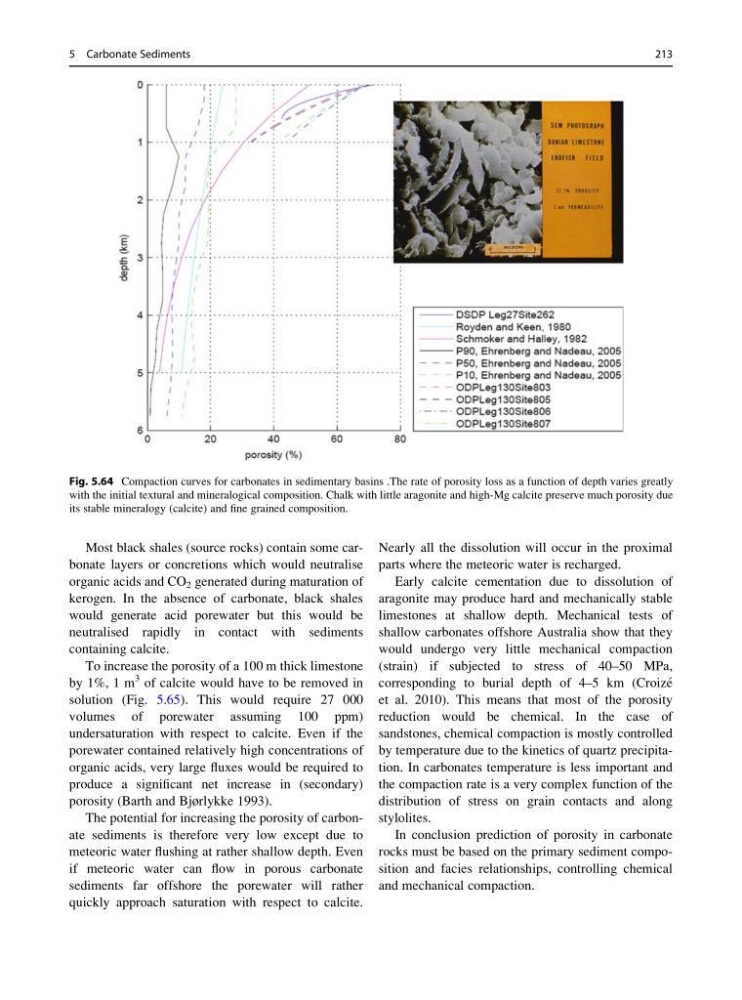
Fig. 5.64 Compaction curves for carbonates in sedimentary basins .The rate of porosity loss as a function of depth varies greatly
with the initial textural and mineralogical composition. Chalk with little aragonite and high-Mg calcite preserve much porosity due
its stable mineralogy (calcite) and fine grained composition.
5 Carbonate Sediments
213
organic acids and CO 2 generated during maturation of
kerogen. In the absence of carbonate, black shales
would generate acid porewater but this would be
neutralised rapidly in contact with sediments
containing calcite.
To increase the porosity of a 100 m thick limestone
by 1%, 1 m
3 of calcite would have to be removed in
solution (Fig. 5.65). This would require 27 000
volumes of porewater assuming 100 ppm)
undersaturation with respect to calcite. Even if the
porewater contained relatively high concentrations of
organic acids, very large fluxes would be required to
produce a significant net increase in (secondary)
porosity (Barth and Bjørlykke 1993).
The potential for increasing the porosity of carbonate sediments is therefore very low except due to
meteoric water flushing at rather shallow depth. Even
if meteoric water can flow in porous carbonate
sediments far offshore the porewater will rather
quickly approach saturation with respect to calcite.
Nearly all the dissolution will occur in the proximal
parts where the meteoric water is recharged.
Early calcite cementation due to dissolution of
aragonite may produce hard and mechanically stable
limestones at shallow depth. Mechanical tests of
shallow carbonates offshore Australia show that they
would undergo very little mechanical compaction
(strain) if subjected to stress of 40–50 MPa,
corresponding to burial depth of 4–5 km (Croize ´
et al. 2010). This means that most of the porosity
reduction would be chemical. In the case of
sandstones, chemical compaction is mostly controlled
by temperature due to the kinetics of quartz precipitation. In carbonates temperature is less important and
the compaction rate is a very complex function of the
distribution of stress on grain contacts and along
stylolites.
In conclusion prediction of porosity in carbonate
rocks must be based on the primary sediment composition and facies relationships, controlling chemical
and mechanical compaction.
Fig. 5.64 Compaction curves for carbonates in sedimentary basins .The rate of porosity loss as a function of depth varies greatly
with the initial textural and mineralogical composition. Chalk with little aragonite and high-Mg calcite preserve much porosity due
its stable mineralogy (calcite) and fine grained composition.
5 Carbonate Sediments
213