

few micrometres in coccolithophores to more than
a metre in some bivalves and sponges. Apart from
grain type, grain size is also dependent on mechanical
abrasion and bio-erosion prior to final burial.
These physical and biological processes can be
described as:
• Mechanical destruction. The rate of abrasion is
highly dependent on the transport mechanism and
energy available in the environment for particle
movement. Shell fragments and other skeletal
particles are rapidly crushed and ground down to
become structurally unrecognisable in a highenergy environment such as a surf zone, while in
low-energy environments the integrity of the original material may remain more or less intact.
Mechanical destruction of skeletal material has
characteristic rates of destruction, depending on
shell thickness, microstructure and possible prior
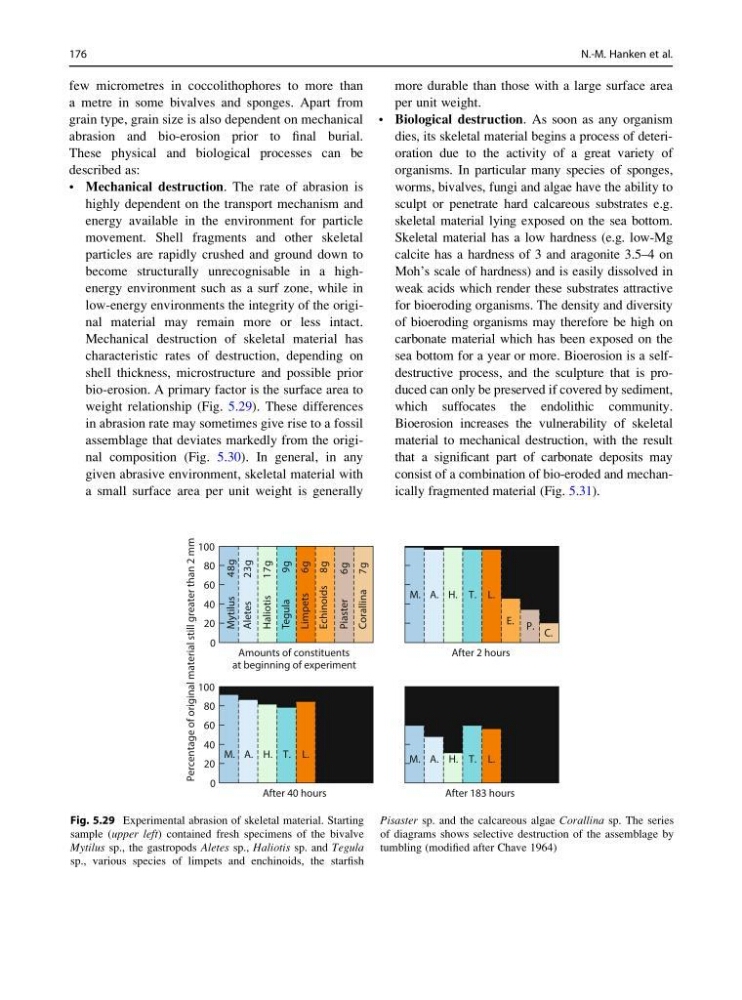
bio-erosion. A primary factor is the surface area to
weight relationship (Fig. 5.29). These differences
in abrasion rate may sometimes give rise to a fossil
assemblage that deviates markedly from the original composition (Fig. 5.30). In general, in any
given abrasive environment, skeletal material with
a small surface area per unit weight is generally
more durable than those with a large surface area
per unit weight.
• Biological destruction. As soon as any organism
dies, its skeletal material begins a process of deterioration due to the activity of a great variety of
organisms. In particular many species of sponges,
worms, bivalves, fungi and algae have the ability to
sculpt or penetrate hard calcareous substrates e.g.
skeletal material lying exposed on the sea bottom.
Skeletal material has a low hardness (e.g. low-Mg
calcite has a hardness of 3 and aragonite 3.5–4 on
Moh’s scale of hardness) and is easily dissolved in
weak acids which render these substrates attractive
for bioeroding organisms. The density and diversity
of bioeroding organisms may therefore be high on
carbonate material which has been exposed on the
sea bottom for a year or more. Bioerosion is a selfdestructive process, and the sculpture that is produced can only be preserved if covered by sediment,
which suffocates the endolithic community.
Bioerosion increases the vulnerability of skeletal
material to mechanical destruction, with the result
that a significant part of carbonate deposits may
consist of a combination of bio-eroded and mechanically fragmented material (Fig. 5.31).
100
100
80
80
60
60
40
40
20
20
0
0
Amounts of constituents
at beginning of experiment
After 40 hours
Percentage of original material still greater than 2 mm
After 183 hours
After 2 hours
M.
M.
M.
A.
A.
A.
H.
H.
H.
T.
T.
T.
L.
L.
L.
E. P. C.
Mytilus
48g
Aletes
23g
Haliotis
17g
Tegula
9g
Limpets
6g
Echinoids 8g
Piaster
6g
Corallina 7g
Fig. 5.29 Experimental abrasion of skeletal material. Starting
sample (upper left) contained fresh specimens of the bivalve
Mytilus sp., the gastropods Aletes sp., Haliotis sp. and Tegula
sp., various species of limpets and enchinoids, the starfish
Pisaster sp. and the calcareous algae Corallina sp. The series
of diagrams shows selective destruction of the assemblage by
tumbling (modified after Chave 1964)
176
N.-M. Hanken et al.
a metre in some bivalves and sponges. Apart from
grain type, grain size is also dependent on mechanical
abrasion and bio-erosion prior to final burial.
These physical and biological processes can be
described as:
• Mechanical destruction. The rate of abrasion is
highly dependent on the transport mechanism and
energy available in the environment for particle
movement. Shell fragments and other skeletal
particles are rapidly crushed and ground down to
become structurally unrecognisable in a highenergy environment such as a surf zone, while in
low-energy environments the integrity of the original material may remain more or less intact.
Mechanical destruction of skeletal material has
characteristic rates of destruction, depending on
shell thickness, microstructure and possible prior
bio-erosion. A primary factor is the surface area to
weight relationship (Fig. 5.29). These differences
in abrasion rate may sometimes give rise to a fossil
assemblage that deviates markedly from the original composition (Fig. 5.30). In general, in any
given abrasive environment, skeletal material with
a small surface area per unit weight is generally
more durable than those with a large surface area
per unit weight.
• Biological destruction. As soon as any organism
dies, its skeletal material begins a process of deterioration due to the activity of a great variety of
organisms. In particular many species of sponges,
worms, bivalves, fungi and algae have the ability to
sculpt or penetrate hard calcareous substrates e.g.
skeletal material lying exposed on the sea bottom.
Skeletal material has a low hardness (e.g. low-Mg
calcite has a hardness of 3 and aragonite 3.5–4 on
Moh’s scale of hardness) and is easily dissolved in
weak acids which render these substrates attractive
for bioeroding organisms. The density and diversity
of bioeroding organisms may therefore be high on
carbonate material which has been exposed on the
sea bottom for a year or more. Bioerosion is a selfdestructive process, and the sculpture that is produced can only be preserved if covered by sediment,
which suffocates the endolithic community.
Bioerosion increases the vulnerability of skeletal
material to mechanical destruction, with the result
that a significant part of carbonate deposits may
consist of a combination of bio-eroded and mechanically fragmented material (Fig. 5.31).
100
100
80
80
60
60
40
40
20
20
0
0
Amounts of constituents
at beginning of experiment
After 40 hours
Percentage of original material still greater than 2 mm
After 183 hours
After 2 hours
M.
M.
M.
A.
A.
A.
H.
H.
H.
T.
T.
T.
L.
L.
L.
E. P. C.
Mytilus
48g
Aletes
23g
Haliotis
17g
Tegula
9g
Limpets
6g
Echinoids 8g
Piaster
6g
Corallina 7g
Fig. 5.29 Experimental abrasion of skeletal material. Starting
sample (upper left) contained fresh specimens of the bivalve
Mytilus sp., the gastropods Aletes sp., Haliotis sp. and Tegula
sp., various species of limpets and enchinoids, the starfish
Pisaster sp. and the calcareous algae Corallina sp. The series
of diagrams shows selective destruction of the assemblage by
tumbling (modified after Chave 1964)
176
N.-M. Hanken et al.