

reservoir. In fractured reservoirs the permeability may
be high even when the porosity is below 10%.
In the planning of production from an oil field, data
from cores and logs from wells must be extrapolated
into a 3D model of the flow properties of the reservoir.
The producible percentage of the oil in place is
called the recovery factor, which may range from
20–30% up to 40–60%. In sandstones with good reservoir quality, improved production technology has in
some cases (e.g. Statfjord and Gullfaks fields, offshore
Norway) boosted the recovery factor to close on 70%.
Recovery is limited both by the amount of oil
remaining in the pores of the drained sandstones and
the presence of undrained compartments within the
reservoir where oil is bypassed. Reservoir quality is a
very important factor in the financial risk assessment
calculations for a prospect.
4.21 Conclusions
Diagenetic reactions are driven towards higher
mechanical and chemical stability. Reactions in
sandstones are driven by the effective stress from the
overburden causing reduced porosity (volume) at
temperatures below 70–80
C. At greater depth (higher
temperatures) compaction is mostly chemical and
mineral reactions are controlled by thermodynamics
and kinetics. Because of low kinetic reaction rates
(high activation energies) silicate reactions are very
sensitive to temperature. The precipitation of quartz is
slow and has high activation energy, and temperature
is the main control on quartz cementation causing
much of the porosity loss in well-sorted sandstones.
The dissolution of K-feldspar and kaolinite at about
130
C occur because the mineral assemblage illite and
quartz is more stable.
Because of the low solubility of silicate minerals
and the limited flow of porewater in the deeper parts of
sedimentary basins, burial diagenetic reactions must
be nearly isochemical. Significant amounts of solids
can not be exported from a sandstone and the porosity
of a single reservoir rock will only decrease and can
not increase during progressive burial.
Prediction of reservoir quality at great burial depth
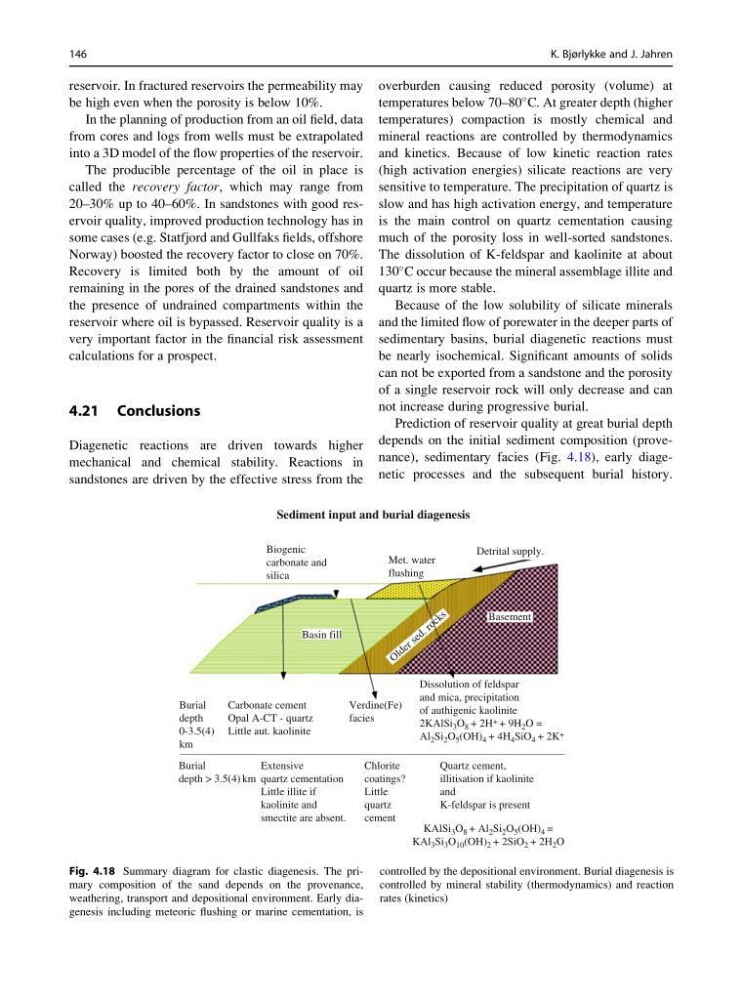
depends on the initial sediment composition (provenance), sedimentary facies (Fig. 4.18), early diagenetic processes and the subsequent burial history.
Sediment input and burial diagenesis
Biogenic
carbonate and
silica
Met. water
flushing
Detrital supply.
Basin fill
Chlorite
coatings?
Little
quartz
cement
Burial
depth
0-3.5(4)
km
Burial
depth > 3.5(4) km
Extensive
quartz cementation
Little illite if
kaolinite and
smectite are absent.
Basement
O l d e r s e d . r o c k s
Carbonate cement
Opal A-CT - quartz
Little aut. kaolinite
Verdine(Fe)
facies
Quartz cement,
illitisation if kaolinite
and
K-feldspar is present
Dissolution of feldspar
and mica, precipitation
of authigenic kaolinite
2KAlSi 3 O 8 + 2H + + 9H 2 O =
Al 2 Si 2 O 5 (OH) 4 + 4H 4 SiO 4 + 2K +
KAlSi 3 O 8 + Al 2 Si 2 O 5 (OH) 4 =
KAl 3 Si 3 O 10 (OH) 2 + 2SiO 2 + 2H 2 O
Fig. 4.18 Summary diagram for clastic diagenesis. The primary composition of the sand depends on the provenance,
weathering, transport and depositional environment. Early diagenesis including meteoric flushing or marine cementation, is
controlled by the depositional environment. Burial diagenesis is
controlled by mineral stability (thermodynamics) and reaction
rates (kinetics)
146
K. Bjørlykke and J. Jahren
be high even when the porosity is below 10%.
In the planning of production from an oil field, data
from cores and logs from wells must be extrapolated
into a 3D model of the flow properties of the reservoir.
The producible percentage of the oil in place is
called the recovery factor, which may range from
20–30% up to 40–60%. In sandstones with good reservoir quality, improved production technology has in
some cases (e.g. Statfjord and Gullfaks fields, offshore
Norway) boosted the recovery factor to close on 70%.
Recovery is limited both by the amount of oil
remaining in the pores of the drained sandstones and
the presence of undrained compartments within the
reservoir where oil is bypassed. Reservoir quality is a
very important factor in the financial risk assessment
calculations for a prospect.
4.21 Conclusions
Diagenetic reactions are driven towards higher
mechanical and chemical stability. Reactions in
sandstones are driven by the effective stress from the
overburden causing reduced porosity (volume) at
temperatures below 70–80
C. At greater depth (higher
temperatures) compaction is mostly chemical and
mineral reactions are controlled by thermodynamics
and kinetics. Because of low kinetic reaction rates
(high activation energies) silicate reactions are very
sensitive to temperature. The precipitation of quartz is
slow and has high activation energy, and temperature
is the main control on quartz cementation causing
much of the porosity loss in well-sorted sandstones.
The dissolution of K-feldspar and kaolinite at about
130
C occur because the mineral assemblage illite and
quartz is more stable.
Because of the low solubility of silicate minerals
and the limited flow of porewater in the deeper parts of
sedimentary basins, burial diagenetic reactions must
be nearly isochemical. Significant amounts of solids
can not be exported from a sandstone and the porosity
of a single reservoir rock will only decrease and can
not increase during progressive burial.
Prediction of reservoir quality at great burial depth
depends on the initial sediment composition (provenance), sedimentary facies (Fig. 4.18), early diagenetic processes and the subsequent burial history.
Sediment input and burial diagenesis
Biogenic
carbonate and
silica
Met. water
flushing
Detrital supply.
Basin fill
Chlorite
coatings?
Little
quartz
cement
Burial
depth
0-3.5(4)
km
Burial
depth > 3.5(4) km
Extensive
quartz cementation
Little illite if
kaolinite and
smectite are absent.
Basement
O l d e r s e d . r o c k s
Carbonate cement
Opal A-CT - quartz
Little aut. kaolinite
Verdine(Fe)
facies
Quartz cement,
illitisation if kaolinite
and
K-feldspar is present
Dissolution of feldspar
and mica, precipitation
of authigenic kaolinite
2KAlSi 3 O 8 + 2H + + 9H 2 O =
Al 2 Si 2 O 5 (OH) 4 + 4H 4 SiO 4 + 2K +
KAlSi 3 O 8 + Al 2 Si 2 O 5 (OH) 4 =
KAl 3 Si 3 O 10 (OH) 2 + 2SiO 2 + 2H 2 O
Fig. 4.18 Summary diagram for clastic diagenesis. The primary composition of the sand depends on the provenance,
weathering, transport and depositional environment. Early diagenesis including meteoric flushing or marine cementation, is
controlled by the depositional environment. Burial diagenesis is
controlled by mineral stability (thermodynamics) and reaction
rates (kinetics)
146
K. Bjørlykke and J. Jahren