

Well log data from distinct lithologies buried to
different depths may also provide a useful database
for predicting the porosity loss due to mechanical
compaction.
4.18 Burial Diagenesis and Reservoir
Quality
Porosity loss due to quartz cementation can be
modelled as a function of temperature, time and surface area available for quartz cementation. This is
sensitive to grain size and grain coatings, which must
be predicted from primary facies evaluation. The
source of silica for quartz cementation may be unstable silica minerals like opal A, opal CT, grain contact
dissolution or clay mineral reactions derived locally.
The presence of pore-filling illite depends on
precursors which may be smectite or kaolinite. Dissolution of kaolinite and precipitation of illite requires
temperatures above 130
C and the local presence of
K-feldspar. Sandstone containing mostly plagioclase
does not develop pore-filling illite as there is insufficient supply of potassium. Prediction of reservoir
quality can thus be based on provenance.
The examples of reservoir quality predictions listed
above are based on the assumption that burial diagenetic reactions are essentially isochemical. Open system diagenesis allowing large scale import and export
of solids in solution violates constraints from mineral
solubilities and fluid flow rates and therefore provides
a poor basis for prediction.
Statistical analyses show that the porosity is lost
as a function of depth and that below 4.0-4.5 km
burial depth the reservoir quality is in most cases
insufficient for economic production. There are however exceptions where relative good reservoir quality
is preserved despite burial to great depth (5-6 km).
This may be due to low geothermal gradients and high
burial rates. Clay coating is also an important factor
retarding quartz cementation and porosity loss. High
temperatures will also increase the degree of cementation in the shales and the permeabilities of seals may
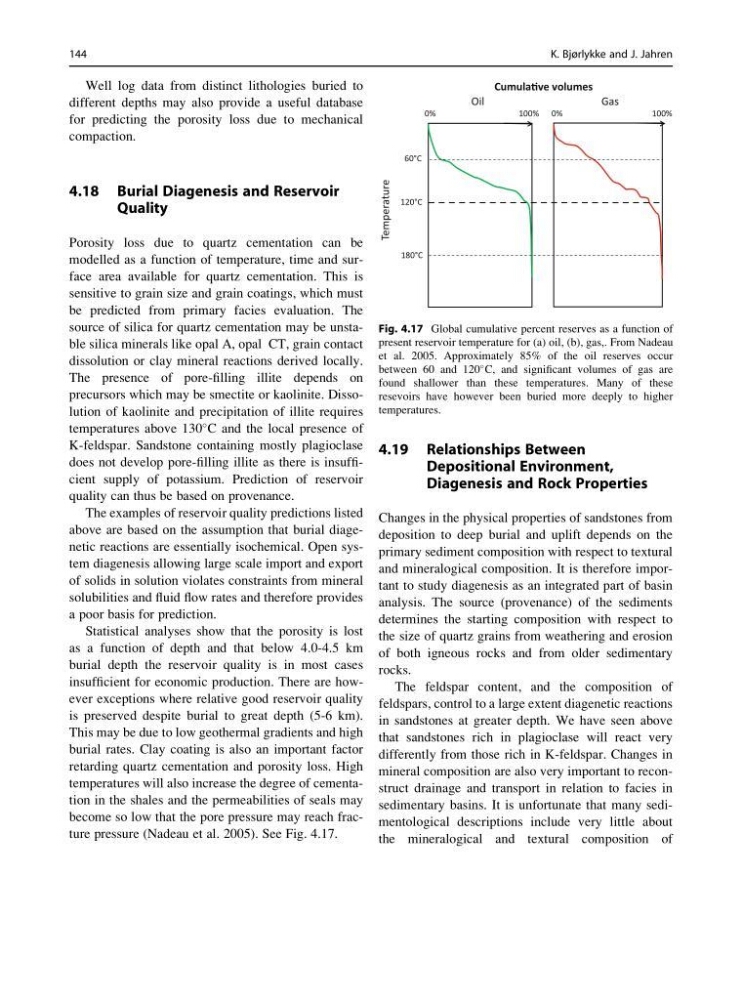
become so low that the pore pressure may reach fracture pressure (Nadeau et al. 2005). See Fig. 4.17.
4.19 Relationships Between
Depositional Environment,
Diagenesis and Rock Properties
Changes in the physical properties of sandstones from
deposition to deep burial and uplift depends on the
primary sediment composition with respect to textural
and mineralogical composition. It is therefore important to study diagenesis as an integrated part of basin
analysis. The source (provenance) of the sediments
determines the starting composition with respect to
the size of quartz grains from weathering and erosion
of both igneous rocks and from older sedimentary
rocks.
The feldspar content, and the composition of
feldspars, control to a large extent diagenetic reactions
in sandstones at greater depth. We have seen above
that sandstones rich in plagioclase will react very
differently from those rich in K-feldspar. Changes in
mineral composition are also very important to reconstruct drainage and transport in relation to facies in
sedimentary basins. It is unfortunate that many sedimentological descriptions include very little about
the mineralogical and textural composition of
100%
0%
100%
0%
60°C
120°C
180°C
Oil
Gas
CumulaƟve volumes
Temperature
Fig. 4.17 Global cumulative percent reserves as a function of
present reservoir temperature for (a) oil, (b), gas,. From Nadeau
et al. 2005. Approximately 85% of the oil reserves occur
between 60 and 120
C, and significant volumes of gas are
found shallower than these temperatures. Many of these
resevoirs have however been buried more deeply to higher
temperatures.
144
K. Bjørlykke and J. Jahren
different depths may also provide a useful database
for predicting the porosity loss due to mechanical
compaction.
4.18 Burial Diagenesis and Reservoir
Quality
Porosity loss due to quartz cementation can be
modelled as a function of temperature, time and surface area available for quartz cementation. This is
sensitive to grain size and grain coatings, which must
be predicted from primary facies evaluation. The
source of silica for quartz cementation may be unstable silica minerals like opal A, opal CT, grain contact
dissolution or clay mineral reactions derived locally.
The presence of pore-filling illite depends on
precursors which may be smectite or kaolinite. Dissolution of kaolinite and precipitation of illite requires
temperatures above 130
C and the local presence of
K-feldspar. Sandstone containing mostly plagioclase
does not develop pore-filling illite as there is insufficient supply of potassium. Prediction of reservoir
quality can thus be based on provenance.
The examples of reservoir quality predictions listed
above are based on the assumption that burial diagenetic reactions are essentially isochemical. Open system diagenesis allowing large scale import and export
of solids in solution violates constraints from mineral
solubilities and fluid flow rates and therefore provides
a poor basis for prediction.
Statistical analyses show that the porosity is lost
as a function of depth and that below 4.0-4.5 km
burial depth the reservoir quality is in most cases
insufficient for economic production. There are however exceptions where relative good reservoir quality
is preserved despite burial to great depth (5-6 km).
This may be due to low geothermal gradients and high
burial rates. Clay coating is also an important factor
retarding quartz cementation and porosity loss. High
temperatures will also increase the degree of cementation in the shales and the permeabilities of seals may
become so low that the pore pressure may reach fracture pressure (Nadeau et al. 2005). See Fig. 4.17.
4.19 Relationships Between
Depositional Environment,
Diagenesis and Rock Properties
Changes in the physical properties of sandstones from
deposition to deep burial and uplift depends on the
primary sediment composition with respect to textural
and mineralogical composition. It is therefore important to study diagenesis as an integrated part of basin
analysis. The source (provenance) of the sediments
determines the starting composition with respect to
the size of quartz grains from weathering and erosion
of both igneous rocks and from older sedimentary
rocks.
The feldspar content, and the composition of
feldspars, control to a large extent diagenetic reactions
in sandstones at greater depth. We have seen above
that sandstones rich in plagioclase will react very
differently from those rich in K-feldspar. Changes in
mineral composition are also very important to reconstruct drainage and transport in relation to facies in
sedimentary basins. It is unfortunate that many sedimentological descriptions include very little about
the mineralogical and textural composition of
100%
0%
100%
0%
60°C
120°C
180°C
Oil
Gas
CumulaƟve volumes
Temperature
Fig. 4.17 Global cumulative percent reserves as a function of
present reservoir temperature for (a) oil, (b), gas,. From Nadeau
et al. 2005. Approximately 85% of the oil reserves occur
between 60 and 120
C, and significant volumes of gas are
found shallower than these temperatures. Many of these
resevoirs have however been buried more deeply to higher
temperatures.
144
K. Bjørlykke and J. Jahren