

Prospects at great depth called HTHP (High Temperature, High Pressure) are expensive to drill and
involve high risks, but in many mature basins nearly
all the shallower prospects have been drilled already.
An extensive study of reservoir sandstones in the
Gulf of Mexico showed that temperature and time are
the main factors controlling reservoir quality (Nadeau
et al. 2008).
4.17 Practical Prediction of Reservoir
Quality
The most important factor controlling reservoir quality
at depth is the primary composition of the sandstones.
Sedimentological and sequence stratigraphic analyses
are normally used primarily to predict reservoir geometry, but for diagenetic processes grain size, sorting
and mineralogical composition are more critical. It is
imperative to establish changes in provenance since
the primary mineralogy places important constraints
on diagenetic reactions at depth.
Reconstructions of facies and climate will provide a
basis for predicting the degree of feldspar dissolution
and precipitation of pore-filling kaolinite. Biogenic
components like calcareous and siliceous organisms
will control the distribution of carbonate cements and
opal A, which will be altered to opal CT and quartz.
Primary aragonite may cause extensive calcite cementation that occludes much of the primary porosity.
Organic silica, e.g. from siliceous sponges, may
serve as a precursor to grain-coating microquartz preserving porosity at depth.
Porosity loss due to mechanical compaction can
vary greatly as a function of textural and mineralogical
composition. Experimental compaction of loose sands
with different grain size and sorting provides a good
basis for prediction of porosity and inter-granular volume before quartz cementation. In cold sedimentary
basins (low geothermal gradient) sand may be buried
to 4–5 km before there is significant quartz cementation and in the absence of overpressure it can be
subjected to 40–50 MPa effective stress.
2000
Velocity (m/s)
1500
2000
2500
3000
Metres below seafloor
3500
Etive Formation
Etive formation
Vertical effective stress (MPa)
3000
4000
1500
3500
1.5
24
0
5
10
15
20
25
30
35
40
45
50
0.71 mm
0.1 mm
26 28 30 32 34 36 38 40 42 44
2.0
2.5
Bulk density (g/cm
3
)
Porosity (%)
30
%
15%
35%
40% ϕ
ϕ
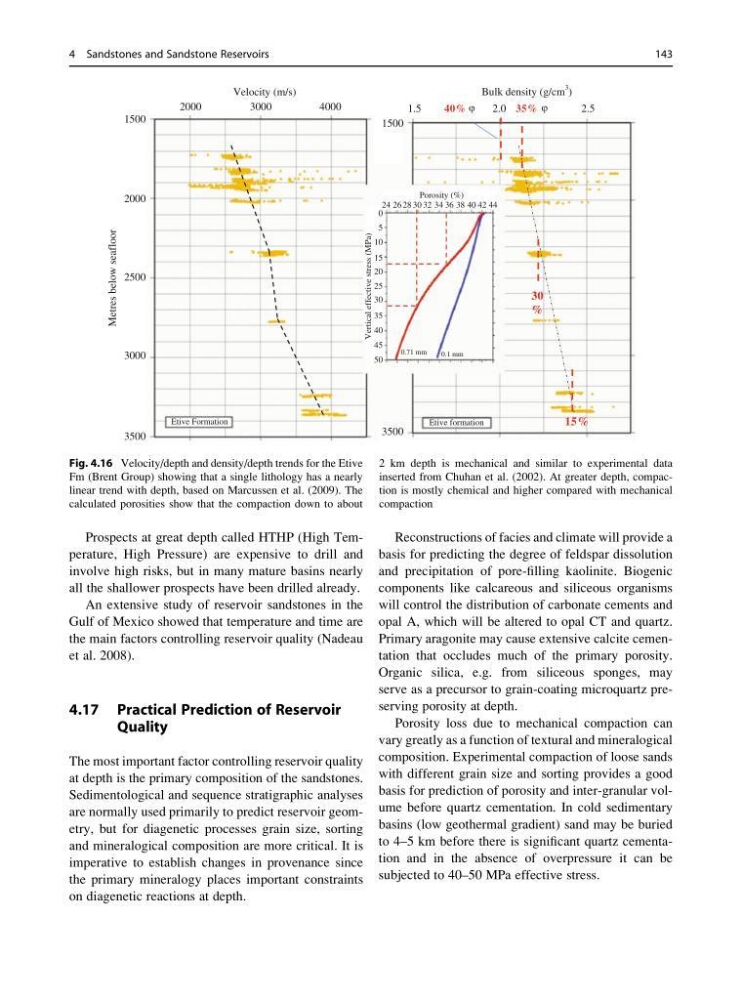
Fig. 4.16 Velocity/depth and density/depth trends for the Etive
Fm (Brent Group) showing that a single lithology has a nearly
linear trend with depth, based on Marcussen et al. (2009). The
calculated porosities show that the compaction down to about
2 km depth is mechanical and similar to experimental data
inserted from Chuhan et al. (2002). At greater depth, compaction is mostly chemical and higher compared with mechanical
compaction
4 Sandstones and Sandstone Reservoirs
143
involve high risks, but in many mature basins nearly
all the shallower prospects have been drilled already.
An extensive study of reservoir sandstones in the
Gulf of Mexico showed that temperature and time are
the main factors controlling reservoir quality (Nadeau
et al. 2008).
4.17 Practical Prediction of Reservoir
Quality
The most important factor controlling reservoir quality
at depth is the primary composition of the sandstones.
Sedimentological and sequence stratigraphic analyses
are normally used primarily to predict reservoir geometry, but for diagenetic processes grain size, sorting
and mineralogical composition are more critical. It is
imperative to establish changes in provenance since
the primary mineralogy places important constraints
on diagenetic reactions at depth.
Reconstructions of facies and climate will provide a
basis for predicting the degree of feldspar dissolution
and precipitation of pore-filling kaolinite. Biogenic
components like calcareous and siliceous organisms
will control the distribution of carbonate cements and
opal A, which will be altered to opal CT and quartz.
Primary aragonite may cause extensive calcite cementation that occludes much of the primary porosity.
Organic silica, e.g. from siliceous sponges, may
serve as a precursor to grain-coating microquartz preserving porosity at depth.
Porosity loss due to mechanical compaction can
vary greatly as a function of textural and mineralogical
composition. Experimental compaction of loose sands
with different grain size and sorting provides a good
basis for prediction of porosity and inter-granular volume before quartz cementation. In cold sedimentary
basins (low geothermal gradient) sand may be buried
to 4–5 km before there is significant quartz cementation and in the absence of overpressure it can be
subjected to 40–50 MPa effective stress.
2000
Velocity (m/s)
1500
2000
2500
3000
Metres below seafloor
3500
Etive Formation
Etive formation
Vertical effective stress (MPa)
3000
4000
1500
3500
1.5
24
0
5
10
15
20
25
30
35
40
45
50
0.71 mm
0.1 mm
26 28 30 32 34 36 38 40 42 44
2.0
2.5
Bulk density (g/cm
3
)
Porosity (%)
30
%
15%
35%
40% ϕ
ϕ
Fig. 4.16 Velocity/depth and density/depth trends for the Etive
Fm (Brent Group) showing that a single lithology has a nearly
linear trend with depth, based on Marcussen et al. (2009). The
calculated porosities show that the compaction down to about
2 km depth is mechanical and similar to experimental data
inserted from Chuhan et al. (2002). At greater depth, compaction is mostly chemical and higher compared with mechanical
compaction
4 Sandstones and Sandstone Reservoirs
143