

The degree of porosity loss by mechanical compaction determines the intergranular volume (IGV) at the
onset of chemical compaction (quartz cementation).
The IGV measured in some North Sea sandstones
varies from about 38 to 28% (Walderhaug 1996) and
the net porosity after precipitation of 10% quartz
cement will then be very different.
4.9
Sandstone Reservoirs Buried to
Intermediate Depth (2.0–3.5 km,
50–120
C)
In basins where there has been mostly continuous
subsidence, reservoirs buried to depths shallower
than about 2.0–2.5 km are still loose or only poorly
cemented, except where there is carbonate cement or
high geothermal gradients. This is well documented in
most of the North Sea basin and parts of the Gulf Coast
Basin (Sharp and McBride 1989, Bjørlykke et al.
1992). In the Statfjord Field where the Middle Jurassic
Brent sandstone is buried to 2.5–3 km, there are
intervals that are so poorly cemented that it is difficult
to obtain good cores because the sandstone
disintegrates in the core barrel. Loose sand grains
may then be produced with the oil (sand production).
Prior to quartz cementation or other types of
cementation the sand grains compact mechanically
by sliding and reorientation. Sand grains may also
fracture under the overburden stress; coarse-grained
sand compacts more due to grain crushing than well
sorted fine-grained sand (Fig. 4.5a,b). In basins like
the North Sea the quartz cementation increases the
rock strength at 2–3 km burial depth (80–100
C) but
coarse-grained sand may additionally show significant
compaction due to grain fracturing. Compaction
experiments show however that carbonate grains
(ooids) are less compressible than quartz grains. This
is because the grain contacts between carbonate grains
will be enlarged due to mechanical and chemical
deformation. The surface of quartz grains is irregular
and so the area of grain contact is very small, also for
large quartz grains, resulting in very high stresses
which can cause grain fracturing. Grain fracturing
due to shear stress is also sensitive to grain size
Porosity
Depth
2.5 km
5 km
x 2
x 1
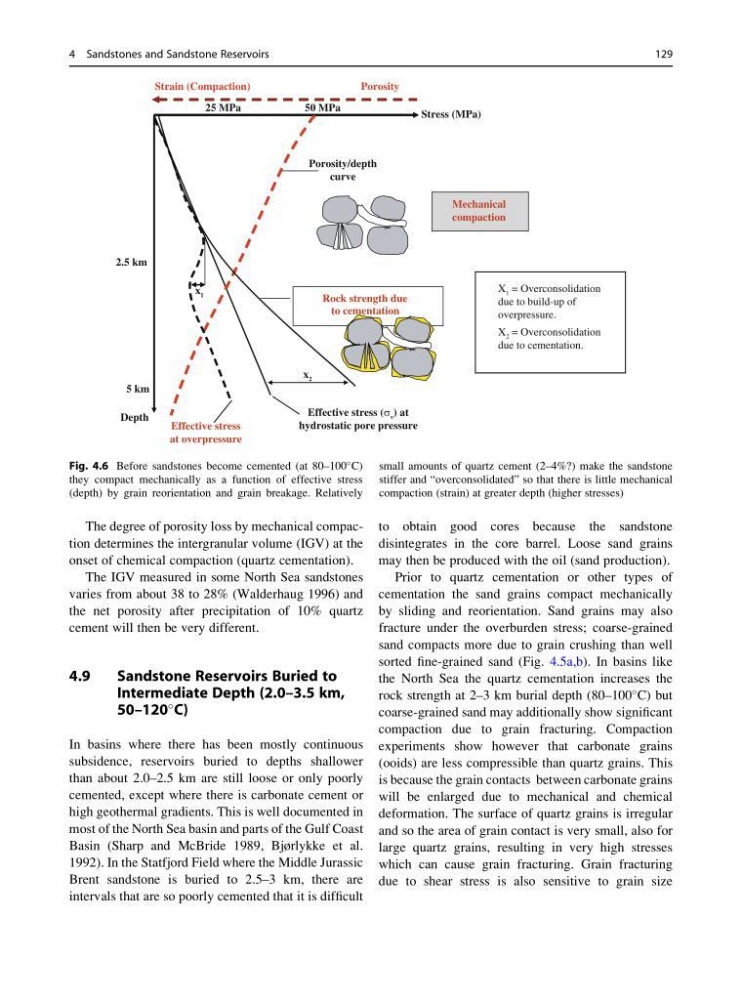
X 1 = Overconsolidation
due to build-up of
overpressure.
X 2 = Overconsolidation
due to cementation.
Effective stress (σ v ) at
hydrostatic pore pressure
Strain (Compaction)
Effective stress
at overpressure
Porosity/depth
curve
Rock strength due
to cementation
Mechanical
compaction
Stress (MPa)
25 MPa
50 MPa
Fig. 4.6 Before sandstones become cemented (at 80–100
C)
they compact mechanically as a function of effective stress
(depth) by grain reorientation and grain breakage. Relatively
small amounts of quartz cement (2–4%?) make the sandstone
stiffer and “overconsolidated” so that there is little mechanical
compaction (strain) at greater depth (higher stresses)
4 Sandstones and Sandstone Reservoirs
129
onset of chemical compaction (quartz cementation).
The IGV measured in some North Sea sandstones
varies from about 38 to 28% (Walderhaug 1996) and
the net porosity after precipitation of 10% quartz
cement will then be very different.
4.9
Sandstone Reservoirs Buried to
Intermediate Depth (2.0–3.5 km,
50–120
C)
In basins where there has been mostly continuous
subsidence, reservoirs buried to depths shallower
than about 2.0–2.5 km are still loose or only poorly
cemented, except where there is carbonate cement or
high geothermal gradients. This is well documented in
most of the North Sea basin and parts of the Gulf Coast
Basin (Sharp and McBride 1989, Bjørlykke et al.
1992). In the Statfjord Field where the Middle Jurassic
Brent sandstone is buried to 2.5–3 km, there are
intervals that are so poorly cemented that it is difficult
to obtain good cores because the sandstone
disintegrates in the core barrel. Loose sand grains
may then be produced with the oil (sand production).
Prior to quartz cementation or other types of
cementation the sand grains compact mechanically
by sliding and reorientation. Sand grains may also
fracture under the overburden stress; coarse-grained
sand compacts more due to grain crushing than well
sorted fine-grained sand (Fig. 4.5a,b). In basins like
the North Sea the quartz cementation increases the
rock strength at 2–3 km burial depth (80–100
C) but
coarse-grained sand may additionally show significant
compaction due to grain fracturing. Compaction
experiments show however that carbonate grains
(ooids) are less compressible than quartz grains. This
is because the grain contacts between carbonate grains
will be enlarged due to mechanical and chemical
deformation. The surface of quartz grains is irregular
and so the area of grain contact is very small, also for
large quartz grains, resulting in very high stresses
which can cause grain fracturing. Grain fracturing
due to shear stress is also sensitive to grain size
Porosity
Depth
2.5 km
5 km
x 2
x 1
X 1 = Overconsolidation
due to build-up of
overpressure.
X 2 = Overconsolidation
due to cementation.
Effective stress (σ v ) at
hydrostatic pore pressure
Strain (Compaction)
Effective stress
at overpressure
Porosity/depth
curve
Rock strength due
to cementation
Mechanical
compaction
Stress (MPa)
25 MPa
50 MPa
Fig. 4.6 Before sandstones become cemented (at 80–100
C)
they compact mechanically as a function of effective stress
(depth) by grain reorientation and grain breakage. Relatively
small amounts of quartz cement (2–4%?) make the sandstone
stiffer and “overconsolidated” so that there is little mechanical
compaction (strain) at greater depth (higher stresses)
4 Sandstones and Sandstone Reservoirs
129