

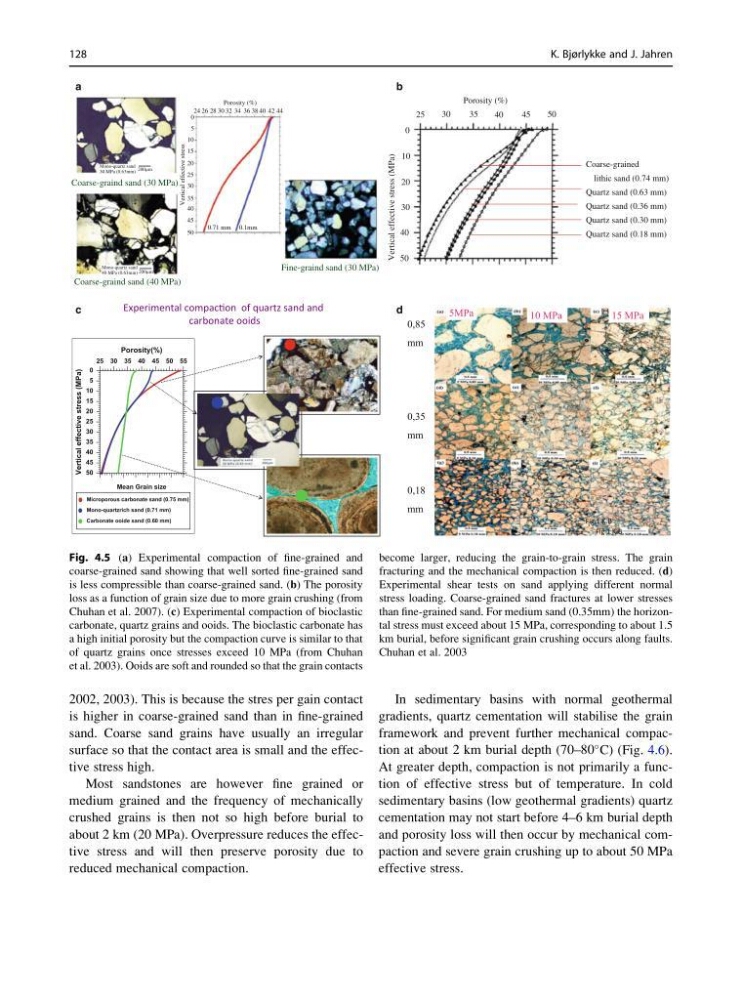
2002, 2003). This is because the stres per gain contact
is higher in coarse-grained sand than in fine-grained
sand. Coarse sand grains have usually an irregular
surface so that the contact area is small and the effective stress high.
Most sandstones are however fine grained or
medium grained and the frequency of mechanically
crushed grains is then not so high before burial to
about 2 km (20 MPa). Overpressure reduces the effective stress and will then preserve porosity due to
reduced mechanical compaction.
In sedimentary basins with normal geothermal
gradients, quartz cementation will stabilise the grain
framework and prevent further mechanical compaction at about 2 km burial depth (70–80
C) (Fig. 4.6).
At greater depth, compaction is not primarily a function of effective stress but of temperature. In cold
sedimentary basins (low geothermal gradients) quartz
cementation may not start before 4–6 km burial depth
and porosity loss will then occur by mechanical compaction and severe grain crushing up to about 50 MPa
effective stress.
Coarse-graind sand (30 MPa)
Porosity (%)
a
b
c
d
Porosity (%)
24
0
5
10
15
Vertical effective stress
20
25
30
35
40
45
50
Mono-quartz sand
30 MPa (0.63mm)
Mono-quartz sand
40 MPa (0.63mm)
0.71 mm 0.1mm
26 28 30 32 34 36 38 40 42 44
Coarse-graind sand (40 MPa)
Fine-graind sand (30 MPa)
Coarse-grained
25
0
10
20
30
40
50
Vertical effective stress (MPa)
30
35
40
45
50
lithic sand (0.74 mm)
Quartz sand (0.63 mm)
Quartz sand (0.36 mm)
Quartz sand (0.30 mm)
Quartz sand (0.18 mm)
200μm
200μm
Experimental compacƟon of quartz sand and
carbonate ooids
Microporous carbonate sand (0.75 mm)
Mono-quartzrich sand (0.71 mm)
Carbonate ooide sand (0.60 mm)
Mean Grain size
25 30 35 40 45 50 55
Porosity(%)
50
45
40
35
30
25
20
15
10
5
0
Vertical effective stress (MPa)
0,85
mm
0,35
mm
0,18
mm
5MPa
10 MPa
15 MPa
Fig 1 K.B
Fig 1 K.B
Fig. 4.5 (a) Experimental compaction of fine-grained and
coarse-grained sand showing that well sorted fine-grained sand
is less compressible than coarse-grained sand. (b) The porosity
loss as a function of grain size due to more grain crushing (from
Chuhan et al. 2007). (c) Experimental compaction of bioclastic
carbonate, quartz grains and ooids. The bioclastic carbonate has
a high initial porosity but the compaction curve is similar to that
of quartz grains once stresses exceed 10 MPa (from Chuhan
et al. 2003). Ooids are soft and rounded so that the grain contacts
become larger, reducing the grain-to-grain stress. The grain
fracturing and the mechanical compaction is then reduced. (d)
Experimental shear tests on sand applying different normal
stress loading. Coarse-grained sand fractures at lower stresses
than fine-grained sand. For medium sand (0.35mm) the horizontal stress must exceed about 15 MPa, corresponding to about 1.5
km burial, before significant grain crushing occurs along faults.
Chuhan et al. 2003
128
K. Bjørlykke and J. Jahren
is higher in coarse-grained sand than in fine-grained
sand. Coarse sand grains have usually an irregular
surface so that the contact area is small and the effective stress high.
Most sandstones are however fine grained or
medium grained and the frequency of mechanically
crushed grains is then not so high before burial to
about 2 km (20 MPa). Overpressure reduces the effective stress and will then preserve porosity due to
reduced mechanical compaction.
In sedimentary basins with normal geothermal
gradients, quartz cementation will stabilise the grain
framework and prevent further mechanical compaction at about 2 km burial depth (70–80
C) (Fig. 4.6).
At greater depth, compaction is not primarily a function of effective stress but of temperature. In cold
sedimentary basins (low geothermal gradients) quartz
cementation may not start before 4–6 km burial depth
and porosity loss will then occur by mechanical compaction and severe grain crushing up to about 50 MPa
effective stress.
Coarse-graind sand (30 MPa)
Porosity (%)
a
b
c
d
Porosity (%)
24
0
5
10
15
Vertical effective stress
20
25
30
35
40
45
50
Mono-quartz sand
30 MPa (0.63mm)
Mono-quartz sand
40 MPa (0.63mm)
0.71 mm 0.1mm
26 28 30 32 34 36 38 40 42 44
Coarse-graind sand (40 MPa)
Fine-graind sand (30 MPa)
Coarse-grained
25
0
10
20
30
40
50
Vertical effective stress (MPa)
30
35
40
45
50
lithic sand (0.74 mm)
Quartz sand (0.63 mm)
Quartz sand (0.36 mm)
Quartz sand (0.30 mm)
Quartz sand (0.18 mm)
200μm
200μm
Experimental compacƟon of quartz sand and
carbonate ooids
Microporous carbonate sand (0.75 mm)
Mono-quartzrich sand (0.71 mm)
Carbonate ooide sand (0.60 mm)
Mean Grain size
25 30 35 40 45 50 55
Porosity(%)
50
45
40
35
30
25
20
15
10
5
0
Vertical effective stress (MPa)
0,85
mm
0,35
mm
0,18
mm
5MPa
10 MPa
15 MPa
Fig 1 K.B
Fig 1 K.B
Fig. 4.5 (a) Experimental compaction of fine-grained and
coarse-grained sand showing that well sorted fine-grained sand
is less compressible than coarse-grained sand. (b) The porosity
loss as a function of grain size due to more grain crushing (from
Chuhan et al. 2007). (c) Experimental compaction of bioclastic
carbonate, quartz grains and ooids. The bioclastic carbonate has
a high initial porosity but the compaction curve is similar to that
of quartz grains once stresses exceed 10 MPa (from Chuhan
et al. 2003). Ooids are soft and rounded so that the grain contacts
become larger, reducing the grain-to-grain stress. The grain
fracturing and the mechanical compaction is then reduced. (d)
Experimental shear tests on sand applying different normal
stress loading. Coarse-grained sand fractures at lower stresses
than fine-grained sand. For medium sand (0.35mm) the horizontal stress must exceed about 15 MPa, corresponding to about 1.5
km burial, before significant grain crushing occurs along faults.
Chuhan et al. 2003
128
K. Bjørlykke and J. Jahren