

mechanical compaction and of chemical processes
involving dissolution and precipitation of minerals.
At any given burial depth the properties depend on the
composition of the sandstones when at shallow depth,
and on their temperature and stress history during burial.
Practical prediction of the porosity and permeability
during exploration and production is only possible if
the processes that change these parameters are
understood.
It should be realised that the starting point for the
diagenetic processes is the initial sandstone composition. This is a function of the rocks eroded (provenance), transport, and depositional environments.
Diagenetic models must therefore be linked to
weathering and climate, sediment transport, facies
models and sequence stratigraphy, and should be
integrated in an interdisciplinary basin analysis.
Diagenesis is often considered a rather specialised
field of sedimentology and petroleum geology, but it
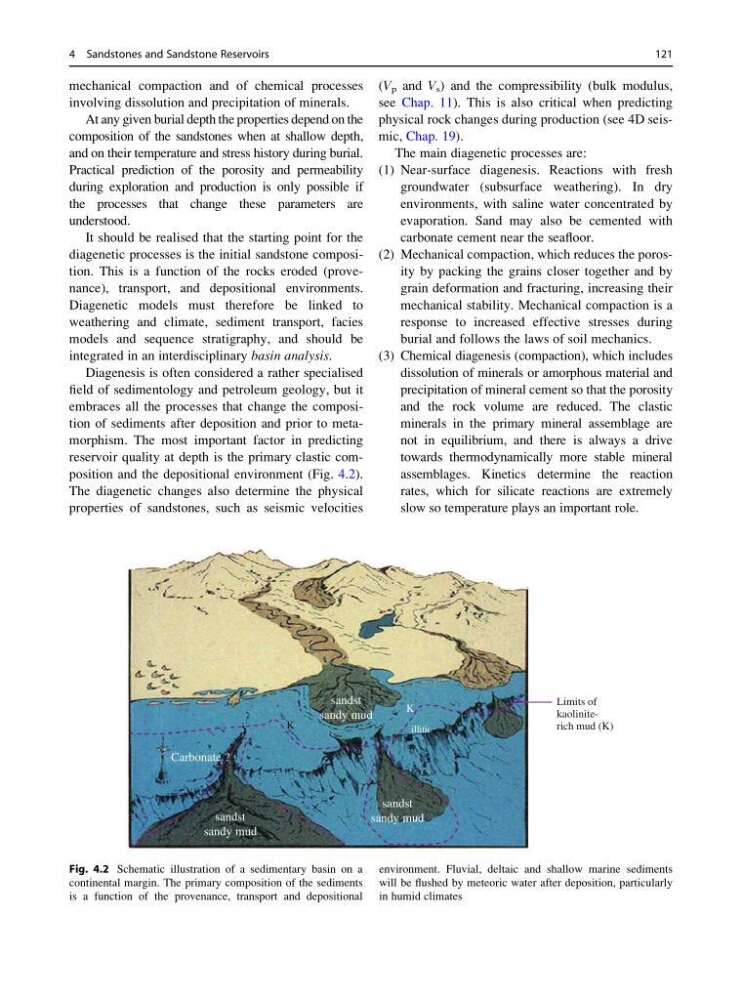
embraces all the processes that change the composition of sediments after deposition and prior to metamorphism. The most important factor in predicting
reservoir quality at depth is the primary clastic composition and the depositional environment (Fig. 4.2).
The diagenetic changes also determine the physical
properties of sandstones, such as seismic velocities
(V p and V s ) and the compressibility (bulk modulus,
see Chap. 11). This is also critical when predicting
physical rock changes during production (see 4D seismic, Chap. 19).
The main diagenetic processes are:
(1) Near-surface diagenesis. Reactions with fresh
groundwater (subsurface weathering). In dry
environments, with saline water concentrated by
evaporation. Sand may also be cemented with
carbonate cement near the seafloor.
(2) Mechanical compaction, which reduces the porosity by packing the grains closer together and by
grain deformation and fracturing, increasing their
mechanical stability. Mechanical compaction is a
response to increased effective stresses during
burial and follows the laws of soil mechanics.
(3) Chemical diagenesis (compaction), which includes
dissolution of minerals or amorphous material and
precipitation of mineral cement so that the porosity
and the rock volume are reduced. The clastic
minerals in the primary mineral assemblage are
not in equilibrium, and there is always a drive
towards thermodynamically more stable mineral
assemblages. Kinetics determine the reaction
rates, which for silicate reactions are extremely
slow so temperature plays an important role.
Limits of
kaoliniterich mud (K)
sandst
sandy mud
sandst
sandy mud
sandst
sandy mud
K
illitic
Carbonate ?
K
Fig. 4.2 Schematic illustration of a sedimentary basin on a
continental margin. The primary composition of the sediments
is a function of the provenance, transport and depositional
environment. Fluvial, deltaic and shallow marine sediments
will be flushed by meteoric water after deposition, particularly
in humid climates
4 Sandstones and Sandstone Reservoirs
121
involving dissolution and precipitation of minerals.
At any given burial depth the properties depend on the
composition of the sandstones when at shallow depth,
and on their temperature and stress history during burial.
Practical prediction of the porosity and permeability
during exploration and production is only possible if
the processes that change these parameters are
understood.
It should be realised that the starting point for the
diagenetic processes is the initial sandstone composition. This is a function of the rocks eroded (provenance), transport, and depositional environments.
Diagenetic models must therefore be linked to
weathering and climate, sediment transport, facies
models and sequence stratigraphy, and should be
integrated in an interdisciplinary basin analysis.
Diagenesis is often considered a rather specialised
field of sedimentology and petroleum geology, but it
embraces all the processes that change the composition of sediments after deposition and prior to metamorphism. The most important factor in predicting
reservoir quality at depth is the primary clastic composition and the depositional environment (Fig. 4.2).
The diagenetic changes also determine the physical
properties of sandstones, such as seismic velocities
(V p and V s ) and the compressibility (bulk modulus,
see Chap. 11). This is also critical when predicting
physical rock changes during production (see 4D seismic, Chap. 19).
The main diagenetic processes are:
(1) Near-surface diagenesis. Reactions with fresh
groundwater (subsurface weathering). In dry
environments, with saline water concentrated by
evaporation. Sand may also be cemented with
carbonate cement near the seafloor.
(2) Mechanical compaction, which reduces the porosity by packing the grains closer together and by
grain deformation and fracturing, increasing their
mechanical stability. Mechanical compaction is a
response to increased effective stresses during
burial and follows the laws of soil mechanics.
(3) Chemical diagenesis (compaction), which includes
dissolution of minerals or amorphous material and
precipitation of mineral cement so that the porosity
and the rock volume are reduced. The clastic
minerals in the primary mineral assemblage are
not in equilibrium, and there is always a drive
towards thermodynamically more stable mineral
assemblages. Kinetics determine the reaction
rates, which for silicate reactions are extremely
slow so temperature plays an important role.
Limits of
kaoliniterich mud (K)
sandst
sandy mud
sandst
sandy mud
sandst
sandy mud
K
illitic
Carbonate ?
K
Fig. 4.2 Schematic illustration of a sedimentary basin on a
continental margin. The primary composition of the sediments
is a function of the provenance, transport and depositional
environment. Fluvial, deltaic and shallow marine sediments
will be flushed by meteoric water after deposition, particularly
in humid climates
4 Sandstones and Sandstone Reservoirs
121