

rocks, i.e. continental crust. In cold climates the rate of
weathering is reduced, thus preserving feldspar and
unstable rock fragments.
In tectonically stable areas with mature relief there is
far more time for weathering of both in situ bedrock and
sediment in transit. In such environments sand particles
(grains) are deposited and eroded many times before
reaching their final deposition site. A greater proportion
of the feldspar grains will then break down during
transport and subarkoses or orthoquartzites will be
deposited. Orthoquartzites (or quartz arenites) are the
purest quartz sandstones, formed when weathering has
eliminated virtually all the unstable minerals to leave a
concentration of quartz and some heavy minerals. This
is particularly true of beach sand where nearly all the
clay particles have been removed. Sand deposited by
rivers (fluvial sand) is less well sorted and may contain
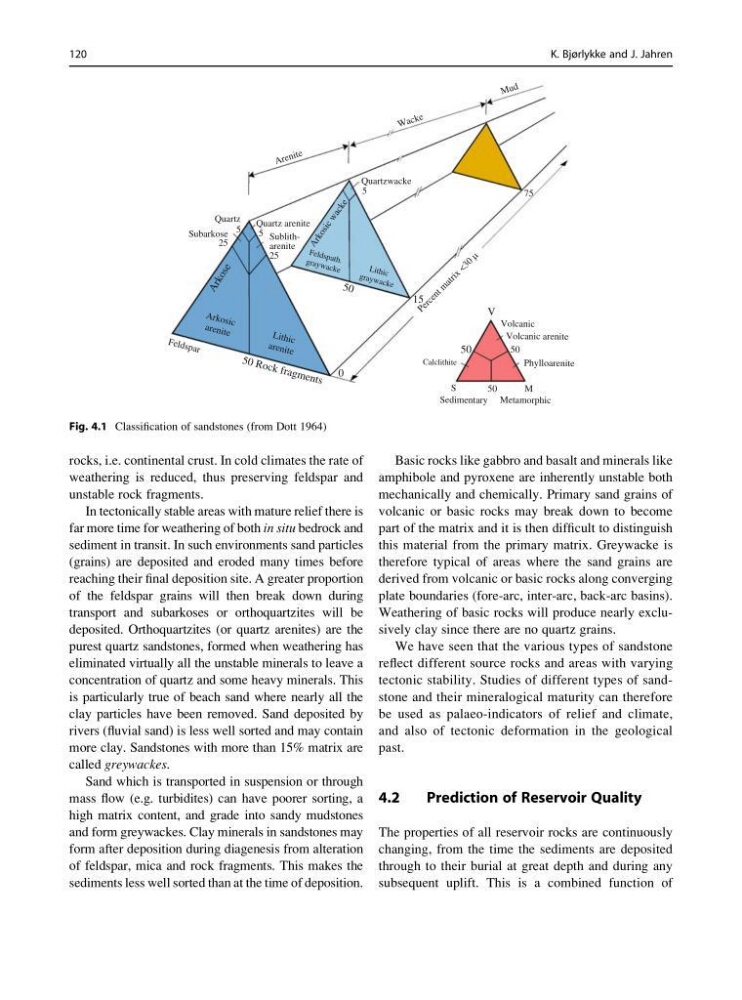
more clay. Sandstones with more than 15% matrix are
called greywackes.
Sand which is transported in suspension or through
mass flow (e.g. turbidites) can have poorer sorting, a
high matrix content, and grade into sandy mudstones
and form greywackes. Clay minerals in sandstones may
form after deposition during diagenesis from alteration
of feldspar, mica and rock fragments. This makes the
sediments less well sorted than at the time of deposition.
Basic rocks like gabbro and basalt and minerals like
amphibole and pyroxene are inherently unstable both
mechanically and chemically. Primary sand grains of
volcanic or basic rocks may break down to become
part of the matrix and it is then difficult to distinguish
this material from the primary matrix. Greywacke is
therefore typical of areas where the sand grains are
derived from volcanic or basic rocks along converging
plate boundaries (fore-arc, inter-arc, back-arc basins).
Weathering of basic rocks will produce nearly exclusively clay since there are no quartz grains.
We have seen that the various types of sandstone
reflect different source rocks and areas with varying
tectonic stability. Studies of different types of sandstone and their mineralogical maturity can therefore
be used as palaeo-indicators of relief and climate,
and also of tectonic deformation in the geological
past.
4.2
Prediction of Reservoir Quality
The properties of all reservoir rocks are continuously
changing, from the time the sediments are deposited
through to their burial at great depth and during any
subsequent uplift. This is a combined function of
A re n it e
W ac k e
M u d
Quartz
Quartz arenite
5
5
75
Quartzwacke
Sublitharenite
25
Subarkose 5
25
Fe ld sp ar
A rk os ic
ar en ite
A r k o s e
A r k o s i c w a c k e
L ith ic
ar en ite
5 0
0
15
50
V
Volcanic
Volcanic arenite
50
Phylloarenite
S
50
M
Sedimentary Metamorphic
Calclithite
Fe ld sp at h.
gr ay w ac ke
Li th ic
gr ay w ac ke
5 0 R o ck fr ag m en ts
P e r c e n t m
a t r i x
< 3 0
μ
Fig. 4.1 Classification of sandstones (from Dott 1964)
120
K. Bjørlykke and J. Jahren
weathering is reduced, thus preserving feldspar and
unstable rock fragments.
In tectonically stable areas with mature relief there is
far more time for weathering of both in situ bedrock and
sediment in transit. In such environments sand particles
(grains) are deposited and eroded many times before
reaching their final deposition site. A greater proportion
of the feldspar grains will then break down during
transport and subarkoses or orthoquartzites will be
deposited. Orthoquartzites (or quartz arenites) are the
purest quartz sandstones, formed when weathering has
eliminated virtually all the unstable minerals to leave a
concentration of quartz and some heavy minerals. This
is particularly true of beach sand where nearly all the
clay particles have been removed. Sand deposited by
rivers (fluvial sand) is less well sorted and may contain
more clay. Sandstones with more than 15% matrix are
called greywackes.
Sand which is transported in suspension or through
mass flow (e.g. turbidites) can have poorer sorting, a
high matrix content, and grade into sandy mudstones
and form greywackes. Clay minerals in sandstones may
form after deposition during diagenesis from alteration
of feldspar, mica and rock fragments. This makes the
sediments less well sorted than at the time of deposition.
Basic rocks like gabbro and basalt and minerals like
amphibole and pyroxene are inherently unstable both
mechanically and chemically. Primary sand grains of
volcanic or basic rocks may break down to become
part of the matrix and it is then difficult to distinguish
this material from the primary matrix. Greywacke is
therefore typical of areas where the sand grains are
derived from volcanic or basic rocks along converging
plate boundaries (fore-arc, inter-arc, back-arc basins).
Weathering of basic rocks will produce nearly exclusively clay since there are no quartz grains.
We have seen that the various types of sandstone
reflect different source rocks and areas with varying
tectonic stability. Studies of different types of sandstone and their mineralogical maturity can therefore
be used as palaeo-indicators of relief and climate,
and also of tectonic deformation in the geological
past.
4.2
Prediction of Reservoir Quality
The properties of all reservoir rocks are continuously
changing, from the time the sediments are deposited
through to their burial at great depth and during any
subsequent uplift. This is a combined function of
A re n it e
W ac k e
M u d
Quartz
Quartz arenite
5
5
75
Quartzwacke
Sublitharenite
25
Subarkose 5
25
Fe ld sp ar
A rk os ic
ar en ite
A r k o s e
A r k o s i c w a c k e
L ith ic
ar en ite
5 0
0
15
50
V
Volcanic
Volcanic arenite
50
Phylloarenite
S
50
M
Sedimentary Metamorphic
Calclithite
Fe ld sp at h.
gr ay w ac ke
Li th ic
gr ay w ac ke
5 0 R o ck fr ag m en ts
P e r c e n t m
a t r i x
< 3 0
μ
Fig. 4.1 Classification of sandstones (from Dott 1964)
120
K. Bjørlykke and J. Jahren