

albite (sodium feldspar), orthoclase and microcline
(potassium feldspar) are more stable. The breakdown
of these silicate minerals will primarily liberate alkali
cations. Silicon and aluminium have very low solubility and form new silicate minerals, largely clay
minerals, though some silicic acid (H 4 SiO 4 ) goes
into solution.
1. 2KðNaÞAl 2 AlSi 3 O 10 ðOHÞ 2 ðmuscoviteÞþ
2H
þ
þ 3H 2 O ¼ 3Al 2 Si 2 O 5 ðOHÞ 4 ðkaoliniteÞþ
2K
þ
ðNa
þ
Þ
2. 2KðMg; FeÞ 3 AlSi 3 O 10 ðOHÞ 2 ðbiotiteÞ þ 12H
þ
þ
2e þ O 2 ¼ Al 2 Si 2 O 5 ðOHÞ 4 ðkaoliniteÞþ
4SiO 2 ðin solutionÞþ
xFe 2 O 3 þ y4 Mg
þþ
þ 6H 2 O þ 2K
þ
3. 2KðNaÞ AlSi 3 O 8 ðfeldsparÞ þ 2H
þ
þ 9H 2 O ¼
Al 2 Si 2 O 5 ðOHÞ 4 ðkaoliniteÞ þ 4H 4 SiO 4 þ
2K
þ
ðNa
þ
Þ
We see that potassium has been replaced by
hydrogen ions in the new silicate minerals. The same
applies to sodium in albite. The equations show that
the reactions are driven to the right by low K
+
/H
+ and
Na
+ /H
+ ratios.
The degree of weathering depends on how undersaturated the water is with respect to the minerals
comprising the rock, and on the volume of water
flowing through the rock. If the reaction products in
the solution, K
+ , Na
+ and silica (H 4 SiO 4 ), are not
removed by water flow, the reactions will cease. This
is why weathering is always found to begin along
cracks where water can penetrate (Fig. 3.11). The
vertical and horizontal joints that often develop in
response to pressure release when previously deeply
buried rock is exposed at the land surface provide the
initial pathways. As the weathering process spreads
outward from joints, blocks of unweathered rock are
gradually isolated. They have rounded corners and
may become entirely round (spheroidal weathering)
(Fig. 3.12a,b,c). In desert areas, where there is little
rainfall, weathering proceeds much more slowly. Illite
and montmorillonite may be formed when the
porewater has higher K
+
/H
+ and Na
+
/H
+ ratios than
for kaolinite, and they are frequently formed where
there is less water percolation and the removal of
potassium or sodium is slower.
There is often also a high silica content in the water
in desert areas due to frequent silica algae (diatom)
blooms and because silica is concentrated by water
evaporation. This helps enhance the stability of
smectite.
Granites subjected to weathering over a very long
period often develop a special topography. Fractures
and fault zones weather fastest and form valleys
where the groundwater collects, which further
Rainfall
Podsol profile Layer A
Leaching (grey)
Precipitation
of Fe(OH) 3 (red)
Layer B
Capillary water
Water table
Phreatic (ground) water
Layer C
Podsol soil
profile.
Downwards
transport.
Brown-earth
profile
Little leaching.
Precipitation of
carbonates
(caliche)
Water table
Phreatic
(ground) water
Layer C
Evaporation
Rainfall
Evaporitic soil
Precipitation
of salts and
carbonates
Water table
phreatic
(ground) water
Layer C
Evaporation
and runoff
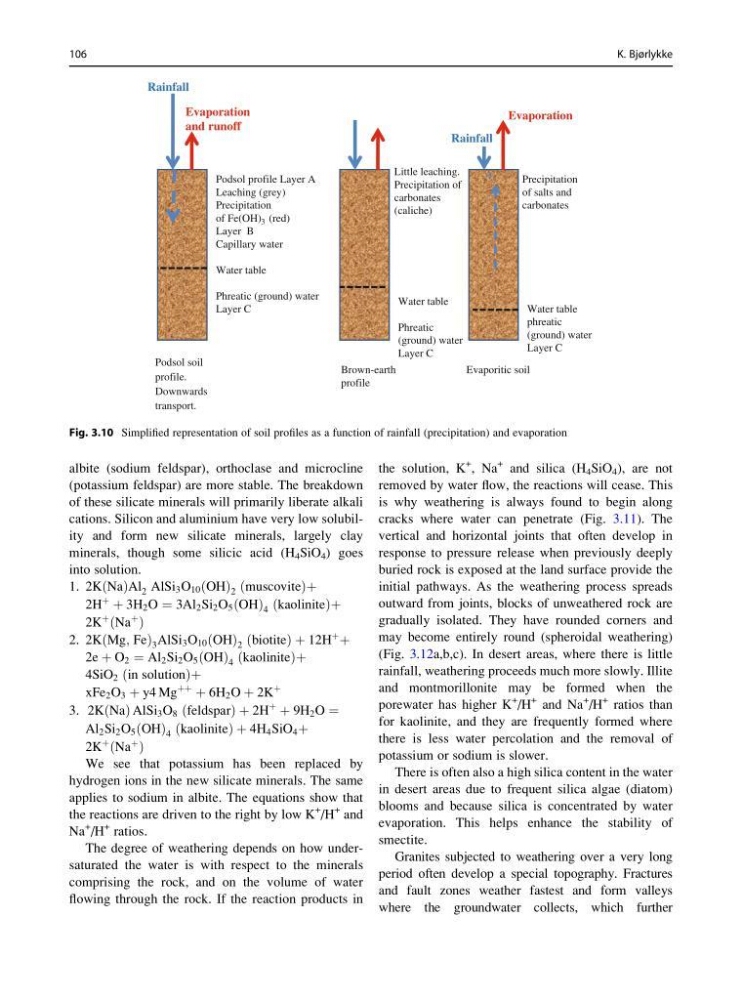
Fig. 3.10 Simplified representation of soil profiles as a function of rainfall (precipitation) and evaporation
106
K. Bjørlykke
(potassium feldspar) are more stable. The breakdown
of these silicate minerals will primarily liberate alkali
cations. Silicon and aluminium have very low solubility and form new silicate minerals, largely clay
minerals, though some silicic acid (H 4 SiO 4 ) goes
into solution.
1. 2KðNaÞAl 2 AlSi 3 O 10 ðOHÞ 2 ðmuscoviteÞþ
2H
þ
þ 3H 2 O ¼ 3Al 2 Si 2 O 5 ðOHÞ 4 ðkaoliniteÞþ
2K
þ
ðNa
þ
Þ
2. 2KðMg; FeÞ 3 AlSi 3 O 10 ðOHÞ 2 ðbiotiteÞ þ 12H
þ
þ
2e þ O 2 ¼ Al 2 Si 2 O 5 ðOHÞ 4 ðkaoliniteÞþ
4SiO 2 ðin solutionÞþ
xFe 2 O 3 þ y4 Mg
þþ
þ 6H 2 O þ 2K
þ
3. 2KðNaÞ AlSi 3 O 8 ðfeldsparÞ þ 2H
þ
þ 9H 2 O ¼
Al 2 Si 2 O 5 ðOHÞ 4 ðkaoliniteÞ þ 4H 4 SiO 4 þ
2K
þ
ðNa
þ
Þ
We see that potassium has been replaced by
hydrogen ions in the new silicate minerals. The same
applies to sodium in albite. The equations show that
the reactions are driven to the right by low K
+
/H
+ and
Na
+ /H
+ ratios.
The degree of weathering depends on how undersaturated the water is with respect to the minerals
comprising the rock, and on the volume of water
flowing through the rock. If the reaction products in
the solution, K
+ , Na
+ and silica (H 4 SiO 4 ), are not
removed by water flow, the reactions will cease. This
is why weathering is always found to begin along
cracks where water can penetrate (Fig. 3.11). The
vertical and horizontal joints that often develop in
response to pressure release when previously deeply
buried rock is exposed at the land surface provide the
initial pathways. As the weathering process spreads
outward from joints, blocks of unweathered rock are
gradually isolated. They have rounded corners and
may become entirely round (spheroidal weathering)
(Fig. 3.12a,b,c). In desert areas, where there is little
rainfall, weathering proceeds much more slowly. Illite
and montmorillonite may be formed when the
porewater has higher K
+
/H
+ and Na
+
/H
+ ratios than
for kaolinite, and they are frequently formed where
there is less water percolation and the removal of
potassium or sodium is slower.
There is often also a high silica content in the water
in desert areas due to frequent silica algae (diatom)
blooms and because silica is concentrated by water
evaporation. This helps enhance the stability of
smectite.
Granites subjected to weathering over a very long
period often develop a special topography. Fractures
and fault zones weather fastest and form valleys
where the groundwater collects, which further
Rainfall
Podsol profile Layer A
Leaching (grey)
Precipitation
of Fe(OH) 3 (red)
Layer B
Capillary water
Water table
Phreatic (ground) water
Layer C
Podsol soil
profile.
Downwards
transport.
Brown-earth
profile
Little leaching.
Precipitation of
carbonates
(caliche)
Water table
Phreatic
(ground) water
Layer C
Evaporation
Rainfall
Evaporitic soil
Precipitation
of salts and
carbonates
Water table
phreatic
(ground) water
Layer C
Evaporation
and runoff
Fig. 3.10 Simplified representation of soil profiles as a function of rainfall (precipitation) and evaporation
106
K. Bjørlykke