

bonds. The elements in the middle, however, have a
greater tendency to form covalent bonds in which the
strength of the M-O bond is not merely a function of
the valency and radius, and the picture becomes far
more complex. The concept of ionic potential is nevertheless still useful; we see that during weathering,
elements with low ionic potential remain in solution
along with the anionic complexes of metals and nonmetals with high ionic potential. This is reflected in the
composition of seawater. The hydrolysates, on the
other hand, become enriched on land as insoluble
residues or through weathering (Al
3+ , Fe
3+ , Mn
4+ ,
Ti
4+ , etc.). Note also that Fe
++ and Mn
++ which
occur in reducing environments have lower ionic
potential and are much more soluble that Fe
3+ and
Mn
4+ .
The most soluble ions remain in the seawater until
they are precipitated as salt when seawater is
concentrated during evaporation. In addition to the
chlorides (i.e. NaCl, KCl), these are mainly salts of
cations with low ionic potential, and of anions with
high ionic potential, e.g. CaSO 4
. 2H 2 O, Na 2 CO 3 and
carbonates such as CaCO 3 (calcite), CaMg(CO 3 ) 2
(dolomite) and MgCO 3 (magnesite).
The principle of ionic hydration and the size of the
ionic radius are capable of explaining a whole range of
geochemical phenomena. Among the Group I
elements of the Periodic Table, we know that Li
+ and
2.0
1.5
1.0
0.5
Soluble cations e.g. Na
+
Hydrolysates e.g.
Fe(OH) 3 .Very low
solubility
Soluble anion
complexes e.g.
SO4
-Ionic radius
Charge (valency)
0
1
2
3
4
5
6
7
Cs
Rb
K
Na
Li
Ca
Sr
Ba
Mn
Sc
Fe
Be
Mg
Ga
Fe
B
Al
Th
U
Ti
P
Si
C
Zr
Nb.Ta
N
S
V
R.E
Mn
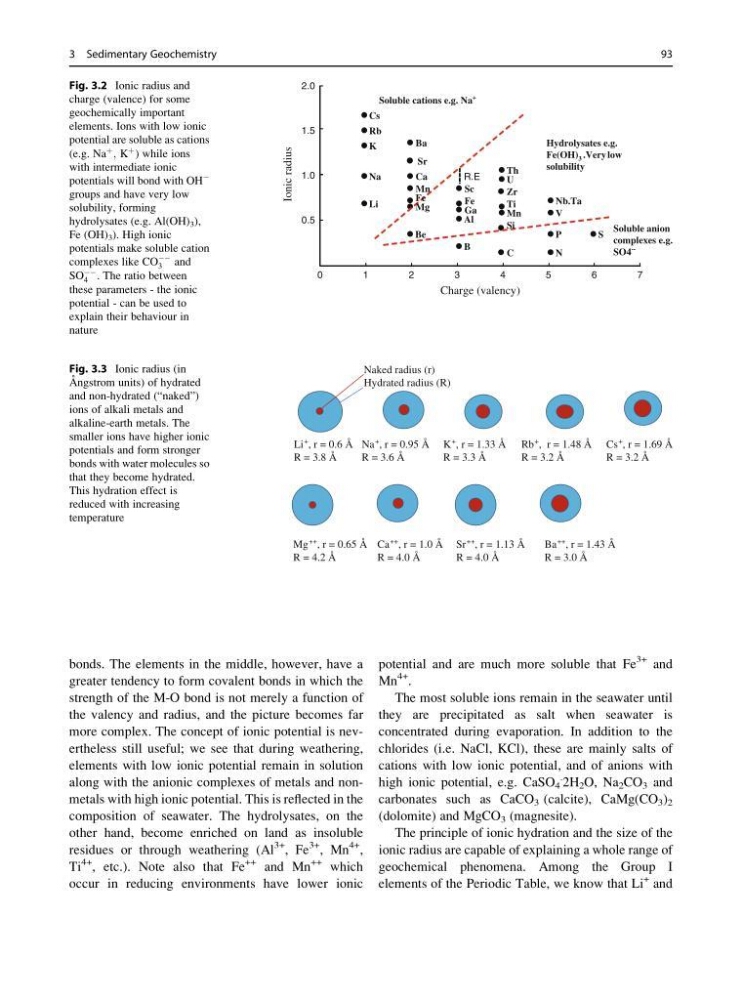
Fig. 3.2 Ionic radius and
charge (valence) for some
geochemically important
elements. Ions with low ionic
potential are soluble as cations
(e.g. Na
þ ; K
þ ) while ions
with intermediate ionic
potentials will bond with OH
À
groups and have very low
solubility, forming
hydrolysates (e.g. Al(OH) 3 ),
Fe (OH) 3 ). High ionic
potentials make soluble cation
complexes like CO
ÀÀ
3
and
SO
ÀÀ
4 . The ratio between
these parameters - the ionic
potential - can be used to
explain their behaviour in
nature
Li
+
, r = 0.6 Å
R = 3.8 Å
Na
+ , r = 0.95 Å
R = 3.6 Å
K
+ , r = 1.33 Å
R = 3.3 Å
Rb
+
, r = 1.48 Å
R = 3.2 Å
Cs
+ , r = 1.69 Å
R = 3.2 Å
Mg
++ , r = 0.65 Å
R = 4.2 Å
Ca
++ , r = 1.0 Å
R = 4.0 Å
Sr
++ , r = 1.13 Å
R = 4.0 Å
Ba
++ , r = 1.43 Å
R = 3.0 Å
Naked radius (r)
Hydrated radius (R)
Fig. 3.3 Ionic radius (in
A ˚ ngstrom units) of hydrated
and non-hydrated (“naked”)
ions of alkali metals and
alkaline-earth metals. The
smaller ions have higher ionic
potentials and form stronger
bonds with water molecules so
that they become hydrated.
This hydration effect is
reduced with increasing
temperature
3 Sedimentary Geochemistry
93
greater tendency to form covalent bonds in which the
strength of the M-O bond is not merely a function of
the valency and radius, and the picture becomes far
more complex. The concept of ionic potential is nevertheless still useful; we see that during weathering,
elements with low ionic potential remain in solution
along with the anionic complexes of metals and nonmetals with high ionic potential. This is reflected in the
composition of seawater. The hydrolysates, on the
other hand, become enriched on land as insoluble
residues or through weathering (Al
3+ , Fe
3+ , Mn
4+ ,
Ti
4+ , etc.). Note also that Fe
++ and Mn
++ which
occur in reducing environments have lower ionic
potential and are much more soluble that Fe
3+ and
Mn
4+ .
The most soluble ions remain in the seawater until
they are precipitated as salt when seawater is
concentrated during evaporation. In addition to the
chlorides (i.e. NaCl, KCl), these are mainly salts of
cations with low ionic potential, and of anions with
high ionic potential, e.g. CaSO 4
. 2H 2 O, Na 2 CO 3 and
carbonates such as CaCO 3 (calcite), CaMg(CO 3 ) 2
(dolomite) and MgCO 3 (magnesite).
The principle of ionic hydration and the size of the
ionic radius are capable of explaining a whole range of
geochemical phenomena. Among the Group I
elements of the Periodic Table, we know that Li
+ and
2.0
1.5
1.0
0.5
Soluble cations e.g. Na
+
Hydrolysates e.g.
Fe(OH) 3 .Very low
solubility
Soluble anion
complexes e.g.
SO4
-Ionic radius
Charge (valency)
0
1
2
3
4
5
6
7
Cs
Rb
K
Na
Li
Ca
Sr
Ba
Mn
Sc
Fe
Be
Mg
Ga
Fe
B
Al
Th
U
Ti
P
Si
C
Zr
Nb.Ta
N
S
V
R.E
Mn
Fig. 3.2 Ionic radius and
charge (valence) for some
geochemically important
elements. Ions with low ionic
potential are soluble as cations
(e.g. Na
þ ; K
þ ) while ions
with intermediate ionic
potentials will bond with OH
À
groups and have very low
solubility, forming
hydrolysates (e.g. Al(OH) 3 ),
Fe (OH) 3 ). High ionic
potentials make soluble cation
complexes like CO
ÀÀ
3
and
SO
ÀÀ
4 . The ratio between
these parameters - the ionic
potential - can be used to
explain their behaviour in
nature
Li
+
, r = 0.6 Å
R = 3.8 Å
Na
+ , r = 0.95 Å
R = 3.6 Å
K
+ , r = 1.33 Å
R = 3.3 Å
Rb
+
, r = 1.48 Å
R = 3.2 Å
Cs
+ , r = 1.69 Å
R = 3.2 Å
Mg
++ , r = 0.65 Å
R = 4.2 Å
Ca
++ , r = 1.0 Å
R = 4.0 Å
Sr
++ , r = 1.13 Å
R = 4.0 Å
Ba
++ , r = 1.43 Å
R = 3.0 Å
Naked radius (r)
Hydrated radius (R)
Fig. 3.3 Ionic radius (in
A ˚ ngstrom units) of hydrated
and non-hydrated (“naked”)
ions of alkali metals and
alkaline-earth metals. The
smaller ions have higher ionic
potentials and form stronger
bonds with water molecules so
that they become hydrated.
This hydration effect is
reduced with increasing
temperature
3 Sedimentary Geochemistry
93